Category: Car Reviews

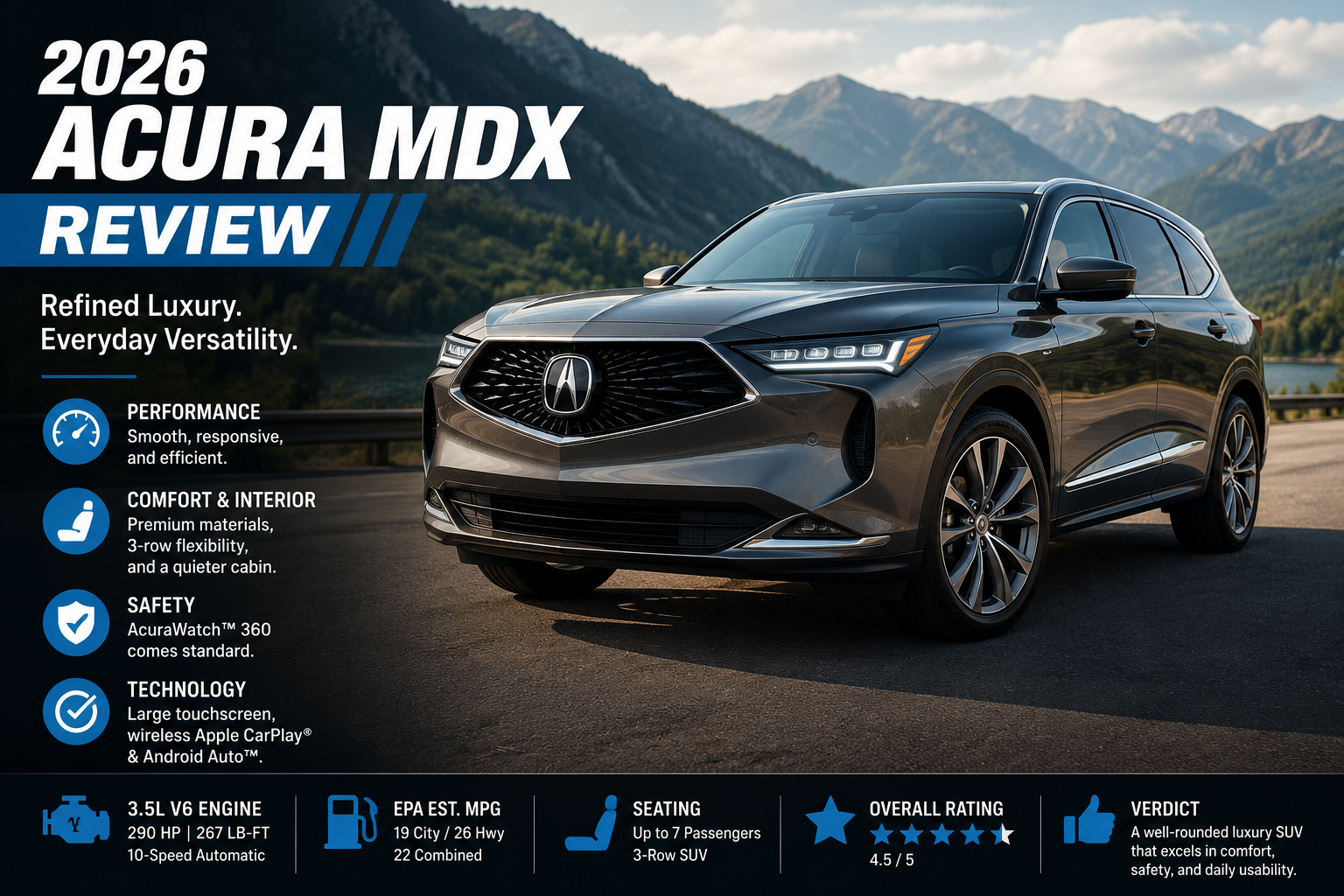
  • 2026 Acura MDX Review

    2026 Acura MDX Review

    A real-life assessment of performance, third-row usefulness, technology, trims, towing, and long-term value

    2026 ACURA MDX AT A GLANCE
    Vehicle type Three-row midsize luxury SUV with seating for up to seven
    US price range $53,250 to $77,300 including the current $1,450 destination charge, before options, tax, title, and dealer fees
    Standard engine 3.5-liter naturally aspirated V6, 290 hp and 267 lb-ft, 10-speed automatic
    Type S engine 3.0-liter turbocharged V6, 355 hp and 354 lb-ft, 10-speed automatic
    Drivetrains Front-wheel drive on selected lower packages; available or standard SH-AWD on the rest
    EPA combined economy 22 mpg FWD, 21 mpg SH-AWD, and 19 mpg Type S Advance
    Towing Up to 3,500 pounds with FWD or 5,000 pounds with SH-AWD when properly equipped
    Passenger and cargo reality Excellent first and second rows; third row is best for children or short adult trips; 16.3 cu ft behind the third row
    Best all-around package Technology SH-AWD for most buyers; Advance for maximum comfort; Type S Advance for performance
    Editorial verdict One of the most enjoyable three-row luxury SUVs to drive, but not the roomiest or most fuel-efficient
    Ownership category Editorial score What determines the score
    Driving enjoyment 9.0 / 10 Accurate steering, composed body control, strong SH-AWD behavior, and a chassis that feels smaller than the vehicle is.
    Daily comfort 8.3 / 10 Supportive seats and a settled ride, with additional comfort available through 16-way massaging seats and Type S air suspension.
    Family practicality 7.6 / 10 Flexible second row and useful cargo floor, but the third row and space behind it are limited.
    Technology 8.6 / 10 Standard 12.3-inch touchscreen, digital cluster, Google built-in, wireless phone integration, and strong audio options.
    Fuel economy 6.2 / 10 Smooth V6 engines require premium fuel and return only 19 to 22 mpg combined.
    Value 8.7 / 10 Many standard features and a lower entry price than several European alternatives.
    Overall 8.2 / 10 Best for buyers who want driver engagement and premium features more than maximum third-row space.

    Score note: These are editorial ownership scores, not manufacturer or instrument-test ratings.

    30-second verdict

    Buy the MDX when driving feel, standard technology, a flexible second row, and strong feature value matter more than an adult-friendly third row or hybrid fuel economy. The Technology SH-AWD package is the strongest balance for most households. The Type S Advance is faster and more distinctive, but its price and 19-mpg combined rating make it a specialized choice rather than the default recommendation.

    This 2026 Acura MDX review finds a luxury SUV with two clear personalities. In normal driving it is a comfortable, well-equipped family vehicle with three rows and an adaptable second-row seat. On a winding road, the responsive chassis and available SH-AWD system give it a level of agility that many seven-seat competitors do not match.

    Its weaknesses are equally easy to identify. The third row has only 29.1 inches of legroom, cargo space is modest when all seats are raised, and no hybrid powertrain is offered. Buyers who need full-time adult seating in all three rows or substantially better mileage should compare alternatives before committing.

    What Changed for 2026?

    The 2026 MDX is essentially a carryover after the model received a meaningful refresh for 2025. The current version keeps the cleaner front styling, the 12.3-inch touchscreen interface, Google built-in, revised audio systems, and expanded driver-assistance equipment introduced with that update. There is no major engine, suspension, or cabin redesign for 2026.

    The supplied Car and Driver MDX overview reaches a similar broad conclusion: the Acura is athletic and well equipped, while fuel economy, third-row space, and ultimate cabin richness remain its primary compromises. Its test data also provides the 6.4-second standard-model and 5.5-second Type S 0-60 mph results used in this guide.

    Used-model opportunity

    Because 2026 brings no major change, a discounted new 2025 or a lightly used 2025 can deliver nearly the same experience. Compare the remaining warranty, finance rate, tire condition, mileage, and dealer fees rather than looking only at the advertised discount.

    The Seven-Day Ownership Audit

    Day and situation What the MDX does well What to inspect Likely verdict
    Monday: commute Good visibility, comfortable front seats, responsive controls, and useful adaptive cruise control. Ride quality on broken pavement and the space needed for a 198.4-inch SUV. Easy to live with, especially on 19- or 20-inch wheels.
    Tuesday: school run Wide-opening doors, flexible second row, removable center seat, and one-touch third-row access. Child-seat installation and whether third-row passengers can enter without moving installed seats. Strong for four or five people; acceptable for occasional seven-seat use.
    Wednesday: highway trip Quiet cabin, smooth V6, stable tracking, and good front-seat support. Real-world fuel economy and whether the 10-speed transmission shifts too often on grades. Comfortable road-trip vehicle, but not an efficiency leader.
    Thursday: back road Direct steering, controlled body motion, strong front-end grip, and active SH-AWD torque distribution. Tire noise and ride firmness on larger wheels. One of the class leaders for driver confidence and enjoyment.
    Friday: downtown parking Available parking sensors, surround-view camera, and a manageable turning circle for the class. Rear visibility and whether the desired package includes the cameras you expect. Advance is easiest to place in tight spaces.
    Weekend: cargo and towing Useful hidden cargo floor, flat-folding rear rows, and up to 5,000 pounds of AWD towing capacity. Payload label, hitch equipment, trailer brakes, and cargo room with the third row raised. Capable for small trailers and family gear, but not a replacement for a full-size SUV.

    Engine, Acceleration, and Road Manners

    Version Engine Output Drive 0-60 mph EPA combined
    MDX FWD 3.5L V6 290 hp / 267 lb-ft FWD About 6.4 sec for standard powertrain 22 mpg
    MDX SH-AWD 3.5L V6 290 hp / 267 lb-ft SH-AWD About 6.4 sec 21 mpg
    Type S Advance 3.0L turbo V6 355 hp / 354 lb-ft SH-AWD 5.5 sec 19 mpg

    The regular 3.5-liter V6 is the sensible engine. It is smooth, predictable, and quick enough for merging or passing, although maximum torque arrives higher in the rev range than it does in many turbocharged competitors. The 10-speed automatic usually keeps the engine relaxed, but multiple downshifts are noticeable when the driver asks for rapid acceleration.

    SH-AWD is more than a winter-weather option. The system can distribute power across the rear axle to help the vehicle rotate into a corner, which contributes to the MDX feeling alert rather than heavy. Buyers in warm climates may still appreciate it for handling, towing, wet-road traction, and resale appeal.

    The Type S Advance adds genuine speed, stronger low-rpm torque, 21-inch wheels, Brembo front brakes, adaptive air suspension, and additional drive modes. It is the most complete version dynamically, yet the improvement is evolutionary rather than transformational. A performance-focused buyer will notice the difference; a relaxed family driver may prefer the lower cost and simpler character of the standard V6.

    Ride Comfort and Noise

    The double-wishbone front suspension gives the MDX precise steering response without making the base vehicle harsh. Wheel choice matters. The standard 19-inch setup offers the best chance of absorbing sharp impacts, while the 20- and 21-inch combinations place more emphasis on appearance and steering response. Test the exact package on the roughest road near the dealership.

    The Type S air suspension can lower the body in its sport setting or raise it in Lift mode. That flexibility is useful, but it also adds complexity. Buyers planning long ownership should weigh the performance and comfort advantages against the potential cost of repairing air-suspension components outside warranty.

    2026 Acura MDX Prices and Packages

    Package Drivetrain Acura MSRP With $1,450 destination Best suited to
    MDX FWD $51,800 $53,250 Value buyer in a mild climate
    MDX SH-AWD $54,000 $55,450 Best low-cost AWD entry
    Technology FWD $57,200 $58,650 Premium cabin without AWD
    Technology SH-AWD $59,400 $60,850 Best overall balance
    A-Spec SH-AWD $62,400 $63,850 Sport styling and ventilated seats
    Advance SH-AWD $66,900 $68,350 Comfort, cameras, HUD, and massage
    A-Spec Advance SH-AWD $68,900 $70,350 Advance luxury with sport design
    Type S Advance SH-AWD $75,850 $77,300 Maximum performance and equipment

    Acura lists the complete current package pricing and equipment on its official 2026 MDX specifications page. Its advertised MSRPs exclude destination, taxes, title, registration, dealer documentation fees, accessories, and any market adjustment. The destination-inclusive totals above match the current $53,250 to $77,300 retail range before optional paint or accessories.

    Which Package Should You Buy?

    Buyer priority Recommended package Why it fits Reason to move up or down
    Lowest price MDX SH-AWD Keeps the standard touchscreen, panoramic roof, three rows, and V6 while adding the more desirable drivetrain. Move to Technology for leather, parking sensors, larger wheels, and upgraded audio.
    Best overall value Technology SH-AWD Adds the features most luxury shoppers expect without paying primarily for appearance or massage functions. Choose FWD only when snow, towing, and handling benefits do not justify the $2,200 AWD charge.
    Sporty appearance A-Spec Adds black exterior details, fog lights, sport cabin trim, ventilated front seats, and 19-speaker audio. It does not add horsepower, so value-focused buyers may prefer Technology.
    Maximum comfort Advance Surround-view camera, head-up display, 16-way front seats, massage functions, and premium interior details. A-Spec Advance mainly changes the visual personality.
    Maximum performance Type S Advance Turbo power, Brembo brakes, air suspension, 21-inch wheels, and the 31-speaker audio system. The regular Advance costs $8,950 less including destination and uses less fuel.
    Best buy: Technology SH-AWD

    This package reaches the practical luxury sweet spot at $60,850 including destination. It adds Milano leather, front and rear parking sensors, 20-inch wheels, and a 19-speaker Bang & Olufsen system while keeping the smoother-riding standard suspension and 290-hp V6.

    Interior Quality and Everyday Comfort

    The cockpit is driver-oriented without feeling cramped. The dashboard combines a digital gauge cluster, a wide touchscreen, physical climate controls, and Acura’s push-button gear selector. Materials improve substantially in the upper packages, where stitched surfaces, open-pore wood, brushed metal, quilted leather, and ambient lighting create a more convincing luxury environment.

    The front seats are a strength. Even the standard chairs provide good support, while Advance, A-Spec Advance, and Type S Advance add 16-way adjustment and nine massage programs. The second row offers 38.5 inches of legroom and a removable center section. With that section installed, the MDX seats seven; removing it creates a pass-through that approximates captain chairs.

    The third row is the limiting factor. Its 29.1 inches of legroom works for children and smaller adults on short journeys, but it is not the right choice for households that regularly carry six or seven adults. The low seating position also places knees higher than ideal. Bring the actual passengers who will use it to the test drive.

    Cargo Capacity and Family Use

    Configuration Standard cargo volume Maximum with underfloor area Real-world use
    Behind third row 16.3 cu ft 18.1 cu ft Groceries, backpacks, or a compact stroller; large luggage loads may require folding one third-row section.
    Behind second row 39.1 cu ft 48.4 cu ft Strong space for a family road trip, home-improvement supplies, or several large suitcases.
    Behind first row 71.4 cu ft 95.0 cu ft Furniture, bicycles with preparation, or bulky household cargo.

    The reversible underfloor cargo panel is more useful than its specification suggests. One surface is easier to clean after carrying wet shoes, sports equipment, or garden supplies. Stowing the panel opens additional depth behind the third row, although the MDX still trails larger three-row competitors when every seat is occupied.

    Infotainment, Audio, and Connectivity

    The 12.3-inch center screen is now a conventional touchscreen, which makes the current MDX easier to use than older versions with Acura’s touchpad controller. Wireless Apple CarPlay and Android Auto, Google built-in, wireless phone charging, navigation, and a 12.3-inch digital instrument display are standard. Physical climate controls remain separate from the screen.

    Feature Standard MDX Technology through Advance Type S Advance
    Center display 12.3-inch touchscreen 12.3-inch touchscreen 12.3-inch touchscreen
    Digital cluster 12.3 inches 12.3 inches 12.3 inches
    Phone integration Wireless Apple CarPlay and Android Auto Same Same
    Built-in services Google Maps, Assistant, and Play integration Same Same
    Audio 11 speakers 19-speaker Bang & Olufsen 31-speaker Bang & Olufsen Ultra
    Parking view Rear camera Sensors on Technology; surround view on Advance grades Surround view

    The interface is responsive and visually clear, but a crowded center console and the push-button transmission controls require a brief learning period. During the test drive, connect both primary phones, place a call, enter a destination, adjust the driver-assistance settings, and check whether the wireless charging pad holds the device securely.

    Fuel Economy and Running Costs

    Powertrain City Highway Combined Approx. gallons per 12,000 miles
    3.5L V6 FWD 19 mpg 26 mpg 22 mpg 545 gallons
    3.5L V6 SH-AWD 19 mpg 25 mpg 21 mpg 571 gallons
    3.0L turbo Type S 17 mpg 21 mpg 19 mpg 632 gallons

    Acura recommends 91-octane premium fuel for every version. To estimate annual fuel cost, divide yearly mileage by the combined EPA rating and multiply the result by the local premium-gas price. A 12,000-mile driver will use roughly 26 more gallons in an SH-AWD standard model than in FWD, while the Type S uses about 61 more gallons than the standard AWD version under the same assumption.

    Fuel economy is the largest strategic weakness in the lineup. There is no hybrid or plug-in hybrid model, so shoppers with long commutes should compare annual fuel expense as well as purchase price. The FWD version saves fuel and upfront cost, but the difference is modest enough that many buyers will still prefer SH-AWD.

    Towing and Weekend Capability

    Front-wheel-drive models are rated to tow up to 3,500 pounds, while SH-AWD versions can reach 5,000 pounds when properly equipped. That is sufficient for many small travel trailers, utility trailers, personal watercraft, or lightweight boats. The rating is not permission to attach any trailer below 5,000 pounds without further checks.

    Before towing Why it matters What to verify
    Read the driver-door payload label Passengers, cargo, accessories, and trailer tongue weight all consume payload. The exact vehicle’s payload, not a brochure maximum.
    Confirm hitch and wiring equipment A receiver, wiring harness, ball mount, and possibly a brake controller may be required. Dealer-installed or properly rated aftermarket components.
    Calculate loaded trailer weight The empty trailer specification excludes water, propane, batteries, food, and gear. A public scale is better than an estimate.
    Check tongue weight Too little or too much can reduce stability and exceed axle or payload limits. Trailer and hitch guidance for the specific setup.
    Plan for passengers and luggage A full cabin can reduce the remaining capacity for trailer tongue weight. Combined loading before departure.

    Safety, Driver Assistance, and Warranty

    Standard driver-assistance equipment includes automatic emergency braking with pedestrian detection, lane-departure warning, lane-keeping assistance, adaptive cruise control, blind-spot monitoring, and related AcuraWatch functions. These systems can reduce workload, but the driver remains responsible for steering, speed, observation, and intervention.

    Test the assistance features rather than assuming every system behaves like the one in a previous vehicle. Pay attention to how smoothly adaptive cruise control brakes, how strongly lane centering corrects, whether warning sounds are easy to identify, and how many menu steps are needed to change settings.

    Coverage Term Ownership implication
    Limited vehicle warranty 4 years / 50,000 miles Typical luxury-brand coverage for defects in materials or workmanship.
    Powertrain warranty 6 years / 70,000 miles Longer protection for major engine and transmission components.
    Complimentary scheduled maintenance 2 years / 24,000 miles Reduces early service expense when performed under Acura program terms.

    How It Compares With Key Alternatives

    Alternative Choose it instead when MDX advantage Main comparison point
    Lexus TX Adult third-row space and maximum cargo room are top priorities. More engaging handling and a lower entry point in many configurations. Family space versus driver involvement.
    Volvo XC90 Elegant design, a calmer cabin, or electrified powertrains matter most. Stronger value and a more overtly sporty personality. Luxury atmosphere versus price and agility.
    Audi Q7 A polished European ride and richer cabin presentation justify a higher price. More standard equipment for the money and simpler package choices. Interior refinement versus value.
    Genesis GV80 Two-row comfort and dramatic cabin design are more important than third-row flexibility. Standard seven-seat capability and a more adaptable second row. Visual luxury versus family packaging.
    Buick Enclave Space, cargo capacity, and easy third-row access matter more than sporty handling. More precise road manners and a stronger premium-performance identity. Maximum utility versus driving feel.

    Who Should Buy the 2026 MDX?

    Strong match Consider another SUV first
    Drivers who want a three-row SUV that still feels responsive on a winding road. Households that regularly place adults in the third row.
    Families that normally use four or five seats and need the third row occasionally. High-mileage commuters prioritizing hybrid fuel economy.
    Buyers who value standard technology, a panoramic roof, and premium features at a competitive price. Buyers seeking the richest cabin materials in the segment regardless of price.
    Owners who want up to 5,000 pounds of towing capacity without moving to a truck-based SUV. People who need more than 5,000 pounds of towing capacity.
    Shoppers who prefer a smooth gasoline V6 over a turbo four-cylinder or hybrid system. Owners who want a compact vehicle for tight city parking.

    A 25-Minute Dealer Test Plan

    1. Sit in all three rows. Adjust the front and second rows for real occupants before judging the third row.
    2. Install or bring the largest child seat used by the household and confirm third-row access around it.
    3. Drive on rough pavement at city speed to compare 19-, 20-, and 21-inch wheel ride quality.
    4. Accelerate from 30 to 60 mph to judge the standard V6 and transmission without an unsafe launch.
    5. Make several tight turns and parking maneuvers to assess size, cameras, and steering effort.
    6. Connect a phone wirelessly, enter a destination, make a call, and test voice commands.
    7. Use adaptive cruise control and lane assistance on a suitable road while remaining fully attentive.
    8. Fold and remove the second-row center seat, then test cargo loading with the third row both raised and folded.
    9. Review the driver-door payload label if towing or carrying a full passenger load is planned.
    10. Request an itemized out-the-door quote that separates MSRP, destination, accessories, taxes, registration, documentation fees, and any market adjustment.

    Frequently Asked Questions

    Is the 2026 Acura MDX a new generation?

    No. It carries over after the 2025 styling and technology refresh, with no major engine or platform change for 2026.

    How much does the 2026 Acura MDX cost?

    The current US range is $53,250 to $77,300 including the $1,450 destination charge, before options, taxes, registration, and dealer fees.

    Which MDX package is the best value?

    Technology SH-AWD is the strongest all-around choice for many buyers because it adds the expected luxury features while staying well below Advance and Type S pricing.

    Is the Acura MDX a true seven-passenger SUV?

    It has seven seat belts and a removable second-row center seat, but the third row is most suitable for children or smaller adults on shorter trips.

    Does the 2026 MDX have a hybrid?

    No. The lineup uses either a naturally aspirated 3.5-liter V6 or the Type S 3.0-liter turbocharged V6.

    Is SH-AWD worth the extra cost?

    It is worthwhile for snow, rain, towing, resale appeal, and sharper handling. FWD remains reasonable for buyers in mild climates who prioritize the lowest price and slightly better fuel economy.

    How fast is the MDX Type S?

    Car and Driver recorded 0-60 mph in 5.5 seconds for the Type S. The standard powertrain required about 6.4 seconds.

    Can the MDX tow a camper?

    An SH-AWD MDX can tow up to 5,000 pounds when properly equipped, but the loaded trailer weight, tongue weight, payload, hitch hardware, and brake requirements must all fit the exact vehicle.

    Does the MDX require premium gas?

    Acura recommends 91-octane premium unleaded for both engines.

    How much cargo space is behind the third row?

    The standard figure is 16.3 cubic feet, with up to 18.1 cubic feet when the underfloor area is configured for maximum volume.

    Is the Type S worth nearly $77,300?

    It is worth considering for buyers who specifically want turbo power, air suspension, Brembo brakes, 21-inch wheels, and the 31-speaker audio system. The Advance is the better value for comfort-focused buyers.

    Should I buy a 2026 or a discounted 2025 MDX?

    Because the models are very similar, compare the final price, finance rate, build date, remaining warranty, mileage, and desired color or package. A discounted 2025 may be the smarter purchase.

    Final Verdict

    The conclusion of this 2026 Acura MDX review is that the MDX remains a compelling middle ground between a practical family crossover and a performance-oriented luxury SUV. It is more rewarding to drive than its seating capacity suggests, includes a strong technology package from the base model upward, and offers meaningful trim choices instead of forcing every buyer into the most expensive version.

    Choose Technology SH-AWD for the best balance, Advance for comfort and parking technology, or Type S Advance only when the faster engine and specialized chassis hardware are central to the purchase. Shoppers who need a spacious adult third row or hybrid efficiency should prioritize those needs before being won over by the Acura’s handling.

    Bottom line

    The 2026 MDX is a driver-focused three-row luxury SUV with strong standard technology and competitive value. Its tight third row and modest fuel economy prevent it from being the universal family choice, but those compromises are manageable for buyers who use the rear seats occasionally and want an SUV that is enjoyable every day.

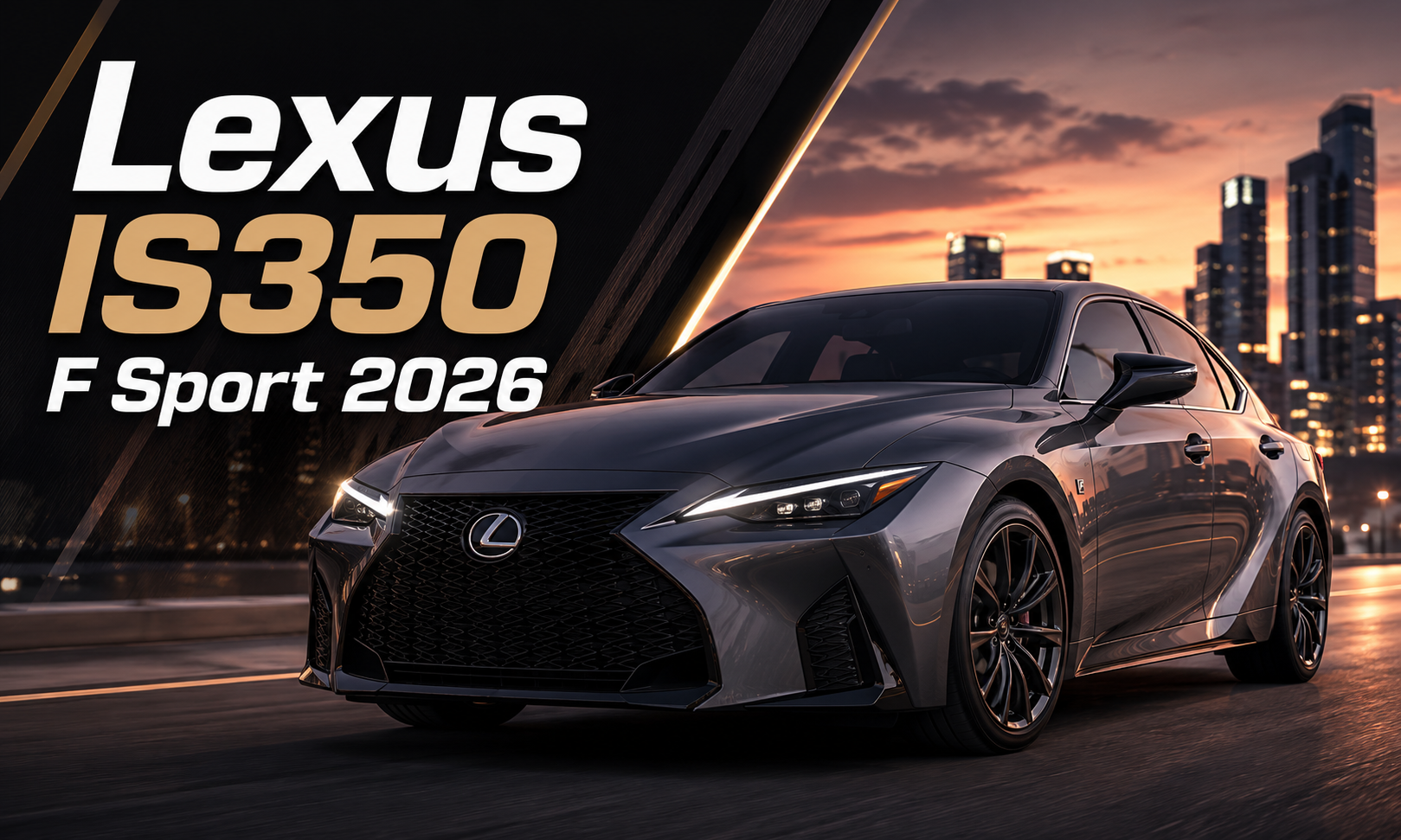
  • 2026 Lexus IS 350 F Sport Review

    2026 Lexus IS 350 F Sport Review

    An old-school V6 sport sedan judged by real-world feel, trim value, drivetrain choice, comfort, and the compromises hidden behind its sharp styling

    2026 LEXUS IS 350 F SPORT AT A GLANCE
    Vehicle type Compact luxury sport sedan with rear-wheel-drive proportions
    Engine 3.5-liter naturally aspirated V6
    Output 311 horsepower and 280 lb-ft of torque
    Drivetrains Rear-wheel drive or all-wheel drive
    Transmissions Eight-speed automatic with RWD; six-speed automatic with AWD
    2026 price range $46,895 to $51,345, including $1,395 delivery, processing, and handling
    F Sport AWD starting price $51,345 including destination
    Tested AWD performance 0 to 60 mph in 5.6 seconds; quarter-mile in 14.1 seconds at 100 mph
    EPA economy, AWD 19 mpg city, 26 mpg highway, 22 mpg combined
    Best reason to buy Naturally aspirated response, composed ride, cabin craftsmanship, and compact-sedan feel
    Main tradeoffs Slower than turbo rivals, tight rear seat, small trunk, and an older six-speed automatic with AWD
    Verdict in 30 seconds

    The 2026 IS 350 F Sport is not the quickest compact luxury sedan for the money. It is the more appealing choice for a driver who values a smooth naturally aspirated V6, predictable throttle response, a forgiving ride, supportive seats, real physical controls, and Lexus-grade cabin finish. Choose rear-wheel drive for the cleaner enthusiast setup, all-wheel drive for winter confidence, and F Sport Design only when appearance and price matter more than the F Sport chassis and comfort upgrades.

    For shoppers searching Lexus IS350 F Sport 2026, the most important question is not whether the car wins a drag race. The better question is whether its increasingly rare combination of a naturally aspirated V6, rear-drive architecture, compact dimensions, and polished ride is more valuable to you than the faster acceleration and newer platforms offered by several German competitors.

    This model also requires careful badge reading. Lexus sells both F Sport Design and F Sport versions, and both look athletic. The regular F Sport costs $2,450 more in either drivetrain, adding functional chassis and comfort equipment rather than a stronger engine. That difference can determine whether the car feels like a stylish luxury sedan or a more complete sport-sedan package.

    The 2026 Lineup Is Simpler, but the Names Still Matter

    Lexus removed the previous four-cylinder IS 300 and V8-powered IS 500 for 2026. Every mainstream model now uses the same 311-hp 3.5-liter V6, leaving buyers to choose between two equipment levels and two drivetrains. This simplifies the engine decision but makes trim and drivetrain selection more important.

    Configuration Drivetrain Transmission Starting price* Best fit
    F Sport Design RWD 8-speed automatic $46,895 Style-first buyer in a mild climate
    F Sport Design AWD AWD 6-speed automatic $48,895 Style and winter traction at the lowest AWD price
    F Sport RWD 8-speed automatic $49,345 Best enthusiast value in the lineup
    F Sport AWD AWD 6-speed automatic $51,345 Full equipment with all-weather traction

    *All prices include the $1,395 delivery, processing, and handling charge. Taxes, registration, options, and dealer-installed equipment are extra.

    Lexus confirms the four-model pricing structure, the single V6 powertrain, standard 12.3-inch displays, updated steering and suspension tuning, and Lexus Safety System+ 3.0 in its official 2026 Lexus IS announcement. The manufacturer also states that rear-drive cars use an eight-speed automatic while AWD cars retain a six-speed automatic.

    F Sport Design Versus F Sport: What Does $2,450 Buy?

    The F Sport Design is not a stripped-looking base car. It already delivers the aggressive exterior treatment and 19-inch wheels that many buyers associate with the F Sport badge. The regular F Sport builds on that appearance with equipment that changes how the car feels and how comfortably the driver fits.

    Feature area F Sport Design F Sport
    Exterior identity F Sport-inspired body treatment and 19-inch wheels Similar core appearance, plus access to additional performance-oriented details
    Suspension Standard tuning Model-specific suspension tuning
    Driver seat support Sport-styled front seating Adds power lumbar adjustment and four-way adjustable front headrests
    Steering wheel Standard configuration Heated F Sport steering wheel
    Brakes and trim Conventional finish Red-painted brake calipers and additional interior trim details
    Handling Package Not the focus of this grade Available with adaptive dampers, additional drive modes, and a Torsen limited-slip differential on RWD models
    Value conclusion Best when price and appearance dominate Better when the driver will notice chassis response and seat adjustability
    Important test-data note

    The instrumented reference test used an IS 350 F Sport Design AWD, not the more expensive F Sport AWD. Its engine and transmission match the F Sport AWD, but the tested car did not represent every chassis, seating, and package advantage available on the regular F Sport.

    Performance Audit: The Stopwatch Is Only Half the Story

    Objectively, the IS 350 AWD is no longer a class leader. Its 311 horsepower sounds healthy, but the naturally aspirated V6 develops peak torque higher in the rev range than modern turbocharged engines. The AWD model also carries a six-speed automatic, which has fewer ratios than the eight-speed unit in the rear-drive car and fewer than many current rivals.

    Measured result 2026 IS 350 F Sport Design AWD What it means in normal driving
    0 to 60 mph 5.6 seconds Quick enough for merging and passing, but well behind several turbocharged rivals
    Rolling 5 to 60 mph 5.9 seconds Strong consistency without relying heavily on launch behavior
    Quarter-mile 14.1 seconds at 100 mph Respectable, not dominant
    70 to 0 mph braking 164 feet Adequate road performance, not a standout test result
    Skidpad grip 0.87 g Limited partly by comfort-oriented all-season tires
    Observed economy 20 mpg Expect fuel use consistent with a naturally aspirated V6 and AWD
    75-mph highway economy 28 mpg Better than the 26-mpg EPA highway rating in this test
    75-mph highway range 480 miles Useful long-distance capability when conditions cooperate

    The supplied Car and Driver instrumented test recorded 5.6 seconds to 60 mph, 0.87 g of skidpad grip, a 164-foot stop from 70 mph, and 28 mpg in its 75-mph highway test. The reviewers also emphasized the V6’s linear response, satisfying sound above 4,000 rpm, smooth low-speed behavior, supportive seats, and composed ride.

    Why the Engine Still Has Real Appeal

    A naturally aspirated engine responds differently from a small turbocharged four-cylinder. The throttle relationship is more progressive, the torque builds as revs rise, and there is less of the sudden low-rpm surge that can make a turbo car feel faster but less linear. The IS rewards the driver for using the upper half of the tachometer, where the V6 becomes more vocal and energetic.

    That character matters most during an on-ramp pull, a two-lane pass, or a winding-road drive. It matters less in a specifications comparison, where newer rivals produce stronger low-rpm torque, faster acceleration, and better EPA fuel economy. The Lexus is a character purchase, not a maximum-output purchase.

    Benchmark Gap Versus Faster Rivals

    Metric Lexus IS 350 AWD Audi S3 benchmark BMW M235 benchmark
    0 to 60 mph 5.6 sec 4.2 sec 4.2 sec
    Skidpad grip 0.87 g 0.95 g 0.94 g
    70 to 0 mph 164 ft 152 ft 154 ft
    Tire context All-season touring tire Summer performance tire Summer performance tire
    Lexus counterpoint Better ride comfort and a smoother naturally aspirated powertrain feel Faster and sharper Faster and sharper

    The tire difference is important. Summer tires can substantially improve grip and braking, while the Lexus test car’s Bridgestone Turanza all-season tires favor year-round usability and ride quality. The numbers still show a genuine performance gap, but they do not isolate the chassis alone.

    Rear-Wheel Drive or All-Wheel Drive?

    The drivetrain choice changes more than traction. Rear-wheel-drive cars are less expensive and receive the newer eight-speed automatic. AWD cars add confidence in snow and cold-weather conditions but retain a six-speed automatic and carry more weight.

    Question RWD answer AWD answer Winner Why
    Lowest price $46,895 Design; $49,345 F Sport $48,895 Design; $51,345 F Sport RWD $2,000 less within the same grade
    Transmission 8-speed automatic 6-speed automatic RWD More ratios and a more modern pairing
    EPA highway rating 27 mpg 26 mpg RWD Small advantage
    Winter traction Depends more heavily on tires and driver conditions Power can reach all four wheels AWD Better launch traction on slippery roads
    Handling Package differential Torsen limited-slip differential available with the package No rear Torsen benefit stated for AWD RWD More enthusiast-focused rear-axle behavior
    Best use case Mild climates and drivers who prioritize feel Snow-belt commuting and all-weather confidence Depends Climate and tires should decide
    Best enthusiast configuration

    For a driver in a moderate climate, the IS 350 F Sport RWD is the most coherent configuration. It combines the lower price, eight-speed automatic, and availability of a Torsen limited-slip differential through the Handling Package. In a true winter climate, AWD with quality winter tires is the more practical choice.

    What Changed for 2026?

    Area 2026 update Why buyers should care
    Lineup Only the IS 350 remains, in F Sport Design and F Sport grades Every buyer receives the V6, but there is no lower-cost four-cylinder or V8 halo model
    Exterior Revised front design and new 19-inch wheel designs Keeps the long-running platform visually current
    Infotainment 12.3-inch Lexus Interface touchscreen is standard Replaces the old small screen and remote touchpad arrangement
    Driver display 12.3-inch digital instrument cluster Improves information clarity and cabin presentation
    Controls New climate toggle bank, USB-C ports, and wireless charging Daily usability is much better
    Interior trim Forged Bamboo ornamentation and available Radiant Red color Adds a distinctive modern identity
    Chassis Revised electric power steering and suspension tuning Targets more linear response without sacrificing ride quality
    Safety Lexus Safety System+ 3.0 standard Updates active safety and driver-assistance capability

    The new displays are the most meaningful everyday improvement. The old remote touchpad has been removed, phone storage is more sensible, charging ports are now USB-C, and the climate interface uses tactile toggles. These changes address long-running ergonomic complaints without replacing every physical control with a screen.

    Cabin Audit: Excellent for Two, Acceptable for Four

    The IS cabin remains one of the strongest reasons to consider the car. Padded surfaces, consistent switch action, a substantial steering wheel, a conventional shift lever, and well-bolstered front seats create a sense of quality that is difficult to measure. The driving position also makes the sedan feel compact rather than bulky.

    Area Strength Compromise Buyer check
    Front seats Strong lateral support and a low, focused driving position Some drivers may find the bolsters tight Sit for at least 15 minutes
    Rear seat Usable for shorter trips and smaller passengers Limited headroom and legroom for tall adults Place the tallest regular passenger behind the driver
    Trunk Conventional sedan opening Only 11 cubic feet Bring a stroller, golf bag, or travel case
    Storage New wireless charging area helps Few useful cubbies and limited small-item space Check phone, keys, sunglasses, and cup placement
    Controls Physical switches and improved touchscreen ergonomics No traditional tuning knob Test common tasks while parked
    Materials Soft-touch surfaces and quality switchgear Some underlying architecture remains familiar from earlier years Compare directly with a newer rival

    A buyer who rarely uses the rear seat may interpret the snug cabin as intimate and driver-focused. A family carrying rear-facing child seats, tall teenagers, or adult clients may experience it as restrictive. That difference cannot be settled by a specification sheet.

    Technology and Safety

    Feature group 2026 content Practical takeaway
    Displays 12.3-inch center touchscreen and 12.3-inch digital instrument cluster Modernizes the cabin without abandoning physical controls
    Audio Standard 10-speaker Lexus system; available 17-speaker Mark Levinson system Audiophiles should test both before paying for the upgrade
    Charging Front and rear USB-C ports plus a wireless charging area Finally provides sensible device support
    Driver assistance Pre-collision support, full-speed adaptive cruise, lane tracing, lane-departure assistance, road-sign recognition, and proactive driving assistance Useful for long commutes, but the driver remains responsible
    Available technology Features such as front cross-traffic alert, lane-change assistance, Traffic Jam Assist, panoramic view monitor, and upgraded lighting can be package-dependent Compare the exact Monroney sticker, not only the trim name

    Ride, Steering, and Daily Use

    The IS does not chase the hard-edged behavior of the sharpest sport sedans. Its steering is appropriately weighted but not rich in road texture, and body control is disciplined rather than aggressive. The reward is a ride that absorbs broken pavement more gracefully than many performance-focused competitors.

    This balance is especially valuable on American roads, where expansion joints, patched asphalt, and potholes can make a stiff car exhausting. The Lexus feels calmer during a long commute and still has enough body control to remain enjoyable on a winding road. Drivers who attend track days or prioritize maximum cornering grip should shop elsewhere or plan a tire upgrade.

    Illustrative Ownership Math

    The following calculations are planning examples, not dealer quotes. They use a 10 percent down payment, a 6.5 percent annual percentage rate, a 60-month term, and no tax, title, registration, options, trade-in balance, or dealer fees. Actual financing can differ substantially.

    Configuration Starting price 10% down Amount financed Illustrative payment
    F Sport Design RWD $46,895 $4,690 $42,206 $826/month
    F Sport Design AWD $48,895 $4,890 $44,006 $861/month
    F Sport RWD $49,345 $4,934 $44,410 $869/month
    F Sport AWD $51,345 $5,134 $46,210 $904/month

    Fuel planning is equally important. At 12,000 miles per year and the AWD combined rating of 22 mpg, the car would use about 545 gallons annually. Multiply that figure by the local price of the fuel grade specified on the vehicle’s fuel door and owner’s manual. Tires, insurance, registration, and optional packages can create a larger ownership-cost difference than the one-mpg gap between RWD and AWD.

    Editorial Buyer-Fit Scorecard

    Category Weight Score Reason
    Powertrain character 20 18 Linear response, satisfying V6 sound, and smooth low-speed behavior
    Objective performance 20 13 Adequate speed, but slower acceleration and lower grip than key rivals
    Ride and road manners 20 17 Composed, comfortable, and easy to live with
    Cabin and technology 20 17 Excellent materials and improved 2026 ergonomics
    Practicality 10 6 Tight rear seat, 11-cu-ft trunk, and limited small-item storage
    Value and configuration 10 8 Competitive base price, but options can push the car beyond its strongest value zone
    Total 100 79 A strong character-driven purchase for the right buyer, not the class benchmark

    Who Should Buy It, and Who Should Skip It?

    Buyer profile Recommendation Reason
    Driver who misses naturally aspirated engines Buy Few new luxury sedans offer this linear V6 character
    Long-distance commuter on rough roads Strong consider The ride and front seats are major strengths
    Snow-belt buyer Choose AWD Adds all-weather traction, though winter tires still matter
    Enthusiast in a mild climate Choose F Sport RWD Eight-speed automatic, lower price, and more coherent handling-package potential
    Parent using rear-facing child seats daily Test carefully Rear-seat space may be the deciding weakness
    Buyer focused on 0 to 60 mph Skip Several turbo rivals are much faster
    Buyer seeking maximum cargo and cabin space Skip The IS is compact inside and has an 11-cu-ft trunk
    Buyer who wants V8 drama Shop used or elsewhere The IS 500 is gone from the 2026 new-car lineup
    Buyer who prioritizes build quality and physical controls Buy This is one of the car’s clearest advantages

    Best 2026 Lexus IS 350 Configuration

    For the broadest enthusiast appeal, the IS 350 F Sport RWD is the strongest choice. It costs $2,000 less than the equivalent AWD model, uses the eight-speed automatic, and can pair with the Handling Package’s adaptive dampers and rear limited-slip differential. It preserves the car’s rear-drive identity without paying for traction hardware that some climates do not require.

    For a driver in a snow-heavy region, the IS 350 F Sport AWD is the safer default, provided the older six-speed transmission is acceptable. Buyers who value the exterior design more than chassis equipment should consider F Sport Design, but the regular F Sport’s $2,450 premium is reasonable when seat adjustability, suspension tuning, and the heated steering wheel will be used.

    Price ceiling recommendation

    The IS makes the strongest value argument near the high-$40,000 to low-$50,000 range. A heavily optioned example approaching special-edition or high-performance pricing should be compared carefully with faster rivals and lightly used luxury performance sedans.

    A 25-Minute Test-Drive Plan

    1. Spend five minutes parked. Set the seat, mirrors, steering wheel, instrument display, phone connection, climate controls, and driver-assistance preferences.
    2. Use a rough urban street. Listen for wheel impact harshness, check low-speed transmission behavior, and evaluate steering effort while parking.
    3. Make one full-throttle highway merge after the engine is warm. Decide whether the V6’s high-rpm character feels engaging or merely slow compared with a turbo rival.
    4. Drive a sweeping on-ramp or safe curved road. Note body control, front-seat support, steering confidence, and whether the all-season tires feel adequate.
    5. Place an adult in the rear seat behind your normal driving position. Check headroom, knee room, foot space, and ease of entry.
    6. Load the trunk with the largest item you regularly carry. The 11-cu-ft capacity matters more than the exterior styling suggests.
    7. Before leaving, compare the exact window sticker with another IS. Confirm drivetrain, grade, packages, audio system, lighting, parking technology, and dealer-installed accessories.

    Frequently Asked Questions

    How much is the 2026 Lexus IS 350 F Sport?

    The rear-wheel-drive F Sport starts at $49,345, while the F Sport AWD starts at $51,345. Both figures include the $1,395 destination-related charge but exclude taxes, registration, options, and dealer fees.

    What is the difference between F Sport Design and F Sport?

    F Sport Design provides the appearance at a lower price. The regular F Sport adds model-specific suspension tuning, power lumbar support, four-way adjustable front headrests, a heated steering wheel, red brake calipers, and access to additional performance equipment.

    How fast is the 2026 IS 350 AWD?

    The referenced instrumented test recorded 0 to 60 mph in 5.6 seconds and a 14.1-second quarter-mile at 100 mph.

    Does the 2026 IS 350 have a turbo?

    No. It uses a naturally aspirated 3.5-liter V6 with 311 horsepower and 280 lb-ft of torque.

    Is the 2026 IS 350 F Sport available with AWD?

    Yes. Both F Sport Design and F Sport can be ordered with all-wheel drive.

    Which transmission does the AWD model use?

    The AWD IS 350 uses a six-speed automatic. Rear-wheel-drive models use an eight-speed automatic.

    Is the rear-wheel-drive model better?

    It is the more enthusiast-focused choice because it costs less, uses the eight-speed transmission, and can gain a Torsen limited-slip differential through the Handling Package. AWD is more practical in winter climates.

    What fuel economy does the AWD model get?

    The EPA ratings are 19 mpg city, 26 mpg highway, and 22 mpg combined. The referenced 75-mph highway test returned 28 mpg.

    Is the rear seat spacious?

    No. The rear seat is one of the model’s main weaknesses, especially for tall adults or families using bulky child seats.

    How large is the trunk?

    The trunk is rated at 11 cubic feet, which is small enough that buyers should test their regular luggage or gear before purchase.

    What changed inside for 2026?

    The IS gains a standard 12.3-inch touchscreen, a 12.3-inch digital instrument cluster, USB-C ports, wireless phone charging, a revised center console, new trim, and better physical climate controls.

    Is the 2026 IS 350 F Sport worth buying?

    It is worth considering for buyers who value ride comfort, cabin quality, physical controls, and naturally aspirated engine character. Buyers who prioritize outright speed, rear-seat space, or maximum fuel economy have stronger alternatives.

    Final Verdict

    The Lexus IS350 F Sport 2026 succeeds by offering a type of luxury performance that is disappearing. It feels compact, polished, mechanical, and predictable, with a naturally aspirated V6 that rewards revs and a suspension that does not punish the driver on ordinary roads. Its measured speed is average, but its control feel and cabin quality remain distinctive.

    Buy the rear-drive F Sport when driving character is the priority, choose AWD when winter traction is essential, and select F Sport Design only when the appearance is enough. The wrong buyer will see an aging, slower sedan with limited space. The right buyer will see one of the last comfortable, naturally aspirated compact luxury sedans available new.