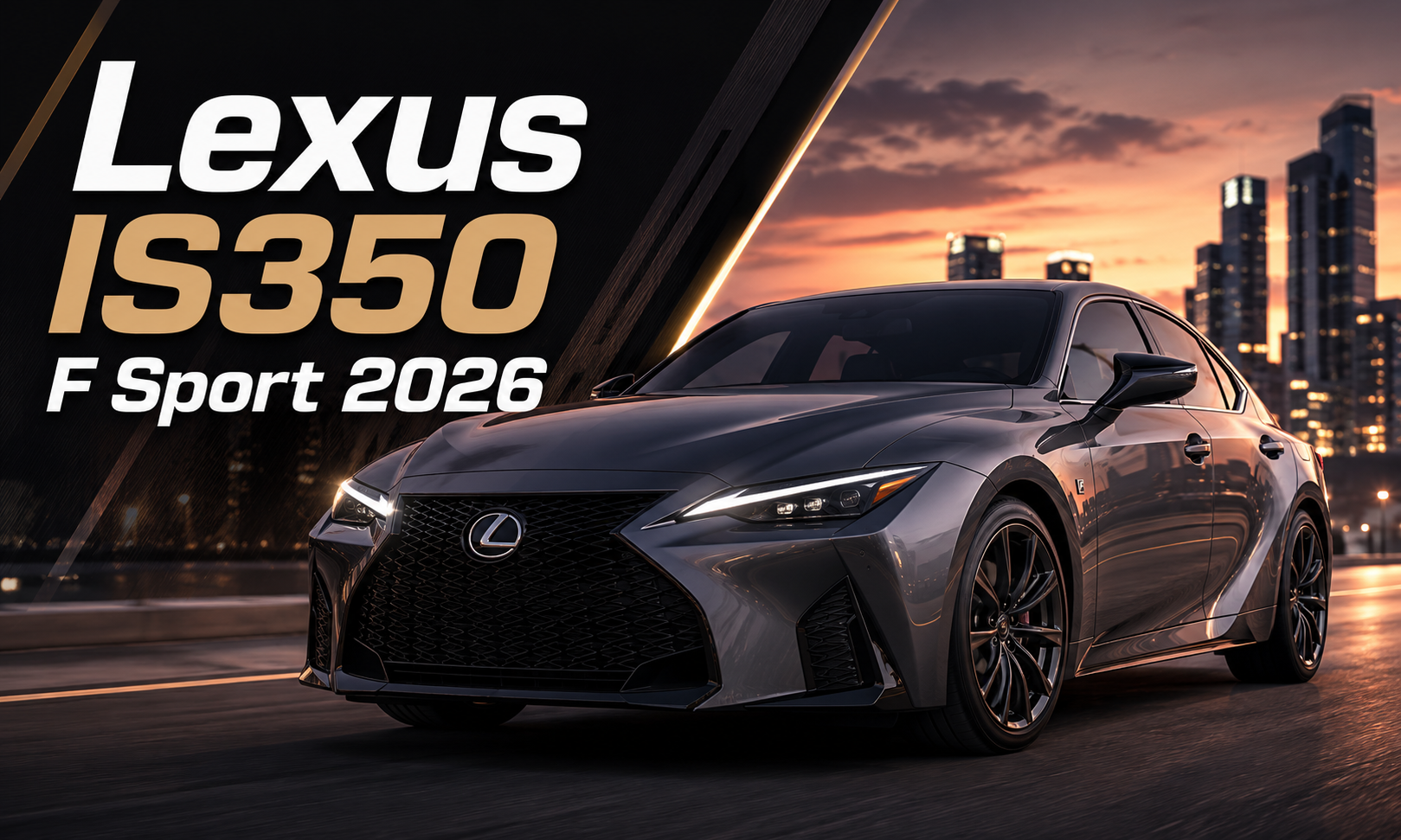
An old-school V6 sport sedan judged by real-world feel, trim value, drivetrain choice, comfort, and the compromises hidden behind its sharp styling
| 2026 LEXUS IS 350 F SPORT AT A GLANCE | |
| Vehicle type | Compact luxury sport sedan with rear-wheel-drive proportions |
| Engine | 3.5-liter naturally aspirated V6 |
| Output | 311 horsepower and 280 lb-ft of torque |
| Drivetrains | Rear-wheel drive or all-wheel drive |
| Transmissions | Eight-speed automatic with RWD; six-speed automatic with AWD |
| 2026 price range | $46,895 to $51,345, including $1,395 delivery, processing, and handling |
| F Sport AWD starting price | $51,345 including destination |
| Tested AWD performance | 0 to 60 mph in 5.6 seconds; quarter-mile in 14.1 seconds at 100 mph |
| EPA economy, AWD | 19 mpg city, 26 mpg highway, 22 mpg combined |
| Best reason to buy | Naturally aspirated response, composed ride, cabin craftsmanship, and compact-sedan feel |
| Main tradeoffs | Slower than turbo rivals, tight rear seat, small trunk, and an older six-speed automatic with AWD |
| Verdict in 30 seconds
The 2026 IS 350 F Sport is not the quickest compact luxury sedan for the money. It is the more appealing choice for a driver who values a smooth naturally aspirated V6, predictable throttle response, a forgiving ride, supportive seats, real physical controls, and Lexus-grade cabin finish. Choose rear-wheel drive for the cleaner enthusiast setup, all-wheel drive for winter confidence, and F Sport Design only when appearance and price matter more than the F Sport chassis and comfort upgrades. |
For shoppers searching Lexus IS350 F Sport 2026, the most important question is not whether the car wins a drag race. The better question is whether its increasingly rare combination of a naturally aspirated V6, rear-drive architecture, compact dimensions, and polished ride is more valuable to you than the faster acceleration and newer platforms offered by several German competitors.
This model also requires careful badge reading. Lexus sells both F Sport Design and F Sport versions, and both look athletic. The regular F Sport costs $2,450 more in either drivetrain, adding functional chassis and comfort equipment rather than a stronger engine. That difference can determine whether the car feels like a stylish luxury sedan or a more complete sport-sedan package.
The 2026 Lineup Is Simpler, but the Names Still Matter
Lexus removed the previous four-cylinder IS 300 and V8-powered IS 500 for 2026. Every mainstream model now uses the same 311-hp 3.5-liter V6, leaving buyers to choose between two equipment levels and two drivetrains. This simplifies the engine decision but makes trim and drivetrain selection more important.
| Configuration | Drivetrain | Transmission | Starting price* | Best fit |
| F Sport Design | RWD | 8-speed automatic | $46,895 | Style-first buyer in a mild climate |
| F Sport Design AWD | AWD | 6-speed automatic | $48,895 | Style and winter traction at the lowest AWD price |
| F Sport | RWD | 8-speed automatic | $49,345 | Best enthusiast value in the lineup |
| F Sport AWD | AWD | 6-speed automatic | $51,345 | Full equipment with all-weather traction |
*All prices include the $1,395 delivery, processing, and handling charge. Taxes, registration, options, and dealer-installed equipment are extra.
Lexus confirms the four-model pricing structure, the single V6 powertrain, standard 12.3-inch displays, updated steering and suspension tuning, and Lexus Safety System+ 3.0 in its official 2026 Lexus IS announcement. The manufacturer also states that rear-drive cars use an eight-speed automatic while AWD cars retain a six-speed automatic.
F Sport Design Versus F Sport: What Does $2,450 Buy?
The F Sport Design is not a stripped-looking base car. It already delivers the aggressive exterior treatment and 19-inch wheels that many buyers associate with the F Sport badge. The regular F Sport builds on that appearance with equipment that changes how the car feels and how comfortably the driver fits.
| Feature area | F Sport Design | F Sport |
| Exterior identity | F Sport-inspired body treatment and 19-inch wheels | Similar core appearance, plus access to additional performance-oriented details |
| Suspension | Standard tuning | Model-specific suspension tuning |
| Driver seat support | Sport-styled front seating | Adds power lumbar adjustment and four-way adjustable front headrests |
| Steering wheel | Standard configuration | Heated F Sport steering wheel |
| Brakes and trim | Conventional finish | Red-painted brake calipers and additional interior trim details |
| Handling Package | Not the focus of this grade | Available with adaptive dampers, additional drive modes, and a Torsen limited-slip differential on RWD models |
| Value conclusion | Best when price and appearance dominate | Better when the driver will notice chassis response and seat adjustability |
| Important test-data note
The instrumented reference test used an IS 350 F Sport Design AWD, not the more expensive F Sport AWD. Its engine and transmission match the F Sport AWD, but the tested car did not represent every chassis, seating, and package advantage available on the regular F Sport. |
Performance Audit: The Stopwatch Is Only Half the Story
Objectively, the IS 350 AWD is no longer a class leader. Its 311 horsepower sounds healthy, but the naturally aspirated V6 develops peak torque higher in the rev range than modern turbocharged engines. The AWD model also carries a six-speed automatic, which has fewer ratios than the eight-speed unit in the rear-drive car and fewer than many current rivals.
| Measured result | 2026 IS 350 F Sport Design AWD | What it means in normal driving |
| 0 to 60 mph | 5.6 seconds | Quick enough for merging and passing, but well behind several turbocharged rivals |
| Rolling 5 to 60 mph | 5.9 seconds | Strong consistency without relying heavily on launch behavior |
| Quarter-mile | 14.1 seconds at 100 mph | Respectable, not dominant |
| 70 to 0 mph braking | 164 feet | Adequate road performance, not a standout test result |
| Skidpad grip | 0.87 g | Limited partly by comfort-oriented all-season tires |
| Observed economy | 20 mpg | Expect fuel use consistent with a naturally aspirated V6 and AWD |
| 75-mph highway economy | 28 mpg | Better than the 26-mpg EPA highway rating in this test |
| 75-mph highway range | 480 miles | Useful long-distance capability when conditions cooperate |
The supplied Car and Driver instrumented test recorded 5.6 seconds to 60 mph, 0.87 g of skidpad grip, a 164-foot stop from 70 mph, and 28 mpg in its 75-mph highway test. The reviewers also emphasized the V6’s linear response, satisfying sound above 4,000 rpm, smooth low-speed behavior, supportive seats, and composed ride.
Why the Engine Still Has Real Appeal
A naturally aspirated engine responds differently from a small turbocharged four-cylinder. The throttle relationship is more progressive, the torque builds as revs rise, and there is less of the sudden low-rpm surge that can make a turbo car feel faster but less linear. The IS rewards the driver for using the upper half of the tachometer, where the V6 becomes more vocal and energetic.
That character matters most during an on-ramp pull, a two-lane pass, or a winding-road drive. It matters less in a specifications comparison, where newer rivals produce stronger low-rpm torque, faster acceleration, and better EPA fuel economy. The Lexus is a character purchase, not a maximum-output purchase.
Benchmark Gap Versus Faster Rivals
| Metric | Lexus IS 350 AWD | Audi S3 benchmark | BMW M235 benchmark |
| 0 to 60 mph | 5.6 sec | 4.2 sec | 4.2 sec |
| Skidpad grip | 0.87 g | 0.95 g | 0.94 g |
| 70 to 0 mph | 164 ft | 152 ft | 154 ft |
| Tire context | All-season touring tire | Summer performance tire | Summer performance tire |
| Lexus counterpoint | Better ride comfort and a smoother naturally aspirated powertrain feel | Faster and sharper | Faster and sharper |
The tire difference is important. Summer tires can substantially improve grip and braking, while the Lexus test car’s Bridgestone Turanza all-season tires favor year-round usability and ride quality. The numbers still show a genuine performance gap, but they do not isolate the chassis alone.
Rear-Wheel Drive or All-Wheel Drive?
The drivetrain choice changes more than traction. Rear-wheel-drive cars are less expensive and receive the newer eight-speed automatic. AWD cars add confidence in snow and cold-weather conditions but retain a six-speed automatic and carry more weight.
| Question | RWD answer | AWD answer | Winner | Why |
| Lowest price | $46,895 Design; $49,345 F Sport | $48,895 Design; $51,345 F Sport | RWD | $2,000 less within the same grade |
| Transmission | 8-speed automatic | 6-speed automatic | RWD | More ratios and a more modern pairing |
| EPA highway rating | 27 mpg | 26 mpg | RWD | Small advantage |
| Winter traction | Depends more heavily on tires and driver conditions | Power can reach all four wheels | AWD | Better launch traction on slippery roads |
| Handling Package differential | Torsen limited-slip differential available with the package | No rear Torsen benefit stated for AWD | RWD | More enthusiast-focused rear-axle behavior |
| Best use case | Mild climates and drivers who prioritize feel | Snow-belt commuting and all-weather confidence | Depends | Climate and tires should decide |
| Best enthusiast configuration
For a driver in a moderate climate, the IS 350 F Sport RWD is the most coherent configuration. It combines the lower price, eight-speed automatic, and availability of a Torsen limited-slip differential through the Handling Package. In a true winter climate, AWD with quality winter tires is the more practical choice. |
What Changed for 2026?
| Area | 2026 update | Why buyers should care |
| Lineup | Only the IS 350 remains, in F Sport Design and F Sport grades | Every buyer receives the V6, but there is no lower-cost four-cylinder or V8 halo model |
| Exterior | Revised front design and new 19-inch wheel designs | Keeps the long-running platform visually current |
| Infotainment | 12.3-inch Lexus Interface touchscreen is standard | Replaces the old small screen and remote touchpad arrangement |
| Driver display | 12.3-inch digital instrument cluster | Improves information clarity and cabin presentation |
| Controls | New climate toggle bank, USB-C ports, and wireless charging | Daily usability is much better |
| Interior trim | Forged Bamboo ornamentation and available Radiant Red color | Adds a distinctive modern identity |
| Chassis | Revised electric power steering and suspension tuning | Targets more linear response without sacrificing ride quality |
| Safety | Lexus Safety System+ 3.0 standard | Updates active safety and driver-assistance capability |
The new displays are the most meaningful everyday improvement. The old remote touchpad has been removed, phone storage is more sensible, charging ports are now USB-C, and the climate interface uses tactile toggles. These changes address long-running ergonomic complaints without replacing every physical control with a screen.
Cabin Audit: Excellent for Two, Acceptable for Four
The IS cabin remains one of the strongest reasons to consider the car. Padded surfaces, consistent switch action, a substantial steering wheel, a conventional shift lever, and well-bolstered front seats create a sense of quality that is difficult to measure. The driving position also makes the sedan feel compact rather than bulky.
| Area | Strength | Compromise | Buyer check |
| Front seats | Strong lateral support and a low, focused driving position | Some drivers may find the bolsters tight | Sit for at least 15 minutes |
| Rear seat | Usable for shorter trips and smaller passengers | Limited headroom and legroom for tall adults | Place the tallest regular passenger behind the driver |
| Trunk | Conventional sedan opening | Only 11 cubic feet | Bring a stroller, golf bag, or travel case |
| Storage | New wireless charging area helps | Few useful cubbies and limited small-item space | Check phone, keys, sunglasses, and cup placement |
| Controls | Physical switches and improved touchscreen ergonomics | No traditional tuning knob | Test common tasks while parked |
| Materials | Soft-touch surfaces and quality switchgear | Some underlying architecture remains familiar from earlier years | Compare directly with a newer rival |
A buyer who rarely uses the rear seat may interpret the snug cabin as intimate and driver-focused. A family carrying rear-facing child seats, tall teenagers, or adult clients may experience it as restrictive. That difference cannot be settled by a specification sheet.
Technology and Safety
| Feature group | 2026 content | Practical takeaway |
| Displays | 12.3-inch center touchscreen and 12.3-inch digital instrument cluster | Modernizes the cabin without abandoning physical controls |
| Audio | Standard 10-speaker Lexus system; available 17-speaker Mark Levinson system | Audiophiles should test both before paying for the upgrade |
| Charging | Front and rear USB-C ports plus a wireless charging area | Finally provides sensible device support |
| Driver assistance | Pre-collision support, full-speed adaptive cruise, lane tracing, lane-departure assistance, road-sign recognition, and proactive driving assistance | Useful for long commutes, but the driver remains responsible |
| Available technology | Features such as front cross-traffic alert, lane-change assistance, Traffic Jam Assist, panoramic view monitor, and upgraded lighting can be package-dependent | Compare the exact Monroney sticker, not only the trim name |
Ride, Steering, and Daily Use
The IS does not chase the hard-edged behavior of the sharpest sport sedans. Its steering is appropriately weighted but not rich in road texture, and body control is disciplined rather than aggressive. The reward is a ride that absorbs broken pavement more gracefully than many performance-focused competitors.
This balance is especially valuable on American roads, where expansion joints, patched asphalt, and potholes can make a stiff car exhausting. The Lexus feels calmer during a long commute and still has enough body control to remain enjoyable on a winding road. Drivers who attend track days or prioritize maximum cornering grip should shop elsewhere or plan a tire upgrade.
Illustrative Ownership Math
The following calculations are planning examples, not dealer quotes. They use a 10 percent down payment, a 6.5 percent annual percentage rate, a 60-month term, and no tax, title, registration, options, trade-in balance, or dealer fees. Actual financing can differ substantially.
| Configuration | Starting price | 10% down | Amount financed | Illustrative payment |
| F Sport Design RWD | $46,895 | $4,690 | $42,206 | $826/month |
| F Sport Design AWD | $48,895 | $4,890 | $44,006 | $861/month |
| F Sport RWD | $49,345 | $4,934 | $44,410 | $869/month |
| F Sport AWD | $51,345 | $5,134 | $46,210 | $904/month |
Fuel planning is equally important. At 12,000 miles per year and the AWD combined rating of 22 mpg, the car would use about 545 gallons annually. Multiply that figure by the local price of the fuel grade specified on the vehicle’s fuel door and owner’s manual. Tires, insurance, registration, and optional packages can create a larger ownership-cost difference than the one-mpg gap between RWD and AWD.
Editorial Buyer-Fit Scorecard
| Category | Weight | Score | Reason |
| Powertrain character | 20 | 18 | Linear response, satisfying V6 sound, and smooth low-speed behavior |
| Objective performance | 20 | 13 | Adequate speed, but slower acceleration and lower grip than key rivals |
| Ride and road manners | 20 | 17 | Composed, comfortable, and easy to live with |
| Cabin and technology | 20 | 17 | Excellent materials and improved 2026 ergonomics |
| Practicality | 10 | 6 | Tight rear seat, 11-cu-ft trunk, and limited small-item storage |
| Value and configuration | 10 | 8 | Competitive base price, but options can push the car beyond its strongest value zone |
| Total | 100 | 79 | A strong character-driven purchase for the right buyer, not the class benchmark |
Who Should Buy It, and Who Should Skip It?
| Buyer profile | Recommendation | Reason |
| Driver who misses naturally aspirated engines | Buy | Few new luxury sedans offer this linear V6 character |
| Long-distance commuter on rough roads | Strong consider | The ride and front seats are major strengths |
| Snow-belt buyer | Choose AWD | Adds all-weather traction, though winter tires still matter |
| Enthusiast in a mild climate | Choose F Sport RWD | Eight-speed automatic, lower price, and more coherent handling-package potential |
| Parent using rear-facing child seats daily | Test carefully | Rear-seat space may be the deciding weakness |
| Buyer focused on 0 to 60 mph | Skip | Several turbo rivals are much faster |
| Buyer seeking maximum cargo and cabin space | Skip | The IS is compact inside and has an 11-cu-ft trunk |
| Buyer who wants V8 drama | Shop used or elsewhere | The IS 500 is gone from the 2026 new-car lineup |
| Buyer who prioritizes build quality and physical controls | Buy | This is one of the car’s clearest advantages |
Best 2026 Lexus IS 350 Configuration
For the broadest enthusiast appeal, the IS 350 F Sport RWD is the strongest choice. It costs $2,000 less than the equivalent AWD model, uses the eight-speed automatic, and can pair with the Handling Package’s adaptive dampers and rear limited-slip differential. It preserves the car’s rear-drive identity without paying for traction hardware that some climates do not require.
For a driver in a snow-heavy region, the IS 350 F Sport AWD is the safer default, provided the older six-speed transmission is acceptable. Buyers who value the exterior design more than chassis equipment should consider F Sport Design, but the regular F Sport’s $2,450 premium is reasonable when seat adjustability, suspension tuning, and the heated steering wheel will be used.
| Price ceiling recommendation
The IS makes the strongest value argument near the high-$40,000 to low-$50,000 range. A heavily optioned example approaching special-edition or high-performance pricing should be compared carefully with faster rivals and lightly used luxury performance sedans. |
A 25-Minute Test-Drive Plan
- Spend five minutes parked. Set the seat, mirrors, steering wheel, instrument display, phone connection, climate controls, and driver-assistance preferences.
- Use a rough urban street. Listen for wheel impact harshness, check low-speed transmission behavior, and evaluate steering effort while parking.
- Make one full-throttle highway merge after the engine is warm. Decide whether the V6’s high-rpm character feels engaging or merely slow compared with a turbo rival.
- Drive a sweeping on-ramp or safe curved road. Note body control, front-seat support, steering confidence, and whether the all-season tires feel adequate.
- Place an adult in the rear seat behind your normal driving position. Check headroom, knee room, foot space, and ease of entry.
- Load the trunk with the largest item you regularly carry. The 11-cu-ft capacity matters more than the exterior styling suggests.
- Before leaving, compare the exact window sticker with another IS. Confirm drivetrain, grade, packages, audio system, lighting, parking technology, and dealer-installed accessories.
Frequently Asked Questions
How much is the 2026 Lexus IS 350 F Sport?
The rear-wheel-drive F Sport starts at $49,345, while the F Sport AWD starts at $51,345. Both figures include the $1,395 destination-related charge but exclude taxes, registration, options, and dealer fees.
What is the difference between F Sport Design and F Sport?
F Sport Design provides the appearance at a lower price. The regular F Sport adds model-specific suspension tuning, power lumbar support, four-way adjustable front headrests, a heated steering wheel, red brake calipers, and access to additional performance equipment.
How fast is the 2026 IS 350 AWD?
The referenced instrumented test recorded 0 to 60 mph in 5.6 seconds and a 14.1-second quarter-mile at 100 mph.
Does the 2026 IS 350 have a turbo?
No. It uses a naturally aspirated 3.5-liter V6 with 311 horsepower and 280 lb-ft of torque.
Is the 2026 IS 350 F Sport available with AWD?
Yes. Both F Sport Design and F Sport can be ordered with all-wheel drive.
Which transmission does the AWD model use?
The AWD IS 350 uses a six-speed automatic. Rear-wheel-drive models use an eight-speed automatic.
Is the rear-wheel-drive model better?
It is the more enthusiast-focused choice because it costs less, uses the eight-speed transmission, and can gain a Torsen limited-slip differential through the Handling Package. AWD is more practical in winter climates.
What fuel economy does the AWD model get?
The EPA ratings are 19 mpg city, 26 mpg highway, and 22 mpg combined. The referenced 75-mph highway test returned 28 mpg.
Is the rear seat spacious?
No. The rear seat is one of the model’s main weaknesses, especially for tall adults or families using bulky child seats.
How large is the trunk?
The trunk is rated at 11 cubic feet, which is small enough that buyers should test their regular luggage or gear before purchase.
What changed inside for 2026?
The IS gains a standard 12.3-inch touchscreen, a 12.3-inch digital instrument cluster, USB-C ports, wireless phone charging, a revised center console, new trim, and better physical climate controls.
Is the 2026 IS 350 F Sport worth buying?
It is worth considering for buyers who value ride comfort, cabin quality, physical controls, and naturally aspirated engine character. Buyers who prioritize outright speed, rear-seat space, or maximum fuel economy have stronger alternatives.
Final Verdict
The Lexus IS350 F Sport 2026 succeeds by offering a type of luxury performance that is disappearing. It feels compact, polished, mechanical, and predictable, with a naturally aspirated V6 that rewards revs and a suspension that does not punish the driver on ordinary roads. Its measured speed is average, but its control feel and cabin quality remain distinctive.
Buy the rear-drive F Sport when driving character is the priority, choose AWD when winter traction is essential, and select F Sport Design only when the appearance is enough. The wrong buyer will see an aging, slower sedan with limited space. The right buyer will see one of the last comfortable, naturally aspirated compact luxury sedans available new.
Leave a Reply