
Category: Automotive

  • Nissan Maxima 2026: Release Status, Price, Specs, and Alternatives

    Nissan Maxima 2026: Release Status, Price, Specs, and Alternatives

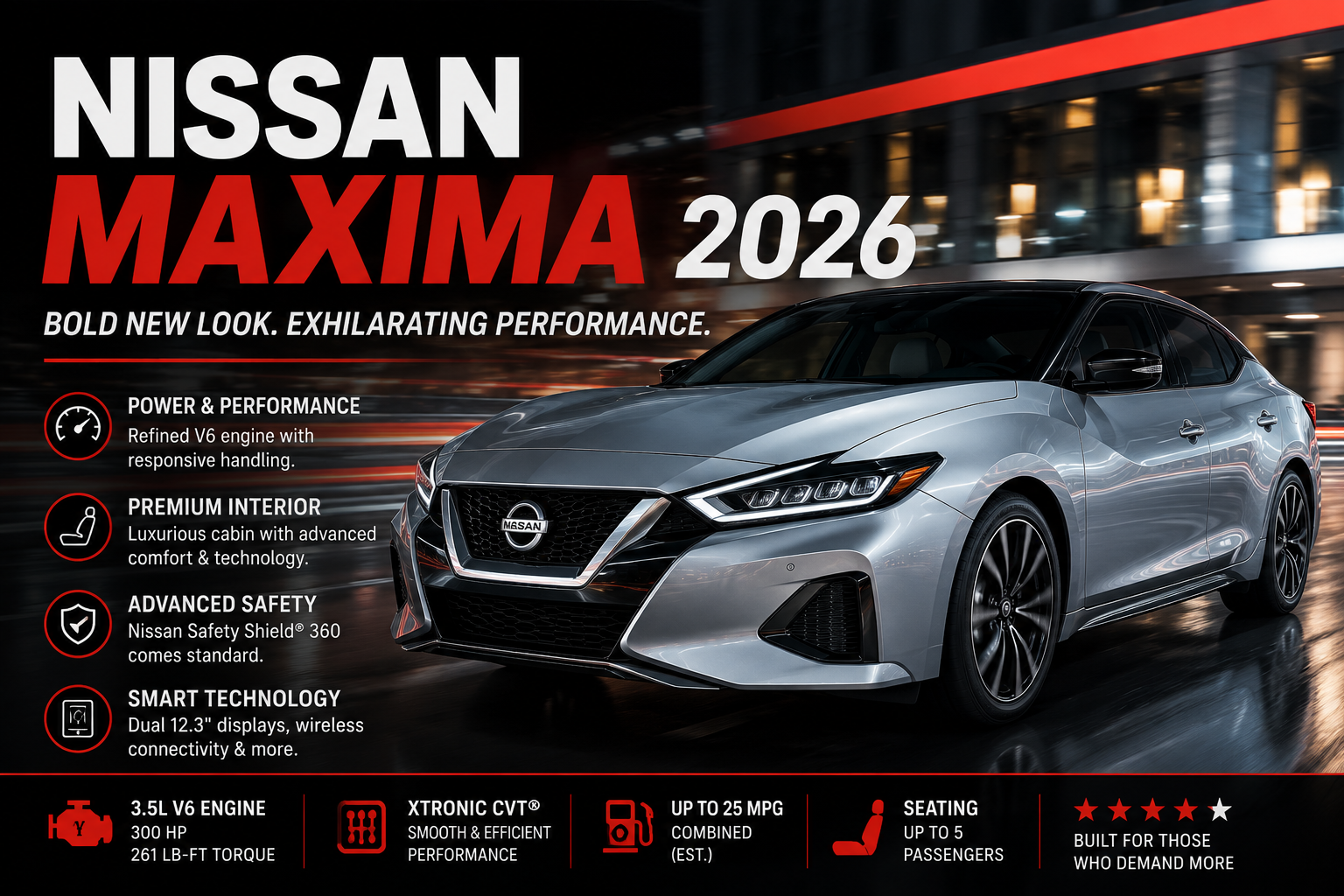
    Search interest in the Nissan Maxima 2026 remains strong because many drivers still want a stylish, powerful sedan positioned above the Altima. However, there is an important fact buyers should know before comparing prices or waiting for a release date: Nissan has not announced or sold a 2026 Maxima in the United States.

    The Maxima ended production after the 2023 model year. Online pages that advertise a new 2026 version often rely on old specifications, unofficial renderings, or predictions about a possible electric successor. This guide separates confirmed information from speculation and explains the most practical options for US shoppers.

    KEY TAKEAWAYS
    ·        There is no officially confirmed 2026 Nissan Maxima for the US market.

    ·        Nissan identifies 2023 as the Maxima’s final production year.

    ·        No official 2026 MSRP, trim list, powertrain, fuel economy rating, or release date exists.

    ·        A future return could use an electric or electrified format, but Nissan has not confirmed a Maxima revival.

    ·        The closest choices are a used 2023 Maxima, the current Nissan Altima, or an upscale sedan from another brand.

    2026 Nissan Maxima Status at a Glance

    Table 1: Verified status of the Maxima nameplate in the United States

    Question Verified answer
    Is there a 2026 Maxima? No official US-market model has been announced or listed for sale.
    Last production year 2023
    Official 2026 starting price Not available
    Official release date None announced
    Confirmed 2026 powertrain None
    Most recent engine 3.5-liter V6 with 300 horsepower
    Most recent drivetrain Front-wheel drive with a continuously variable transmission
    Possible future direction Electric or electrified revival remains speculation, not confirmed product information

    Is There a 2026 Nissan Maxima?

    No. Nissan’s official discontinued-model page states that 2023 was the final year of production for the Maxima. The company describes the sedan as no longer in production and directs shoppers toward other vehicles rather than presenting a replacement Maxima model.

    This means there is no factory order guide, EPA fuel economy label, trim lineup, warranty announcement, or dealer launch schedule for a 2026 version. Listings that present exact prices or specifications should be treated cautiously unless they come directly from Nissan.

    The confusion is understandable. Nissan built the Maxima for decades and positioned it as a flagship four-door sports car. Because the name still has strong recognition, automotive publications and enthusiasts continue to discuss how it might return. Discussion, however, is not the same as an official product announcement.

    Why Are People Expecting the Maxima to Return?

    The Maxima name carries more history than many discontinued sedans. Earlier generations combined V6 power, distinctive styling, and a more premium cabin than buyers typically expected from a mainstream Nissan. That reputation makes the name valuable even after production has ended.

    There has also been long-running speculation that Nissan could reuse the name for an electric sedan, a fastback, or an elevated crossover-like car. Such a vehicle could match the industry shift toward electrification while preserving the Maxima’s role as a more emotional flagship. As of July 2026, Nissan has not confirmed that any future EV or concept will be called Maxima.

    It is also important not to confuse the Max-Out concept with a production Maxima. The Max-Out was presented as a futuristic electric convertible concept. Its similar name does not make it a direct preview of a 2026 Maxima sedan.

    What the Last Nissan Maxima Offered

    Table 2: Key specifications from the final-generation Maxima

    Specification Final-generation Maxima
    Engine 3.5-liter naturally aspirated V6
    Output 300 hp and 261 lb-ft of torque
    Transmission Continuously variable automatic transmission with manual mode
    Drivetrain Front-wheel drive
    Seating Five passengers
    EPA fuel economy 24 mpg combined, 20 city, and 30 highway
    Trunk capacity About 14 cubic feet
    Infotainment 8-inch touchscreen with smartphone integration
    2023 base MSRP $38,340 before destination for the SV trim

    The final Maxima delivered strong straight-line performance for a front-wheel-drive sedan. Its V6 produced smooth power, and tested acceleration was quick enough to compete with some entry-level luxury sedans. The main criticism was the continuously variable transmission, which reduced the mechanical involvement expected from a car marketed as sporty.

    Inside, the Maxima offered comfortable front seats, soft-touch materials, and a driver-focused dashboard. It felt more upscale than the typical midsize family sedan, but rear-seat room and trunk space were not class-leading. Buyers choosing a used model should decide whether the styling and V6 performance matter more than maximum passenger and cargo space.

    Fuel economy was respectable for a 300-horsepower V6, but it cannot match modern hybrid sedans. The EPA rating of 24 mpg combined means fuel expenses may be noticeably higher for drivers with long daily commutes.

    Expected Price and Release Date

    There is no responsible way to quote an official 2026 Maxima price because the vehicle does not exist in Nissan’s announced US lineup. Websites that provide a precise base price, trim structure, or arrival month are publishing estimates rather than confirmed information.

    For context, the 2023 Maxima SV had a base MSRP of $38,340 before its destination charge. A future revival would probably need to sit above Nissan’s mainstream sedan offerings, but inflation, battery costs, equipment, body style, and powertrain choice would determine the actual price. Until Nissan issues a formal announcement, even a broad estimate is speculative.

    Could a Future Maxima Be Electric?

    An electric Maxima is possible, but it is not confirmed. Reusing the name on an EV could help Nissan give a future sedan an established identity. Electric motors could also deliver the quick acceleration and smooth power expected from a flagship model.

    Another possibility is an electrified fastback or crossover-style sedan rather than a traditional low-roof four-door. That approach could provide more cargo flexibility and respond to the US market’s preference for higher seating positions. Nissan could also decide not to revive the Maxima at all. All three outcomes remain possible until the company publishes official product details.

    Best Alternatives for US Buyers in 2026

    Table 3: Practical alternatives to a nonexistent new Maxima

    Alternative Why it may fit Main compromise
    Used 2023 Nissan Maxima The closest match to the familiar V6-powered Maxima experience Used-car condition, age, and remaining warranty vary
    2026 Nissan Altima A current Nissan sedan with available all-wheel drive and modern driver assistance Less power and a less premium feel than the Maxima
    Toyota Crown Upscale design, hybrid efficiency, and standard all-wheel-drive positioning Different driving character and higher trims can be expensive
    Acura TLX Premium cabin and stronger performance-oriented branding Rear-seat and cargo space may not satisfy every family
    Lexus ES Comfort, refinement, and strong efficiency in hybrid form Focused more on comfort than sporty handling

    For buyers who want to stay with Nissan, the 2026 Nissan Altima is the closest current sedan in the brand’s US lineup. It offers available all-wheel drive, modern connectivity, and a lower purchase price, although it does not reproduce the Maxima’s 300-horsepower V6 character.

    A well-maintained 2023 Maxima is the better choice for drivers who specifically want the design, powertrain, and interior of the final model. Buyers who prioritize fuel economy or a newer warranty may be better served by a hybrid sedan or a current midsize model.

    What to Check When Buying a Used Maxima

    • Service records: Look for consistent oil changes, scheduled maintenance, and documented transmission inspections.
    • CVT behavior: During a test drive, watch for hesitation, shuddering, unusual noises, or inconsistent acceleration.
    • Tires and brakes: Sport-oriented trims may have larger wheels and costlier replacement tires.
    • Accident history: Inspect panel gaps, paint consistency, alignment, and vehicle-history records.
    • Technology functions: Test the touchscreen, cameras, driver-assistance systems, remote features, and smartphone connectivity.
    • Pre-purchase inspection: Have an independent mechanic inspect the car before signing a purchase agreement.

    Frequently Asked Questions

    Is Nissan making a Maxima for 2026?

    No official 2026 Nissan Maxima has been announced for the United States. Nissan says the 2023 model was the final production year.

    How much does a 2026 Nissan Maxima cost?

    There is no official price because there is no confirmed 2026 model. Prices published on unofficial sites are estimates or may refer to older vehicles.

    Will the Nissan Maxima return as an electric car?

    It is possible, but Nissan has not confirmed an electric vehicle using the Maxima name. Any claimed battery size, range, horsepower, or launch date is speculative.

    Can I still buy a new Nissan Maxima?

    A truly new, untitled 2023 example may occasionally appear as old inventory, but most Maximas available in 2026 will be used or certified pre-owned vehicles.

    What replaced the Nissan Maxima?

    Nissan has not introduced a direct replacement. The Altima is the brand’s closest current mainstream sedan, while shoppers seeking a more premium experience may need to compare other brands.

    Final Verdict

    For shoppers researching the Nissan Maxima 2026, the accurate conclusion is that no such production model has been confirmed for the United States. The Maxima remains discontinued after 2023, and a future electric or electrified revival is only a possibility. Buyers should avoid treating unofficial renderings, price estimates, and predicted specifications as verified facts. A used 2023 Maxima is the best route to the original V6 experience, while the current Altima and competing upscale sedans offer newer technology and warranty coverage.

  • Jeep Grand Cherokee Airbag Recall: VIN Check, Warning Signs, and Free Repair

    Jeep Grand Cherokee Airbag Recall: VIN Check, Warning Signs, and Free Repair

    419,035

    SUVs potentially involved

    $0

    Dealer software remedy

    NO

    Do Not Drive advisory

    The Jeep Grand Cherokee airbag recall covers 419,035 SUVs in the United States because software in the Occupant Restraint Controller may delay side-airbag deployment in certain crashes. The campaign includes specific 2022-2026 Grand Cherokee vehicles and 2023-2025 Grand Cherokee L vehicles, but model year alone cannot confirm eligibility. Owners need to check the 17-character VIN.
    FCA US says dealers will reprogram the controller with updated software at no charge. NHTSA’s filing does not carry a Do Not Drive or Park Outside instruction, but the defect affects occupant protection, so an open recall should be scheduled promptly rather than postponed.

    USA RECALL SNAPSHOT
    Recall status Active U.S. safety recall with a dealer software remedy
    NHTSA campaign 26V328, also displayed as 26V328000 in some databases
    Manufacturer campaign 01D
    Potential population 419,035 vehicles
    Affected models Certain 2022-2026 Jeep Grand Cherokee and 2023-2025 Jeep Grand Cherokee L SUVs
    Affected component Occupant Restraint Controller (ORC) software
    Safety concern Side airbags may deploy late in certain crashes, reducing occupant protection
    Warning after fault sets Airbag light remains illuminated and a chime sounds at each ignition cycle
    Dealer remedy Reprogram the ORC with updated software
    Owner cost No charge for the recall repair
    Driving advisory No formal Do Not Drive or Park Outside notice for campaign 26V328
    Key contacts FCA US: 800-853-1403 | NHTSA Vehicle Safety Hotline: 888-327-4236

    What Owners Should Do Today

    YOUR SITUATION WHAT TO DO NEXT
    Your model year appears in the recall range Do not rely on model year alone. Check the VIN for NHTSA campaign 26V328 or FCA campaign 01D.
    Your VIN shows an open recall Call an authorized Jeep dealer, quote campaign 01D, and schedule the free ORC software reprogramming.
    The airbag light stays on or a chime sounds at every start Contact a dealer promptly and describe the warning. Other restraint-system faults can cause similar symptoms, so a diagnosis still matters.
    Your VIN shows no unrepaired recall Save the result. If you recently bought the SUV or received a letter that conflicts with the result, ask Jeep or NHTSA to verify the VIN.

    Which Vehicles Are Included?

    The Jeep Grand Cherokee airbag recall is not a blanket recall of every SUV in the listed model years. FCA used vehicle production and supplier records to identify the suspect population, and similar vehicles built after the suspect periods or with door impact pressure sensors from a different supplier were excluded. A VIN result is the final practical test for an individual vehicle.

    MODEL MODEL YEARS SUSPECT PRODUCTION DATES VEHICLES SHARE
    Jeep Grand Cherokee (non-L) 2022-2026 May 16, 2022 to Aug. 19, 2025 140,130 33.4%
    Jeep Grand Cherokee L 2023-2025 May 16, 2022 to Oct. 9, 2025 278,905 66.6%
    Total VIN-specific Combined suspect population 419,035 100%
    Why the dates can look confusing: A model year does not have to match the calendar year in which a vehicle was assembled. For example, the affected Grand Cherokee L range begins with 2023 model-year vehicles even though the suspect production period began in May 2022.

    A 2026 Grand Cherokee L is not named in this campaign’s model-year range, while a 2026 non-L Grand Cherokee may be included. A 2021 vehicle is not part of campaign 26V328. None of those statements replaces a VIN check, because the same vehicle may have other open recalls or service campaigns.

    What Went Wrong Inside the Airbag System?

    The Occupant Restraint Controller is the electronic decision unit that monitors parts of the supplemental restraint system. Door pressure sensors help the vehicle identify a side-impact event. According to FCA’s filing, the suspect ORC software can cause a temporary door airbag pressure-sensor fault to stay active for the remaining life of the sensor.

    STAGE NORMAL ROLE RECALL CONDITION
    Door pressure sensor Provides information used to recognize certain side impacts A transient sensor fault can occur
    ORC software Evaluates restraint-system information and controls deployment decisions Software may keep the transient fault active
    Side airbag response Deploys at the timing needed for occupant protection Deployment may be delayed in certain crash types

    This is not an airbag-inflator rupture recall, and the filing does not describe an airbag deploying without a crash. It is a software and sensor-fault handling problem that can affect how quickly the side airbags respond. It is also separate from the older Takata inflator campaigns.

    How Serious Is the Safety Risk?

    NHTSA’s report says delayed side-airbag deployment may reduce protection in certain crashes and increase the risk of injury. FCA also identified a possible failure to comply with Federal Motor Vehicle Safety Standard 214, which covers side-impact protection.

    QUESTION OFFICIAL STATUS PRACTICAL OWNER TAKEAWAY
    Can the side airbags deploy late? Yes, in certain crash types if the fault condition is present Complete an open recall promptly
    Is there an injury concern? Yes, reduced protection can increase injury risk Do not treat the update as optional maintenance
    Is this a Do Not Drive recall? No formal Do Not Drive advisory is listed Driving is not prohibited by the filing, but repair should not be delayed
    Must the SUV be parked outside? No Park Outside advisory is listed This is not a fire-risk parking instruction
    Does FCA estimate every recalled SUV has the defect? No, the filing estimates 1% of the population may have the defect Every VIN with an open campaign is still eligible for the remedy
    The 1% estimate is not an owner-level diagnosis. Drivers cannot tell from appearance, mileage, trim, engine, or normal operation whether the software condition will occur. If the VIN shows an open recall, the correct response is to complete the free update.

    Warning Signs to Watch For

    The recall documentation says there is no warning before the fault sets. Once it sets, the airbag warning light will remain continuously illuminated in the instrument cluster, and a chime will sound at each ignition cycle.

    WHAT YOU SEE OR HEAR WHAT IT MAY MEAN RECOMMENDED RESPONSE
    Airbag light appears briefly at startup, then turns off Normal system self-check in many vehicles Still check the VIN because the absence of a warning does not rule out the recall
    Airbag light stays on continuously A restraint-system fault has been detected Contact an authorized Jeep dealer promptly
    Airbag light plus chime at every ignition cycle Consistent with the warning described after this recall fault sets Mention campaign 01D when booking service
    Warning remains after recall service The update may not have been recorded, or another restraint-system issue may exist Return to the dealer and keep the repair paperwork
    Important: Do not wait for the dashboard light before checking eligibility. The official filing specifically says there is no warning before failure.

    How to Check Your VIN in Three Minutes

    1. Find the 17-character VIN. Look through the lower driver-side corner of the windshield, or check the registration card, title, insurance card, or driver-door label.
    2. Search the complete VIN, not only the year, make, and model. A VIN search identifies whether that exact SUV has an unrepaired recall.
    3. Look for NHTSA campaign 26V328 or manufacturer campaign 01D. Save a screenshot or printout for your records.

    Use NHTSA’s official recall lookup to enter the VIN or license plate. NHTSA explains that a VIN result shows unrepaired recalls, while a recall that has already been completed may no longer appear as open.

    If the result says “0 unrepaired recalls,” it means the database does not show a currently open recall for that VIN at the time of the search. It does not prove the vehicle was never included, and it does not replace repair documentation. If a mailed notice or dealer record conflicts with the online result, ask FCA US or NHTSA to verify the VIN.

    What the Jeep Dealer Will Do

    The official remedy is to reprogram the Occupant Restraint Controller with updated software. The filing describes a software repair rather than replacement of the side airbags, pressure sensors, or controller hardware as the standard campaign remedy.

    STEP WHAT TO EXPECT
    Before the visit Provide the VIN, quote recall 01D, confirm that the dealer can perform the update, and ask for an estimated appointment time.
    At the dealership A technician reprograms the ORC using the approved recall procedure. The recall repair is provided at no charge.
    Before leaving Request a repair order showing the VIN, mileage, campaign number, completion date, and work performed.
    After the visit Confirm that the airbag warning light completes its normal startup check and does not remain on. Keep the paperwork with the vehicle records.

    Do not assume that a routine Uconnect or infotainment update completed the recall. The campaign documentation calls for dealer reprogramming of the ORC. Appointment length can vary with dealer workload, equipment availability, and any unrelated diagnostic work.

    Can You Keep Driving Before the Repair?

    NHTSA’s Part 573 report leaves the Do Not Drive and Park Outside advisory boxes unchecked. That means campaign 26V328 does not carry either formal instruction. It does not mean the defect is harmless or that an owner should ignore an open recall.

    SITUATION SENSIBLE NEXT STEP
    VIN is open, but no airbag warning is present Arrange the free update at the earliest practical appointment.
    Airbag light remains on or chime repeats at startup Call the dealer promptly, describe the warning, and ask for vehicle-specific guidance.
    Vehicle has recent collision or restraint-system repair history Tell the dealer before the recall visit because additional diagnosis may be appropriate.
    Dealer cannot schedule immediately Ask for the earliest opening, call another authorized Jeep dealer, and document your attempts.

    An authorized dealer can give advice based on the warning lights, stored fault codes, and condition of the specific vehicle. Owners should follow any newer instruction from FCA US or NHTSA if the campaign guidance changes after this article is published.

    Recall Timeline

    DATE DEVELOPMENT
    February 2023 FCA engineering and supplier quality became aware of a small number of warranty incidents involving door airbag pressure sensors.
    June 6, 2024 FCA’s safety and regulatory organization opened an investigation into possible delayed side-airbag deployment.
    April 22, 2026 FCA recognized a vehicle-build issue that could create noncompliance with the side-impact standard.
    May 14, 2026 FCA decided that a federal safety-standard noncompliance existed in certain vehicles.
    May 21, 2026 FCA submitted Part 573 recall report 26V328 to NHTSA.
    May 28, 2026 Dealers were scheduled to be notified, and affected VINs were scheduled to become searchable.
    June 11-19, 2026 Owner remedy letters were scheduled to be mailed in phases.
    July 20, 2026 This guide was checked against the available recall filing and owner-action information.

    The supplied Car and Driver report provides the original news overview of the 419,035-vehicle campaign and the affected Grand Cherokee versus Grand Cherokee L split.

    What If You Already Paid for Related Work?

    FCA’s NHTSA filing states that the manufacturer has a general reimbursement plan on file. That does not guarantee that every prior airbag-light diagnosis, sensor replacement, software update, towing charge, or rental expense will qualify. Eligibility depends on the work performed, the dates, the recall condition, and FCA’s reimbursement rules.

    • Keep the original repair invoice and proof of payment.
    • Record the VIN, mileage, repair date, dealer or shop name, diagnostic codes, and parts or software listed.
    • Contact FCA US or an authorized Jeep dealer and ask specifically about reimbursement under campaign 01D.
    • Do not surrender original documents unless you retain clear copies.

    Advice for Used-Grand-Cherokee Shoppers

    A used SUV may fall within the model-year range but already have the recall completed, or it may still have an open campaign. Check the VIN yourself rather than relying only on a listing, history report, window sticker, or verbal statement from the seller.

    • Run the VIN before placing a deposit or taking delivery.
    • Ask for the dealer repair order if the seller says campaign 01D was completed.
    • Confirm that the airbag warning light comes on for its normal startup check and then turns off.
    • Recheck the VIN after purchase and register the vehicle with current contact information so future recall letters reach you.

    Frequently Asked Questions

    Is every 2022-2026 Grand Cherokee recalled?

    No. The listed model years describe the potential population, but the recall is VIN-specific. Similar vehicles built outside the suspect period or using a different sensor supplier were excluded.

    Does the recall include the Grand Cherokee L?

    Yes. It includes certain 2023-2025 Grand Cherokee L vehicles. The L accounts for 278,905 of the 419,035 potentially involved SUVs.

    Is a 2026 Grand Cherokee L included?

    The NHTSA filing lists 2023-2025 for the Grand Cherokee L. Owners of any model year should still run the VIN because other recalls may apply.

    Does the airbag light need to be on for the VIN to qualify?

    No. The filing says there may be no warning before the fault sets. Recall eligibility comes from the VIN, not the presence of a dashboard light.

    What exactly is delayed?

    The concern is delayed deployment of the side airbags in certain crash types when the relevant sensor fault is active.

    Is this the same as a Takata airbag recall?

    No. Campaign 26V328 concerns ORC software and the handling of a door pressure-sensor fault, not a Takata inflator.

    Is the repair free if the SUV is out of warranty?

    The campaign remedy is a safety-recall repair and is listed as free of charge. Confirm the open VIN and appointment details with an authorized Jeep dealer.

    Can an independent repair shop perform the official recall?

    The no-charge campaign remedy is administered through authorized Jeep dealers. An independent shop may diagnose other issues, but owners should use a Jeep dealer to record completion of campaign 01D.

    Will a software update replace any airbag parts?

    The standard remedy described by FCA is ORC reprogramming. A dealer may recommend separate work only if it finds an unrelated or additional fault.

    What should I do if the warning remains after the update?

    Return to the dealer, describe when the light or chime appears, and ask for written documentation of the diagnosis. Keep both the recall repair order and any follow-up records.

    Final Owner Checklist

    Priority: Check the VIN now, schedule an open recall promptly, and keep proof that campaign 01D was completed.
    • Locate the full 17-character VIN.
    • Search for NHTSA 26V328 or FCA 01D.
    • Book an authorized Jeep dealer if the campaign is open.
    • Mention any continuously illuminated airbag light or repeated ignition chime.
    • Get a dated repair order showing the recall was completed at no charge.
    • Return for diagnosis if the warning remains after service.

    The most important distinction is simple: matching a model-year range means the SUV may be involved, while the VIN confirms whether the individual vehicle has an open recall. Owners do not need to diagnose the software themselves. They need to verify the VIN, arrange the free dealer reprogramming, and preserve the completion record.

  • Honda Accord 2027 Rendering: A Futuristic Refresh May Be Coming

    Honda Accord 2027 Rendering: A Futuristic Refresh May Be Coming

    2027 ACCORD REFRESH: QUICK FACTS

    Honda Accord Future-Model Snapshot
    Vehicle Honda Accord midsize sedan
    Article status Unofficial rendering analysis and reported product plans
    Official refresh images Not released by Honda
    Reported update timing Second half of 2027
    Likely U.S. model year Possibly 2028, depending on launch timing
    Expected exterior direction Narrower grille, slimmer headlights, sharper rear styling
    Expected cabin change Larger infotainment display
    Likely powertrains 1.5-liter turbo and 2.0-liter two-motor hybrid carryover
    Likely drivetrain Front-wheel drive
    Estimated price range About $30,000 to $43,000, editorial estimate
    Honda confirmation No specific Accord refresh details confirmed as of July 20, 2026
    Accuracy note

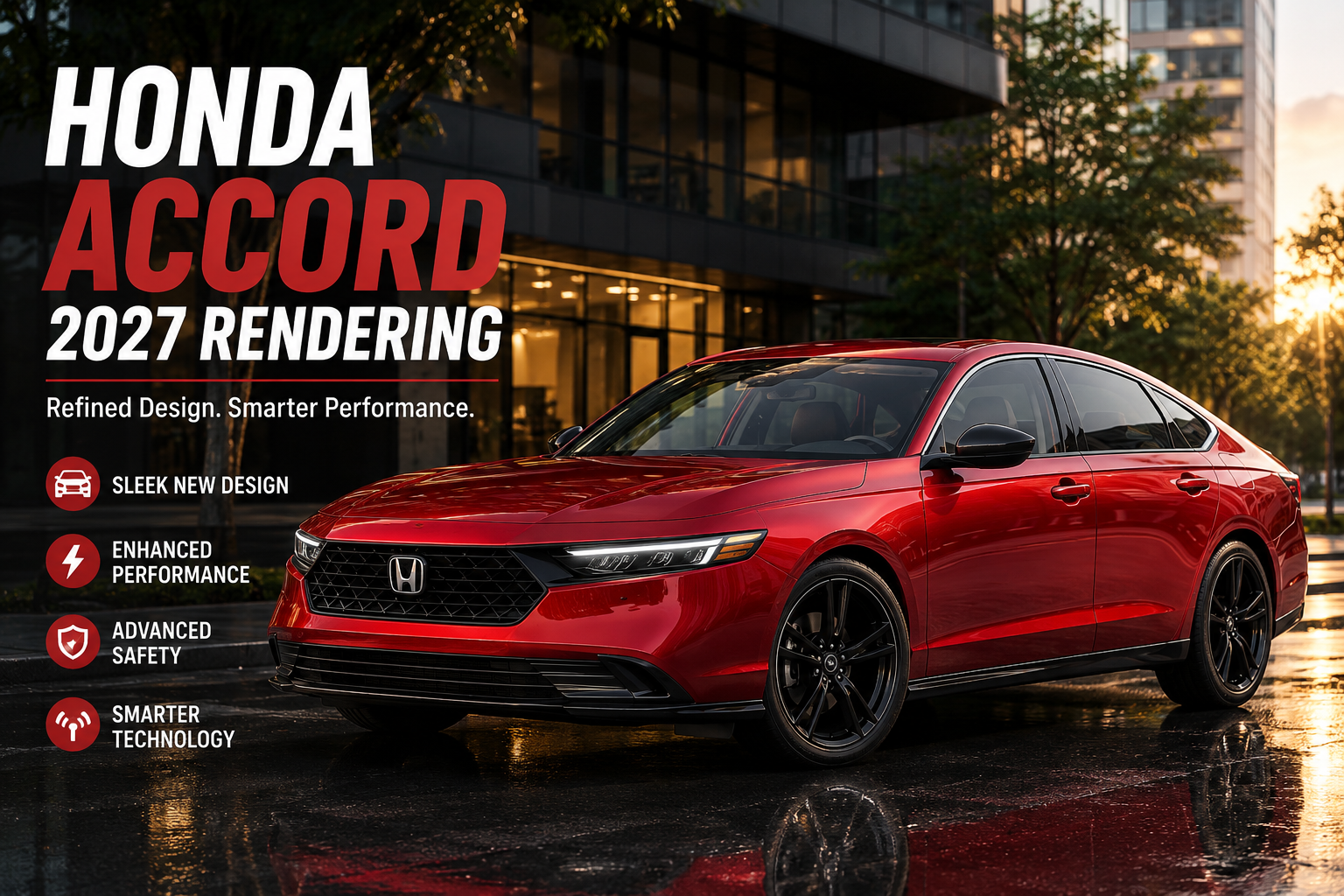
    This article discusses an unofficial rendering and reported future product plans. Honda has not released final refresh images, specifications, pricing, trim details, or a confirmed U.S. model-year designation.

    The Honda Accord 2027 rendering is best understood as an unofficial preview of where Honda may take its midsize sedan next. Recent reporting points to a much sharper Accord arriving in the second half of 2027, but Honda has not published production images or confirmed whether the refreshed car will wear a 2027 or 2028 model-year badge in the United States.

    That timing matters. A vehicle introduced late in a calendar year is often marketed as the following model year, so the most dramatic design shown in speculative artwork may not match the regular 2027 Accord already expected to continue with few changes. The useful question is not whether every line in a rendering is accurate, but which reported details are credible enough to shape a realistic preview.

    Is Honda’s Futuristic Accord Refresh Official?

    A June 8, 2026 Car and Driver report says the Accord is scheduled for a substantial makeover in the second half of 2027. The report describes a narrower grille, slimmer headlights, a more angular rear, a larger infotainment display, and possible use of Honda’s S+ Shift feature.

    Honda did not confirm the Accord details when asked for comment. That leaves the overall direction reasonably well supported by industry reporting, while the exact sheet metal, lighting graphics, trim lineup, dimensions, and release schedule remain unconfirmed.

    The safest way to read any future-model illustration is to separate three categories: reported changes, logical carryover items, and purely artistic choices. Thin lamps and a tighter grille have been reported. A similar wheelbase and familiar sedan proportions are logical. Full-width light bars, dramatic vents, oversized wheels, and supercar-like bodywork are artistic unless Honda shows them on a production vehicle.

    Why Both 2027 and 2028 Are Being Discussed

    Car and Driver’s separate 2027 Accord model page currently describes the car as unchanged. At the same time, the June product-plan report places the major makeover in the second half of 2027. Both statements can be true if Honda sells a carryover 2027 model first and then launches the refreshed sedan as a 2028 model later in the year.

    Honda could also reveal the update months before U.S. dealership deliveries begin. Automakers often show a refreshed vehicle early, announce trims and specifications later, and then stagger production by region. Until Honda issues a formal press release, the calendar-year timing is more reliable than any assumed model-year badge.

    What a Realistic Future Accord Rendering Should Show

    A convincing Honda Accord 2027 rendering should look like an evolution of the current eleventh-generation sedan, not a completely unrelated concept car. The strongest interpretation would keep the Accord’s long cabin, low hood, usable rear seat, and large trunk while adding the thinner lighting and crisp body surfacing previewed by Honda’s recent Hybrid Sedan prototype.

    Front Design

    The front end is likely to deliver the biggest visual change. A narrower grille could sit lower between very slim LED headlights, giving the car a wider and more planted appearance. Stronger hood creases and cleaner bumper openings would add definition without turning the Accord into an aggressive performance sedan.

    Sport-oriented trims may use darker trim, larger lower intakes, and 19-inch wheels, while efficiency-focused versions could retain simpler bumper details and 17-inch wheels. A single basic body shape with trim-specific graphics would let Honda create more personality without adding unnecessary manufacturing complexity.

    Side Profile

    The current Accord already has a long, fastback-like roofline and a wheelbase that supports excellent rear legroom. A mid-cycle update is unlikely to change those hard points significantly. Expect new wheel patterns, sharper lower-door sculpting, revised mirrors, and possibly a more defined shoulder line instead of an entirely new greenhouse.

    A realistic illustration should also avoid exaggerated ride height changes or very short overhangs. The Accord remains a practical front-wheel-drive family sedan, and packaging needs will continue to influence its proportions more than styling drama.

    Rear Design

    Reporting describes the rear as more angular and less soft than the current car. That could mean squarer corners, tighter taillight shapes, a more sharply creased trunk lid, and a cleaner lower bumper. A subtle integrated spoiler on Sport trims would fit the design direction, but a large wing or complex diffuser would be unlikely on mainstream versions.

    TABLE 1. DESIGN FORECAST: REPORTED CHANGES VS. EDITORIAL EXPECTATIONS

    Area Current Character Likely Refresh Direction Confidence
    Front fascia Wide, restrained, horizontal design Narrower grille and slimmer headlights Reported
    Body surfacing Smooth and understated Crisper lines influenced by the Hybrid Sedan prototype Inferred
    Rear styling Rounded and visually soft More angular corners and tighter light graphics Reported
    Wheels and colors 17-inch and 19-inch designs New wheel patterns and updated color choices Expected
    Overall proportions Long sedan body with fastback-like roof Likely to remain close to the current package Expected

    Expected Interior and Technology Updates

    The most credible cabin change is a larger infotainment display. The current 2026 lineup uses a 9-inch screen in the LX and SE, while hybrid trims receive a 12.3-inch unit. Honda could make the larger display standard across more trims, introduce a wider screen for premium versions, or redesign the dashboard around a newer software platform.

    A digital instrument cluster, wireless Apple CarPlay and Android Auto, wireless phone charging, and available Google built-in should remain central to the technology package. The Touring model may continue to distinguish itself with features such as a head-up display, premium audio, additional connected services, and upgraded cabin materials.

    Honda is also reported to be considering S+ Shift, the simulated gear-change system used in the hybrid Prelude. In the Accord, it could add artificial shift points, sound changes, and paddle interaction to make the hybrid feel more engaging. It would not convert the car into a conventional automatic with physical gears, so buyers should view it as a driving-experience feature rather than a mechanical transmission change.

    Physical climate and volume controls are likely to remain. Honda’s current cabins are valued for simple operation, and replacing every control with touchscreen menus would work against one of the Accord’s strengths.

    Engine and Hybrid Expectations

    Honda’s official 2026 Accord specifications provide the best current baseline. The LX and SE use a 192-horsepower 1.5-liter turbocharged engine, while the four upper trims use a 204-horsepower two-motor hybrid system. Every version is front-wheel drive.

    The reported refresh is expected to retain those basic powertrains. Honda may revise calibration, engine sound, electric-motor response, regenerative braking behavior, or drive modes, but a large horsepower increase has not been reported. Carryover hardware would also help Honda control development costs while focusing the update on styling and technology.

    All-wheel drive remains uncertain. Honda has not offered it on the current Accord, and no reliable report has confirmed it for the refresh. Shoppers who require all-weather traction should not assume it will be added simply because competitors offer it.

    A hybrid-only Accord is more plausible with the next full redesign around 2030, not necessarily with the late-2027 facelift. Keeping the turbo engine on lower trims would preserve a lower entry price, while the hybrid would continue to serve buyers prioritizing efficiency and stronger low-speed response.

    TABLE 2. CURRENT ACCORD BASELINE AND POSSIBLE REFRESH OUTLOOK

    Category Current 2026 Accord Late-2027 Refresh Outlook
    Gas powertrain 1.5-liter turbo, 192 hp Likely carryover with calibration updates
    Hybrid powertrain 2.0-liter two-motor system, 204 hp Likely carryover; S+ Shift possible
    Drivetrain Front-wheel drive Front-wheel drive expected; AWD unconfirmed
    Touchscreen 9-inch gas trims; 12.3-inch hybrid trims Larger display or wider availability reported
    Best EPA rating Up to 51 city / 44 highway / 48 combined mpg Similar range expected; no official rating
    Cargo volume 16.7 cubic feet Likely close to current capacity
    Length 195.7 inches Major dimensional change unlikely in a facelift
    Base MSRP $28,395 before destination Price increase expected; no official figure

    Possible Fuel Economy

    If the engines and body structure largely carry over, fuel economy should remain near current levels. Small improvements could come from revised software, lower rolling-resistance tires, wheel design, underbody airflow, and more efficient hybrid control. Large gains are less likely without a new platform or substantially revised hybrid hardware.

    The current EX-L Hybrid is the efficiency leader at an EPA-estimated 51 mpg city, 44 mpg highway, and 48 mpg combined. Its 17-inch wheels help it outperform hybrid trims fitted with 19-inch wheels. The same pattern may continue if Honda preserves a comfort-and-efficiency-focused hybrid trim.

    Safety and Driver Assistance

    Honda Sensing should remain standard, including automatic emergency braking, adaptive cruise control with low-speed follow, lane-keeping assistance, road-departure mitigation, forward-collision warning, and traffic-sign recognition. Blind-spot monitoring and rear cross-traffic alert are likely to remain available or standard on more trims.

    The refresh could bring improved camera resolution, smoother lane centering, better object detection, and more natural adaptive-cruise behavior. Those are reasonable expectations for a software-focused update, but Honda has not confirmed specific sensor or feature changes.

    Expected U.S. Price

    Official pricing is not available. The current 2026 Accord starts at $28,395 before destination, and the Touring Hybrid starts at $39,495 before destination. A larger screen, new exterior panels, and broader standard equipment could push the refreshed lineup higher.

    A reasonable editorial estimate is roughly $30,000 to $31,500 for an entry model, $35,000 to $37,000 for the least expensive hybrid, and $41,000 to $43,000 for a top trim before options. Destination charges, paint fees, accessories, regional availability, and future market conditions could change the final transaction price.

    TABLE 3. EDITORIAL PRICE ESTIMATE FOR THE REFRESHED LINEUP

    Version Estimated Starting Range What Could Affect It
    Entry gasoline model $30,000 to $31,500 Standard screen size, safety equipment, destination fee
    Entry hybrid model $35,000 to $37,000 Hybrid content, wheel size, standard comfort features
    Top hybrid model $41,000 to $43,000 Premium audio, head-up display, connected technology

    Expected Reveal and Release Timeline

    The current report places the makeover in the second half of 2027. A public reveal could happen earlier, potentially in the first half of 2027, followed by U.S. specifications and pricing closer to production. Dealership arrivals could then begin later in 2027 and continue into early 2028.

    The model-year badge remains the largest point of confusion. If Honda launches after the regular 2027 Accord has already been on sale, the refreshed vehicle is more likely to be labeled a 2028 Accord. Buyers should focus on the production date and equipment list rather than the year used in early rendering headlines.

    Should U.S. Buyers Wait for the Refresh?

    Waiting makes sense for shoppers who care strongly about exterior styling, the largest available display, newer software, or the possibility of S+ Shift. A major visual update can also help the car feel current for longer, which may matter to buyers planning to keep it for many years.

    Buying the current Accord can still be the better decision for anyone who needs a car soon or finds a strong discount. The existing sedan already provides a spacious rear seat, a 16.7-cubic-foot trunk, efficient hybrid trims, straightforward controls, and a strong set of standard driver-assistance features. Waiting also brings the risk of higher pricing and limited early inventory.

    A practical strategy is to watch for Honda’s official reveal before making a final decision. Once the design, trim structure, and launch date are confirmed, shoppers can compare the refresh against remaining current-generation inventory with fewer assumptions.

    Frequently Asked Questions

    Is the redesigned Accord shown in renderings official?

    No. Honda has not released final production images for the reported makeover. Current artwork should be treated as an independent interpretation based on reported styling cues and Honda’s Hybrid Sedan prototype.

    Will the 2027 Honda Accord be completely redesigned?

    The regular 2027 model is currently expected to be largely unchanged. The substantial update reported for the second half of 2027 sounds like a major mid-cycle refresh rather than a new generation, and it may be marketed as a 2028 model.

    What styling changes are most likely?

    The strongest reported details are a narrower grille, slimmer headlights, crisper bodywork, and a more angular rear design. Exact taillight graphics, wheel designs, and bumper details remain unknown.

    Will the refreshed Accord still offer a hybrid?

    Yes, the two-motor hybrid is expected to continue. Reports also suggest the current turbocharged gasoline engine may remain for lower trims during this refresh.

    Will it have all-wheel drive?

    All-wheel drive has not been confirmed. Front-wheel drive remains the safest expectation until Honda publishes official specifications.

    How much could the refreshed Accord cost?

    An unofficial estimate places the lineup near $30,000 to $43,000 before options, depending on powertrain and trim. Honda has not announced pricing.

    Final Verdict

    The reported Accord makeover appears designed to solve the current car’s biggest image problem: styling that some buyers consider too conservative. A tighter grille, thin headlights, sharper rear treatment, and a more technology-focused cabin could give the sedan a stronger showroom presence without sacrificing the space and efficiency that define it.

    For now, the most responsible conclusion is that the direction is credible but the details are fluid. Treat dramatic illustrations as previews, not proof. The final production car may borrow the prototype’s crisp visual language while remaining more practical, restrained, and familiar than the boldest online concepts suggest.

  • Hyundai Boulder Concept Explained: What Is Real, What Is Speculation, and Why It Matters

    Hyundai Boulder Concept Explained: What Is Real, What Is Speculation, and Why It Matters

    STATUS
    Pure design study
    CONFIRMED PRODUCTION
    Midsize pickup by 2030
    SUV PRICE / DATE
    Not announced

    Hyundai Boulder at a Glance

    Quick fact Current information
    Vehicle status SUV-shaped concept and body-on-frame platform preview
    Global debut April 1, 2026, New York International Auto Show
    Production vehicle confirmed A Hyundai midsize pickup targeted for delivery by 2030
    Production SUV confirmed No
    Design team Hyundai Design North America in Southern California
    Architecture Fully boxed body-on-frame concept platform
    Tire specification 37×12.50R18 LT mud-terrain tires
    Key utility features Coach-style doors, dual-hinged tailgate, power rear window, accessory-ready body
    Powertrain Not announced
    Official price Not announced
    Primary market focus United States and North America
    Information status Updated July 20, 2026
    THE 30-SECOND ANSWER: The dramatic SUV is real as a concept, but Hyundai has not approved it for production. The company has confirmed that its new body-on-frame architecture will support a U.S.-focused midsize pickup by 2030.

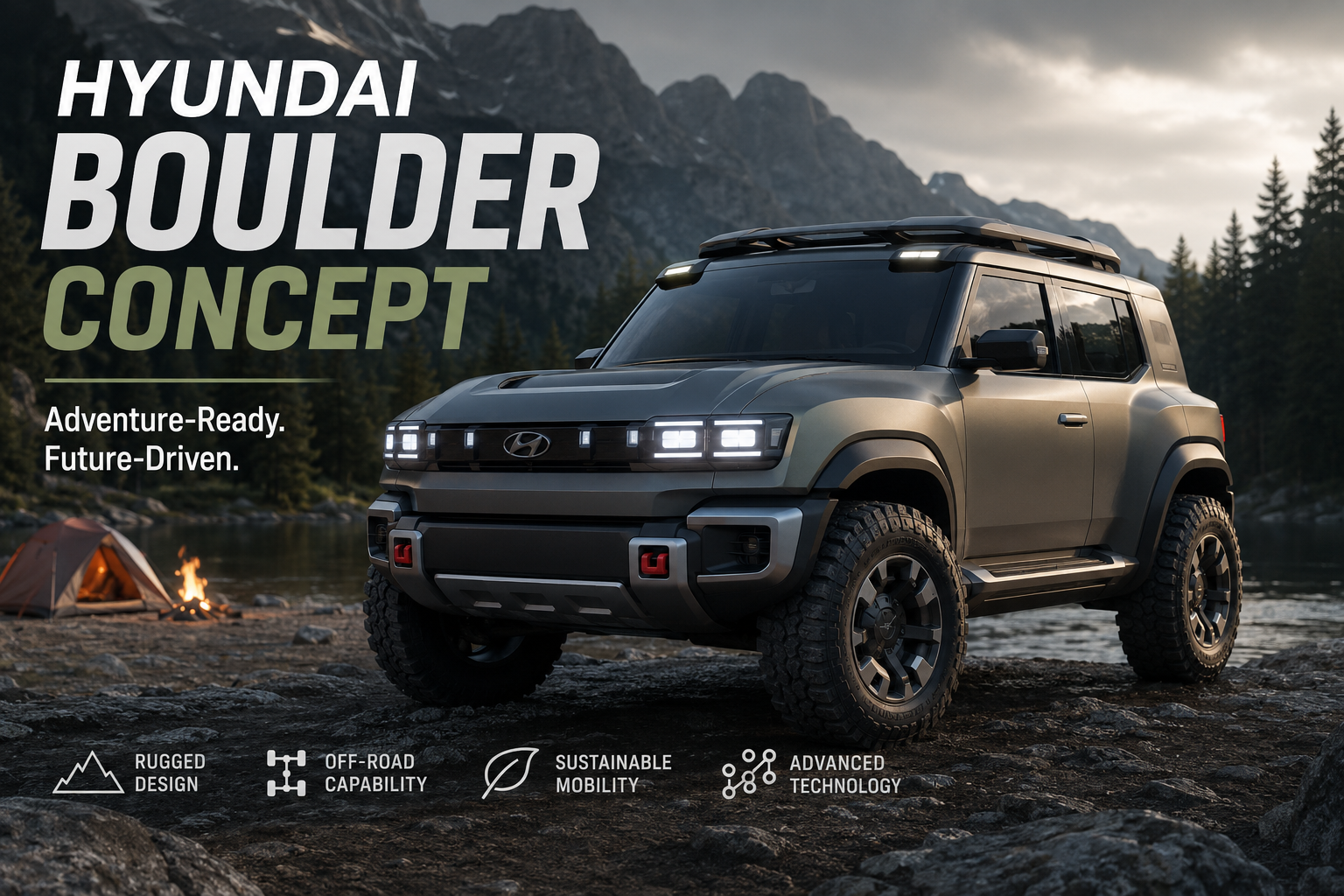
    The Hyundai Boulder Concept is one of the clearest signs yet that Hyundai wants to move beyond crossover-based adventure trims and enter America’s serious off-road market. Revealed in New York with huge tires, an upright body, and trail-focused utility, it looks ready to challenge the Ford Bronco, Jeep Wrangler, and Toyota 4Runner. Its real significance, however, is more strategic than its show-car appearance suggests.

    This guide uses a reality-check approach. It separates confirmed engineering and design details from media estimates, then considers which ideas are most likely to survive if Hyundai develops a showroom SUV from the concept. That distinction matters because the related pickup has a public deadline, while the SUV does not.

    Market estimate: Car and Driver currently presents the vehicle as a possible 2028 model with an estimated $40,000 starting price. Both figures are projections rather than manufacturer announcements. See the publication’s early Boulder overview for its current interpretation of the project.

    What Hyundai Has Actually Confirmed

    Official record: Hyundai confirms an April 2026 debut, a fully boxed body-on-frame architecture, 37-inch mud-terrain tires, U.S.-centered development, and a production midsize pickup due by 2030. The complete details appear in Hyundai Motor Group’s launch announcement.

    The crucial wording is ‘design study.’ Hyundai says the SUV previews the company’s first fully boxed body-on-frame architecture. The manufacturer directly commits that platform to a midsize pickup, but it stops short of promising that the SUV body shown at the auto show will reach dealerships.

    Topic Status What that means
    Concept debut and design Confirmed Shown publicly in April 2026
    Fully boxed body-on-frame platform Confirmed Production pickup will use the new architecture
    Midsize pickup by 2030 Confirmed The clearest production commitment
    Production Boulder SUV Unconfirmed Hyundai calls the SUV a pure design study
    2028 model-year arrival Media estimate Possible, but not announced by Hyundai
    $40,000 starting price Media estimate Useful positioning guess, not official pricing
    Engine, hybrid system, or EV setup Unknown No powertrain details released
    Towing, payload, dimensions, MPG Unknown No production specifications released

    Why This Concept Is Bigger Than a Styling Exercise

    Hyundai already sells SUVs with XRT branding, but those vehicles begin with unibody crossover platforms. The Boulder points toward a different class of product. In a body-on-frame vehicle, the cabin and body sit on a separate structural frame. That arrangement is commonly chosen when durability, towing, payload, modification potential, and rough-terrain use take priority over minimum weight and carlike road behavior.

    For Hyundai, the platform is the headline. It gives the brand a route into U.S. segments where authenticity matters and where appearance packages alone are not enough. A credible midsize pickup needs more than rugged trim. It needs a structure, cooling strategy, suspension, four-wheel-drive hardware, and accessory ecosystem designed around work and trail use from the start.

    The concept also gives Hyundai a low-risk way to test public reaction to a fixed-roof SUV before it commits billions of dollars to a second body style. Strong demand for the pickup platform could make an SUV easier to justify later, especially if major components can be shared.

    Exterior Design Decoded

    An upright shape built around visibility

    The Boulder uses a traditional two-box silhouette, with a long, level roof and a nearly vertical rear. This shape is not simply retro styling. It can improve outward visibility, create a more usable cargo area, and leave room for roof-mounted equipment. The tall greenhouse and square corners also help a driver judge the vehicle’s position on narrow trails.

    Art of Steel gives the body visual weight

    Hyundai describes the design language as Art of Steel. Broad surfaces transition into crisp edges, giving the body a forged and machined appearance instead of the soft surfacing found on many crossovers. The Liquid Titanium finish reinforces that theme. A production model would probably simplify some forms for stamping, repairability, and cost, but the upright stance and strong shoulder line could translate well.

    Thirty-seven-inch tires create the show-car drama

    The concept rides on 37×12.50R18 LT mud-terrain tires and carries a matching full-size spare on the tailgate. Tires this large improve obstacle clearance and visual presence, but they also add rotating mass, road noise, aerodynamic drag, cost, and stress on steering and driveline parts. A showroom version would be more likely to use smaller standard tires, with the most aggressive size reserved for a halo trim or dealer accessory package.

    The doors and tailgate focus on access

    Coach-style rear doors create a wide side opening for people and equipment. At the back, a double-hinged cargo door can open from either side, while a power drop-down rear window can accommodate long items and increase ventilation. These ideas are more than visual theater, but each would require careful engineering for sealing, crash performance, hinges, wiring, and long-term durability.

    Safari windows and an accessory-ready roof

    Fixed upper windows add daylight and improve the view of steep terrain. A low-profile rack with steel webbing provides another mounting surface for cargo and adventure equipment. Hyundai also describes the exterior as a blank canvas for accessories. That matters because buyers in the off-road market often personalize vehicles with racks, recovery gear, lighting, protection, storage, and camping equipment.

    The Cabin Makes a Case for Physical Controls

    The interior does not chase the biggest possible central touchscreen. Hyundai emphasizes durable materials at grab handles and other high-wear points, plus physical knobs and buttons that can be operated while the vehicle is moving over rough ground. That is a practical choice. A driver wearing gloves or bracing against motion can use a distinct control more reliably than a flat touch target.

    Fold-out tray tables make the cabin useful during trail stops, remote work, or camping. The broader design suggests a modular space rather than a luxury lounge. Any production version would still need airbags, storage, cupholders, climate controls, charging ports, and family-friendly comfort, but the concept establishes a clear priority: function should remain visible.

    The Digital Spotter Could Matter More Than the Giant Tires

    Hyundai says an available software-driven, real-time off-road guidance system can act like a digital spotter. The company has not explained the full sensor package, but the basic idea is compelling. Cameras, wheel-angle data, inclinometer readings, and terrain views could help a driver place tires, avoid rocks, monitor clearance, and choose a safer line.

    This is one concept feature with a strong chance of reaching production in some form. Camera-based trail views already exist in the market, and software can give Hyundai a point of difference without relying only on mechanical hardware. The system’s value would depend on clear graphics, low latency, durable cameras, and controls that remain simple under pressure.

    What Is Most Likely to Survive Production?

    Concept cars exaggerate proportions and features to communicate an idea quickly. The table below is an editorial assessment, not a Hyundai product plan. It ranks how easily each element could transfer to a production SUV or pickup.

    Concept element Transfer likelihood Reasoning
    Body-on-frame architecture Very high Already confirmed for the future pickup
    Upright, boxy proportions High Supports visibility, cargo use, and market identity
    Physical off-road controls High Practical and consistent with the concept mission
    Accessory mounting strategy High Important for work, overlanding, and personalization
    Digital trail guidance Medium to high Software feature is realistic, details may change
    Safari-style upper windows Medium Distinctive, but adds cost and sealing complexity
    Dual-hinged rear cargo door Medium Useful, yet mechanically more complex
    Coach-style rear doors Low to medium Crash, cost, and daily-use requirements may alter them
    37-inch standard tires Low Likely too extreme for mainstream trims

    Powertrain: The Biggest Missing Piece

    Hyundai has not announced an engine, transmission, battery, electric range, horsepower figure, or four-wheel-drive system. It has not confirmed locking differentials, a low-range transfer case, axle types, or suspension travel either. Those omissions prevent meaningful performance comparisons with established off-roaders.

    A production pickup or SUV could take several paths. A turbocharged gasoline engine would support familiar refueling and towing use. A hybrid could add low-speed torque and improve efficiency. A battery-electric version could deliver precise motor control, but large tires, towing, cold weather, and remote charging would create range challenges. A mixed powertrain family may ultimately be the most flexible strategy, but that remains analysis rather than confirmed information.

    The drivetrain hardware will matter more than the headline horsepower. Off-road buyers will look for low-speed control, cooling capacity, underbody protection, axle articulation, recovery points, water management, and dependable operation far from pavement.

    Release Date and Price: How to Read the Estimates

    The 2028 date circulating online should be treated as an early forecast for a possible SUV, not a launch schedule. Hyundai’s official timetable applies to the midsize pickup, which is planned for delivery by 2030. An SUV could arrive before the truck, alongside it, after it, or not at all. Platform testing, factory planning, supplier contracts, and market research will determine the order.

    A $40,000 entry estimate would place a hypothetical production model near the lower portion of the serious midsize off-road SUV market. That number is plausible as a target, but the concept’s specialized doors, large tires, trail technology, and body-on-frame structure could push well-equipped versions much higher. Until Hyundai names a production vehicle, even a broad price range is speculative.

    Timing or price item Current answer
    Official SUV release date Not announced
    Media forecast Possible 2028 model year
    Confirmed related product Midsize pickup targeted by 2030
    Official SUV price Not announced
    Media starting-price estimate About $40,000
    Best interpretation Use the estimates for market context, not purchase planning

    Where a Production Boulder Would Fit in the U.S. Market

    A showroom version would enter a crowded but clearly defined field. The Wrangler owns the open-air trail identity, the Bronco combines retro design with a broad off-road trim ladder, the 4Runner emphasizes fixed-roof utility, and the Defender adds a premium technology angle. Hyundai would need a distinct reason for buyers to switch.

    The concept suggests that reason could be a combination of approachable pricing, unusual cargo access, strong warranty coverage, digital trail assistance, and a factory-backed accessory strategy. Hyundai would also need to prove durability and off-road credibility over time. In this category, brand trust is built through real-world use, not only specifications.

    Reference point Established appeal Possible Hyundai angle
    Ford Bronco Open-air adventure and broad trim range Modern utility features and potentially lower entry pricing
    Jeep Wrangler Deep trail heritage and removable body panels More enclosed daily usability with tech-forward assistance
    Toyota 4Runner Fixed-roof utility and established reputation Fresh cabin design and unusual cargo-access ideas
    Land Rover Defender Premium image and advanced terrain technology A more accessible, American-built interpretation
    Hyundai pickup sibling Work, towing, and bed utility Shared platform could create an SUV family with lower development cost

    Who Should Pay Attention Now?

    The concept is most relevant to shoppers who like the idea of a Bronco or 4Runner but are open to a new brand, especially buyers interested in camping, overlanding, outdoor equipment, towing, and vehicle customization. It is also important for current Hyundai owners who want more capability than a crossover can provide.

    It is not yet a vehicle to wait for in a practical purchase timeline. There are no order books, trims, dealer allocations, production specifications, or official reservation program. A buyer who needs an off-road SUV soon should compare vehicles that are already on sale rather than delay a purchase around an unconfirmed concept.

    What to Watch Next

    • Hyundai naming the U.S. factory that will build the body-on-frame family.
    • Prototype sightings that reveal wheelbase, suspension, cab size, and powertrain packaging.
    • Trademark activity or official language that separates the pickup name from a possible SUV name.
    • Announcements about engines, hybrid systems, four-wheel drive, towing, and payload.
    • Whether Hyundai expands XRT into a genuine hardware-led off-road sub-brand.
    • A production-intent concept with conventional doors, road-legal lighting, and realistic tire sizes.

    Frequently Asked Questions

    Is the Hyundai Boulder a real vehicle?

    It is a real, publicly displayed concept vehicle. It is not a production model and cannot currently be ordered.

    Has Hyundai confirmed a Boulder SUV for production?

    No. Hyundai describes the SUV as a pure design study. The company has confirmed a midsize pickup using the new body-on-frame architecture by 2030.

    Why do some websites call it a 2028 model?

    That date is an editorial forecast based on the concept and Hyundai’s future product plans. Hyundai has not announced a 2028 SUV launch.

    How much could a production version cost?

    Car and Driver estimates a starting price near $40,000. Hyundai has not released official pricing, so the final amount could differ substantially.

    What engine does it use?

    Hyundai has not disclosed a powertrain. Gasoline, hybrid, and electric possibilities remain open until the company provides production details.

    Does the concept have 37-inch tires?

    Yes. Hyundai specifies 37×12.50R18 LT mud-terrain tires, including a tailgate-mounted full-size spare. A production vehicle may use smaller sizes.

    What is a digital off-road spotter?

    Hyundai describes a software-driven real-time guidance system that can assist the driver on trails. Exact cameras, sensors, displays, and functions have not been detailed.

    Will the related pickup replace the Santa Cruz?

    Hyundai has not said that it will. The future midsize body-on-frame truck would serve a more capability-focused role than the unibody Santa Cruz.

    Final Verdict

    The Hyundai Boulder Concept matters because it reveals a business plan, not merely an eye-catching show vehicle. Hyundai is developing an American-centered body-on-frame family, and the concept establishes the design, utility, and technology themes that could define it. The confirmed pickup is the near-term commitment. A production SUV remains a credible possibility, but it should not be treated as a guaranteed 2028 model until Hyundai says so.

    For now, the most useful way to view the Boulder is as a promise of direction. Expect the production vehicles to retain the tough architecture, upright character, practical controls, and accessory focus. Expect the extreme tires, dramatic door solutions, and show-car details to be evaluated against cost, safety, efficiency, and everyday usability.