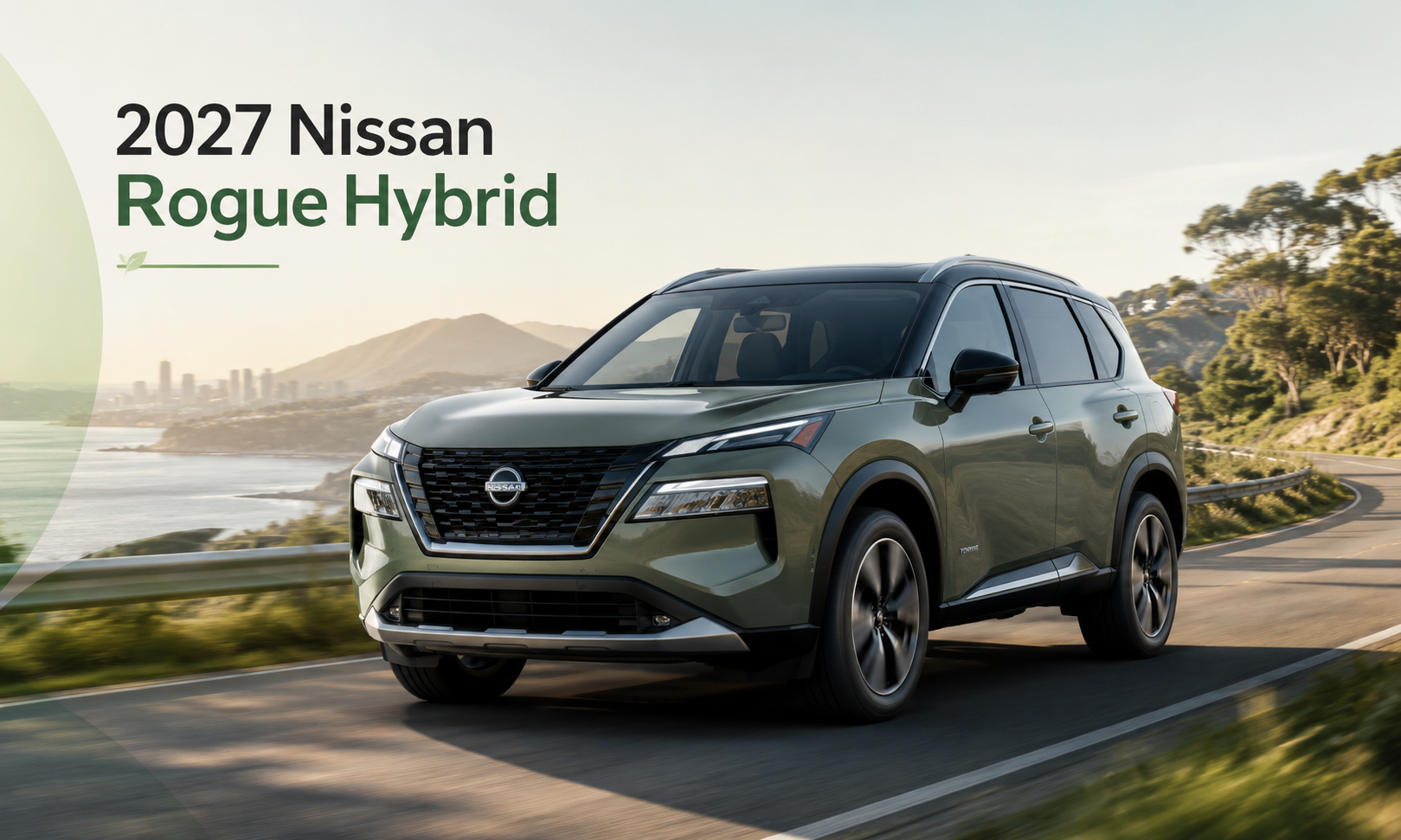

Prototype impressions, expected price, powertrain details, release timing, and buyer advice for the US market
Nissan is preparing one of the biggest changes in Rogue history. Its e-Power system uses a gasoline engine to generate electricity, while electric motors drive the wheels. The goal is EV-like response and smoothness without requiring owners to charge at home.
For shoppers comparing upcoming family SUVs, the 2027 Nissan Rogue Hybrid could be worth waiting for because it combines standard all-wheel drive, roughly 200 horsepower, one-pedal operation, and a fully redesigned body. Final fuel economy, trim pricing, cargo figures, and towing limits remain unconfirmed, so buyers should separate official facts from estimates.
| KEY TAKEAWAYS
· The all-new model is scheduled to reach US dealerships in late 2026 as a 2027 model. · Its e-Power system uses a turbocharged 1.5-liter three-cylinder engine as a generator, while two electric motors drive the wheels. · Standard Intelligent All-Wheel Drive, e-Pedal operation, and roughly 200 horsepower have been announced or previewed. · Car and Driver estimates pricing from about $40,000 to $54,000, but Nissan has not released final MSRP or trim details. · Prototype impressions suggest quiet acceleration and a refined ride, although final production testing is still needed. |
Confirmed Facts Versus Details Still Pending
Because journalists drove a prototype, some details are confirmed while others remain estimates. Buyers should not treat every early number as a final production specification.
| Item | Current Status | What Buyers Should Know |
| US arrival | Confirmed | Nissan says the vehicle is coming in late 2026. |
| Hybrid type | Confirmed | Third-generation e-Power series-hybrid system with no plug required. |
| Drivetrain | Confirmed | Standard Intelligent All-Wheel Drive using front and rear electric motors. |
| Gas engine | Confirmed | Turbocharged 1.5-liter three-cylinder used primarily to generate electricity. |
| Output | Preliminary | Prototype coverage points to approximately 200 horsepower. |
| Price | Estimated | Car and Driver projects a range of roughly $40,000 to $54,000. |
| EPA fuel economy | Not announced | Official city, highway, and combined ratings remain unavailable. |
| Cargo and towing | Not announced | Final dimensions and capability figures are still pending. |
Why e-Power Is Different From a Normal Hybrid
Most mainstream hybrids allow the gasoline engine to help drive the wheels. Nissan’s series-hybrid layout is different: the engine generates electricity, while the electric motors provide propulsion.
Electric motors deliver torque immediately, so acceleration should feel more linear in traffic and during low-speed merging. There is also no conventional transmission changing ratios between the engine and wheels.
Nissan’s official Rogue Hybrid preview confirms that no plug is required. Owners refuel with gasoline, while the engine and regenerative braking maintain the battery. This is different from the 2026 Rogue Plug-in Hybrid, which can use externally charged battery power.
Prototype Drive: What the Early Experience Revealed
The prototype reportedly responded quickly, remained quiet at ordinary speeds, and delivered a controlled ride. Those traits could address the delayed acceleration and engine noise found in some compact SUVs.
In its prototype drive report, Car and Driver described immediate acceleration, a hushed cabin, supportive seats, and a stable ride. Steering feedback was less engaging, suggesting the production SUV may prioritize comfort over sportiness.
The rear motor can also manage traction and distribute force between the axles. That may provide confident behavior in rain, snow, and changing road conditions.
e-Pedal and Smooth Stop Could Matter Every Day
e-Pedal increases regenerative braking when the driver lifts off the accelerator, and the prototype could come to a full stop without pressing the brake pedal. The conventional brake remains available, but one-pedal operation may reduce fatigue in traffic.
Smooth Stop programming manages the final portion of deceleration to reduce passenger head toss. That small refinement may matter to families and motion-sensitive passengers.
Expected Price and Likely Position in the Market
Final pricing has not been announced. A current estimate places the lineup at approximately $40,000 to $54,000. The entry model could cost more than some rivals, although standard AWD and added technology may narrow the equipment-adjusted difference.
Compare out-the-door pricing rather than MSRP alone. Destination charges, dealer add-ons, financing, insurance, wheel size, and included equipment can change the real cost significantly.
How It May Compare With Established Hybrid SUVs
Nissan will enter a segment filled with proven Honda, Toyota, Hyundai, Kia, Mazda, and Subaru hybrids. Its clearest advantage may be electric-like driving behavior rather than the highest MPG rating.
| Model Type | Main Strength | Possible Trade-Off |
| 2027 Rogue Hybrid e-Power | EV-like response, no plug, standard AWD | Unproven US-market system and pending EPA data |
| Honda CR-V Hybrid | Refined, spacious, and well established | Some trims can become expensive |
| Toyota RAV4 Hybrid | Strong efficiency and broad trim selection | High demand may affect transaction prices |
| Hyundai Tucson Hybrid | Feature value and responsive turbo hybrid | Driving feel is more conventional |
| Kia Sportage Hybrid | Roomy cabin and competitive equipment | Real-world economy can vary by trim |
| Mazda CX-50 Hybrid | Premium design and confident road manners | Less cargo-focused than some rivals |
The 2026 Plug-in Model and the 2027 e-Power Model Are Not the Same
The naming may confuse shoppers. The 2026 Rogue Plug-in Hybrid is related to the Mitsubishi Outlander PHEV and accepts external charging. The redesigned 2027 model uses Nissan’s own e-Power system and needs no charging cable.
A plug-in may suit owners with home charging and short commutes. The e-Power Rogue should be simpler for apartment residents and road-trip drivers because gasoline is the only energy source owners purchase directly.
Interior, Cargo Space, and Technology Expectations
Nissan has not released complete US interior specifications. Exact screen sizes, cargo measurements, seating dimensions, and trim materials remain pending, although the redesign should preserve the Rogue’s family-friendly layout.
The current Rogue offers useful storage and accessible rear seating. The redesign must retain those strengths while adding clear controls for e-Pedal, regenerative braking, energy flow, and driver assistance.
Shoppers researching broader options can also review our best hybrid SUVs for 2027 guide to compare passenger space, estimated pricing, drivetrain types, and likely fuel-economy priorities across the segment.
Fuel Economy: What Would Count as Competitive?
No official EPA rating is available. A competitive result would likely fall in the upper 30s or low 40s combined, depending on trim and wheel size. Standard AWD may make matching the most efficient front-drive rivals difficult.
City driving may favor the system because regenerative braking recovers energy frequently. Highway testing will be equally important because the engine must generate electricity at sustained speed.
Who Should Wait for the 2027 Rogue Hybrid?
- Drivers who want electric-style response but cannot or do not want to charge a vehicle.
- Buyers who consider standard all-wheel drive essential for snow, rain, or changing road conditions.
- Current Rogue owners who like the SUV’s practicality but want smoother acceleration and better efficiency.
- Families that value a quiet cabin and gentle low-speed braking more than sharp steering feedback.
Who May Be Better Buying an Established Rival Now?
- Anyone who needs a vehicle immediately rather than waiting until late 2026 inventory reaches dealers.
- Buyers who want a proven hybrid system with years of US reliability and resale data.
- Shoppers who need verified towing, cargo, child-seat, or accessibility measurements before purchasing.
- People who prefer engaging steering and sportier road manners over comfort-focused tuning.
A Practical Wait-or-Buy Decision Table
| Your Priority | Best Decision Right Now |
| Immediate purchase | Buy or test-drive a current CR-V, RAV4, Tucson, Sportage, CX-50, or Forester Hybrid. |
| EV-like driving without charging | Wait for the production Rogue Hybrid and compare it directly after launch. |
| Lowest verified fuel cost | Wait for official EPA numbers before placing a deposit. |
| Home charging and electric commuting | Consider a plug-in hybrid or full EV instead. |
| Snow-belt traction | The Rogue’s standard dual-motor AWD makes it worth monitoring. |
| Long-term reliability certainty | Wait for production testing or choose an established hybrid system. |
What to Check Before Signing a Purchase Agreement
During a test drive, listen for generator noise, evaluate the transition into regenerative braking, and confirm that e-Pedal feels natural. Include city traffic and a highway climb, not only a short dealership loop.
Compare rear-seat comfort, cargo-floor height, visibility, tire size, spare-tire provisions, and physical controls. Request a written out-the-door price that separates MSRP, destination, accessories, fees, taxes, and financing products. Our compact SUV buying checklist can help organize these checks before negotiating.
Frequently Asked Questions
Does the 2027 Rogue Hybrid need to be plugged in?
No. The e-Power system uses its gasoline engine to generate electricity for the battery and electric motors. Owners refuel it with gasoline and do not connect it to an external charger.
How much horsepower will it have?
Prototype information points to a combined output of approximately 200 horsepower. Nissan may publish a more precise production figure closer to launch.
Will all-wheel drive be standard?
Yes. Nissan says the US-market Rogue Hybrid will include Intelligent All-Wheel Drive with electric motors at the front and rear.
When will it go on sale?
Nissan says it is coming in late 2026 as a 2027 model. Exact dealer arrival dates may vary by region and trim availability.
How much will it cost?
Official MSRP has not been released. Current estimates suggest approximately $40,000 to $54,000, but buyers should wait for Nissan’s final trim and destination pricing.
Is it worth waiting for?
It may be worth waiting for shoppers who want standard AWD, no-plug convenience, and EV-like acceleration. Buyers who need a vehicle now or require verified efficiency and reliability data may be better served by an established rival.
Final Verdict
The Rogue Hybrid could give Nissan a distinctive position in the compact SUV market. Its e-Power layout promises smooth response, while gasoline refueling avoids the charging limitations that keep some households from choosing an EV.
Final price, EPA economy, cargo capacity, towing, equipment, and reliability will determine whether it is genuinely competitive. Shoppers who can wait should compare the production Nissan directly with the CR-V Hybrid, RAV4 Hybrid, and Tucson Hybrid after launch.