
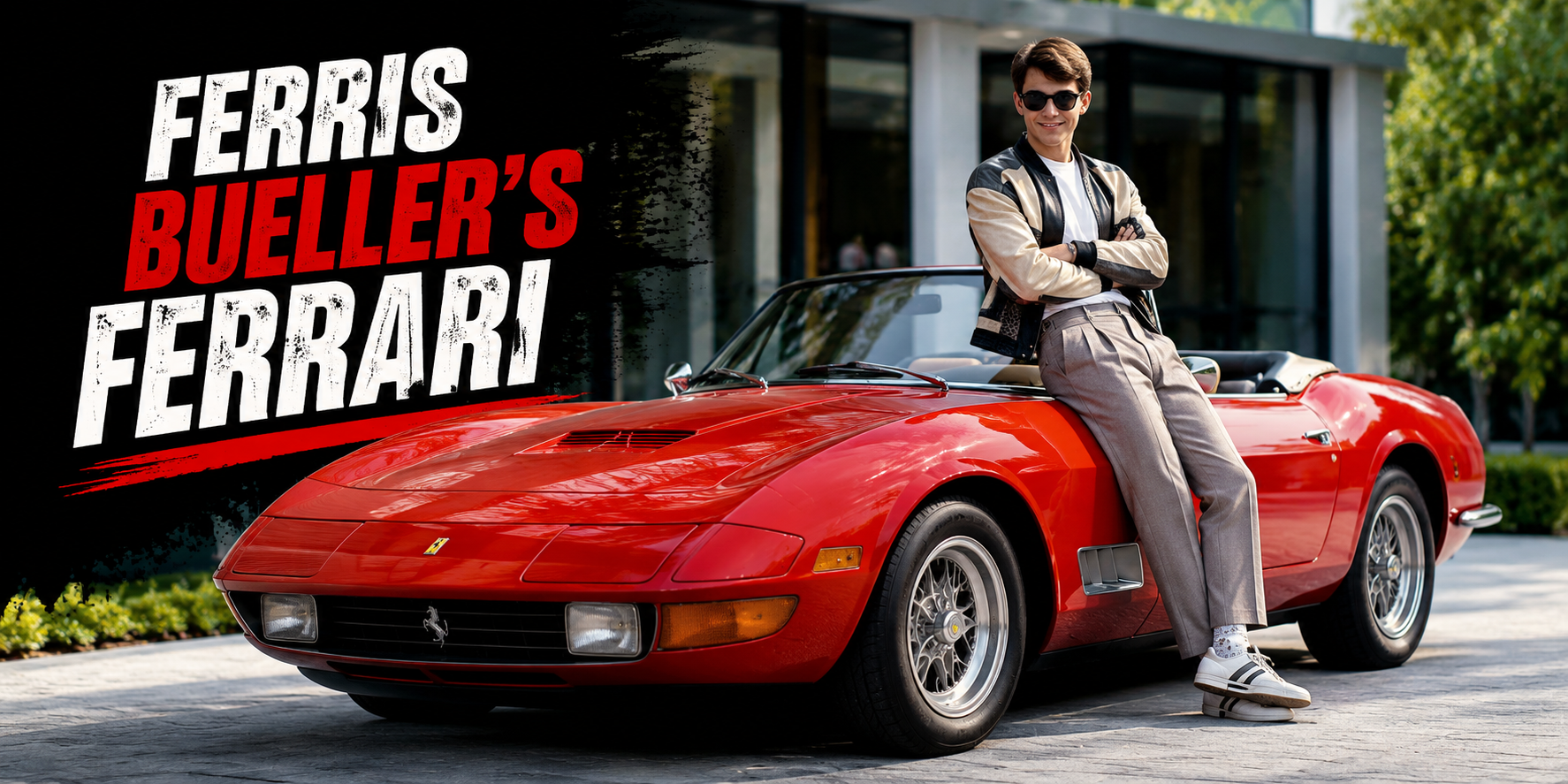

Why the famous red convertible was mostly a Modena replica, how several cars divided the filming work, and what happened to them after the garage scene
| Movie-car fact | What to know |
| Movie | Ferris Bueller’s Day Off, released June 11, 1986 |
| Car portrayed | 1961 Ferrari 250 GT California Spider |
| Main filming car | 1985 Modena Spyder California replica |
| Replica builders | Mark Goyette and Neil Glassmoyer of Modena Design & Development |
| Replica construction | Fiberglass body, custom frame, and a 302-cubic-inch V8 in the registered hero car |
| How many were used | Three Modena cars or shells served different filming jobs, plus a genuine Ferrari for selected close-ups |
| Famous license plate | NRVOUS |
| Historic status | One hero car is documented on the National Historic Vehicle Register |
| The short answer
The car viewers remember was presented as Cameron Frye’s father’s priceless Ferrari 250 GT California Spider, but most full-car and driving footage used purpose-built Modena replicas. A genuine California Spider was rented for carefully controlled close-ups. The car launched through the glass garage wall was a non-running shell, so an original Ferrari was never destroyed for the film. |
The Ferris Bueller Ferrari became one of cinema’s most recognizable cars because it was more than transportation. It represented freedom to Ferris, fear and family pressure to Cameron, and unimaginable financial value to Cameron’s father. The twist is that the red roadster seen racing around Chicago was usually not an authentic Ferrari at all.
That production decision made the movie possible. A real 250 GT California Spider was already rare and extremely valuable in the mid-1980s, making jumps, repeated takes, city driving, and a destructive finale too risky. The replicas gave the crew the right silhouette while allowing each car to be prepared for a specific job.
Car and Driver’s 40th-anniversary feature collects the production history behind the red convertible, including the early Porsche idea, the multiple filming cars, the Highland Park house, and the later auction results. Read the supplied Car and Driver movie-car history. The most important fact for viewers is that the production blended genuine Ferrari detail shots with convincing replicas rather than using one priceless original for every scene.
Was the Car in Ferris Bueller a Real Ferrari?
Yes and no. Within the story, the car is a 1961 Ferrari 250 GT California Spider. During production, a genuine California Spider was rented for selected close-up shots, particularly the carefully framed garage introduction that lets viewers study the badges, dashboard details, and bodywork.
For wide shots, road scenes, actor footage, jumps, and the final crash, the filmmakers relied on Modena Spyder California replicas. These cars were created to resemble the short-wheelbase Ferrari without exposing an original to stunt work. They used fiberglass bodywork and more conventional American mechanical parts, making them easier to operate, repair, and modify on a movie schedule.
| Feature | Genuine Ferrari 250 GT California Spider | 1985 Modena movie replica |
| Purpose | Rare Italian road and competition-inspired grand tourer | Film stand-in designed to reproduce the Ferrari look |
| Engine | Approximately 3.0-liter Ferrari V12 | 302-cubic-inch V8 in the registered hero car |
| Body | Hand-built Ferrari and Scaglietti construction | Fiberglass replica body on a custom frame |
| Film use | Selected close-ups under controlled conditions | Driving, actor, action, and stunt work |
| Risk level | Too valuable for destructive filming | Built so the production could repeat and modify scenes |
Why the Ferrari Replaced an Earlier Car Idea
Early versions of the screenplay reportedly gave Cameron’s father a black Porsche, and another concept involved a Mercedes. The Ferrari suggestion worked better for the story because the 250 GT California Spider immediately communicated rarity, beauty, and danger. Even viewers who knew little about cars could understand why Cameron was terrified to touch it.
The open-top shape also suited the movie visually. Ferris, Cameron, and Sloane could remain visible together while driving, Chicago landmarks stayed prominent in the frame, and the red body created a bright moving focal point against the city’s gray streets and modern architecture. The car therefore supported both character development and cinematography.
How Many Ferris Bueller Cars Were Used?
Accounts commonly describe three Modena vehicles or shells, although the labels used for them can differ. What matters is that the production did not ask one car to perform every task. A road-going hero car handled many complete-car shots, another vehicle supported actor and action work, and a non-running shell was prepared for the garage-window destruction.
| Production vehicle | Primary job | Why a separate car helped |
| Hero or driving car | Wide shots and regular road footage | Needed to look complete and operate reliably enough for repeated takes |
| Action or actor car | Interior footage and more demanding driving sequences | Could be reinforced or adapted around cameras and performers |
| Rolling shell | The backward launch through the glass garage wall | No engine or normal road equipment was needed for a one-time controlled stunt |
| Rented real Ferrari | Tight beauty shots and authentic details | Provided genuine Ferrari surfaces without exposing it to stunt risk |
The documented hero car is a 1985 Modena Spyder California. The National Historic Vehicle Register records a 302-cubic-inch V8, red exterior, tan interior, and the car’s connection to the movie. View the registered 1985 Modena Spyder California. Its preservation shows that a replica can become historically significant because of what it represented on screen, even though it did not leave the Ferrari factory.
How the Famous Garage Crash Was Filmed
The final garage sequence works because the movie builds anxiety around the car for nearly two hours. After Cameron attacks it in frustration, the car slips off the jack stands, rolls backward, breaks through the glass wall, and drops into the ravine. The image feels spontaneous, but the effect was carefully engineered.
The non-running shell was positioned on a concealed track. A cable and pulley system connected it to a vehicle outside the camera frame. When pulled, the shell accelerated backward through breakaway glass and into the ravine. The house’s original glass was removed and protected, and the production prepared the area so debris could be cleaned without permanently damaging the property.
| No real Ferrari was destroyed
The car that left the garage was a purpose-built shell without normal running gear. The stunt’s emotional impact came from the audience believing the car was priceless, not from the production sacrificing an authentic 250 GT California Spider. |
The Highland Park House Was Part of the Illusion
Cameron’s glass-walled garage was filmed at the Ben Rose House in Highland Park, Illinois. Its modernist pavilion projected wealth, precision, and emotional coldness, making it a perfect home for a car that seemed more important to Cameron’s father than his son. The cantilevered room above a ravine also created a finale that a conventional suburban garage could not deliver.
The architecture and car reinforce each other. The Ferrari replica looks like a museum object behind glass, and Cameron initially treats it that way. When the car finally breaks through the wall, the destruction becomes a visual rejection of the control and fear that have defined his relationship with his father.
Small Details That Made the Movie Car Memorable
- The NRVOUS license plate reflects Cameron’s anxiety as much as the car owner’s personality.
- Other plates in the film reference John Hughes projects, turning background cars into inside jokes.
- The open cabin keeps all three main characters visible during the Chicago drive.
- The red paint makes the car instantly recognizable in traffic and against modern architecture.
- The contrast between Cameron’s ordinary Alfa Romeo and his father’s exotic roadster establishes the Ferrari as forbidden property.
What Happened to the Movie Cars After Filming?
The replicas developed collector value because their movie history became more important than their lack of Ferrari identity. The hero car later sold at auction in 2010 for $108,251 and eventually entered the National Historic Vehicle Register. It has appeared in public displays, including exhibitions in Washington, D.C., and at The Henry Ford museum.
Another restored and modified Modena associated with the production sold for $396,000 at a 2020 Barrett-Jackson auction. Even the rebuilt display shell connected with the crash sequence sold for $337,500 in 2022. Those results show how provenance can transform a replica or prop into a valuable cultural artifact.
| Car or shell | Reported sale | Collector appeal |
| Registered hero car | $108,251 in 2010 | Driving history, screen use, and later national documentation |
| Restored production Modena | $396,000 in 2020 | Strong presentation and direct association with the movie |
| Rebuilt crash shell | $337,500 in 2022 | Connection to one of the film’s most famous scenes |
Why the Car Still Matters 40 Years Later
The roadster remains famous because the movie gives it a complete dramatic arc. It begins as an untouchable object, becomes the vehicle for a perfect day, creates constant fear about consequences, and ends as the trigger for Cameron’s decision to confront his father. Few movie cars are so closely tied to a character’s emotional transformation.
Its replica status has not weakened that legacy. In some ways, it makes the story more interesting. The Modena builders created an illusion convincing enough to shape how millions of viewers imagine the Ferrari 250 GT California Spider. The result is a movie prop that earned its own place in American automotive history.
Frequently Asked Questions
What Ferrari was in Ferris Bueller’s Day Off?
The story identifies the car as a 1961 Ferrari 250 GT California Spider. Most filming used 1985 Modena Spyder California replicas, with a genuine Ferrari used for selected close-ups.
Was the Ferrari that crashed real?
No. The car sent through the garage window was a non-running replica shell prepared for the stunt.
What engine was in the movie replica?
The hero car documented on the National Historic Vehicle Register has a 302-cubic-inch V8 rather than a Ferrari V12.
How many movie cars were made?
Most accounts describe three Modena cars or shells serving different production purposes, plus a rented genuine California Spider for detail shots.
Where is the hero car now?
The documented hero car is preserved on the National Historic Vehicle Register and has appeared in museum and public exhibitions.
How much is a Ferris Bueller movie car worth?
Auction results have ranged from roughly $108,000 to nearly $400,000 depending on which production car or shell was offered, its condition, and its documentation.
Final Takeaway
The famous convertible in Ferris Bueller’s Day Off was a clever mixture of authentic Ferrari imagery and practical movie engineering. A real 250 GT California Spider supplied the close-up credibility, while Modena replicas handled the scenes that required movement, modification, or destruction.
That combination protected an irreplaceable classic and created a screen car with a legacy of its own. The replica did not need a Ferrari badge from Maranello to become priceless in the eyes of movie fans. Its value came from the role it played in one of the most memorable days off in film history.