
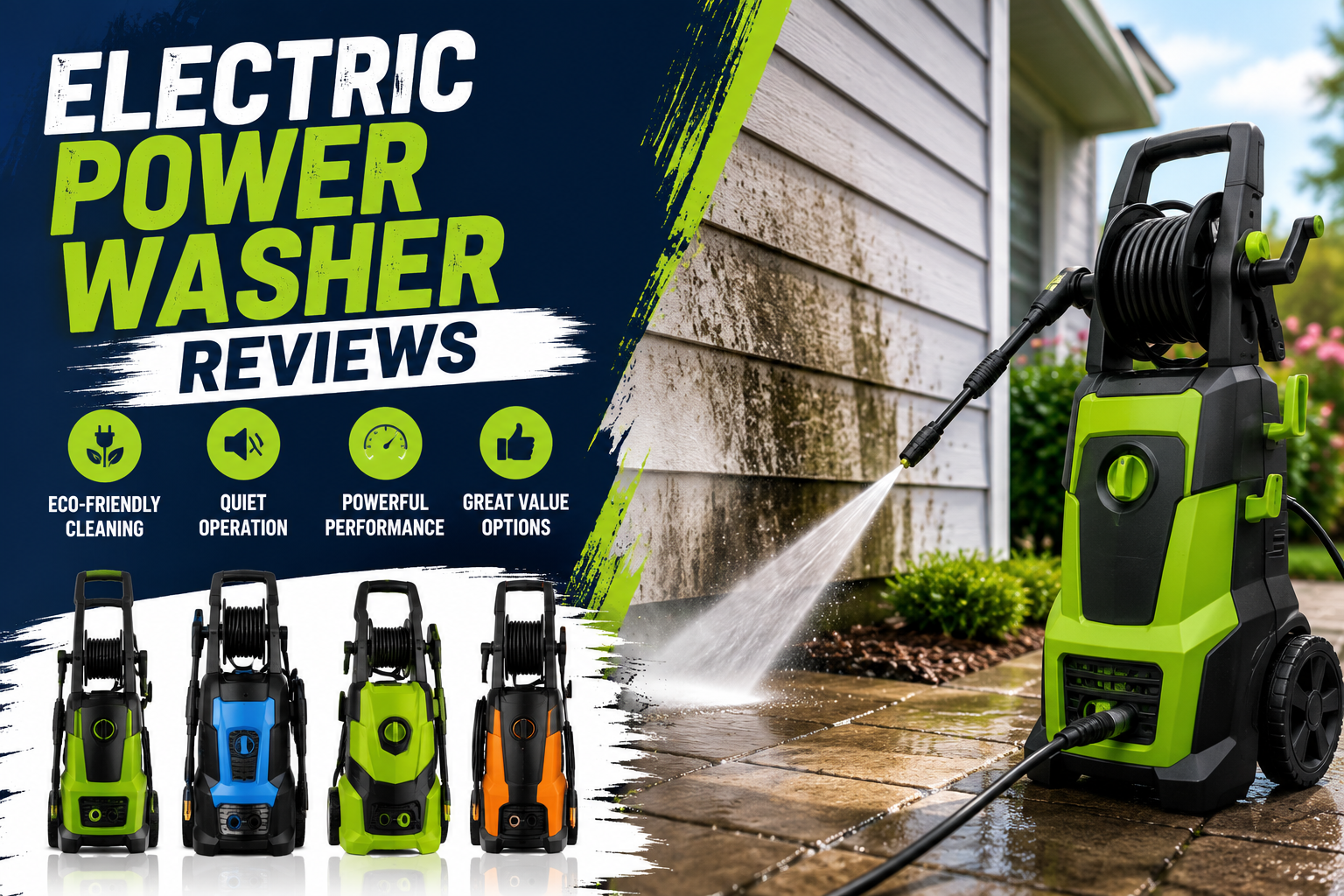

A job-matching guide for choosing the right electric pressure washer in the United States
Electric pressure washers are easier to start, quieter, and simpler to maintain than gas machines, but they are not interchangeable. A compact unit that feels ideal beside a car may take too long on a stained driveway, while a 3,000-PSI model can be unnecessarily aggressive for paint, trim, and delicate wood. The best choice depends on the surface, the size of the job, available storage, and how much setup you are willing to manage.
These electric power washer reviews compare models by the work they perform best, not simply by the largest number printed on the box. For most households, a balanced 1,700-to-2,100-PSI corded model is the practical sweet spot. Heavy concrete cleaning may justify a larger brushless machine, while vehicle detailing rewards controlled pressure, useful nozzles, quiet operation, and a hose that does not fight the user.
| Key Takeaways
· The Craftsman CMEPW2100 offers the strongest all-around balance for cars and routine household cleaning. · The Ryobi 1900 PSI is the easiest recommendation for small garages, apartments, and light-duty users who value compact storage. · The Greenworks Pro 3000 is the best fit for driveways, brick, siding, and larger residential jobs, but it is heavier and too aggressive for careless car washing. · The Chemical Guys ProFlow PM2000 is tuned more toward vehicle detailing than heavy property cleaning. · Tested pressure and flow matter more than advertised maximums because nozzle choice, water supply, hose length, and measurement methods affect real output. |
Best Electric Power Washers at a Glance
| Model | Best For | Stated Output | Tested Character | Main Tradeoff |
| Craftsman CMEPW2100 | Best overall | 2,100 PSI / 1.2 GPM | Strong, controlled, quiet | Not intended for the toughest concrete restoration |
| Ryobi 1900 PSI | Best compact | 1,900 PSI / 1.2 GPM | Useful power in a small frame | Fewer nozzle choices and awkward cord storage |
| Greenworks Pro 3000 | Best heavy-duty electric | 3,000 PSI max / up to 2.0 GPM | Near gas-like residential cleaning | Heavy, costly, and excessive for delicate surfaces |
| Chemical Guys ProFlow PM2000 | Best for car detailing | 2,030 PSI / 1.77 GPM | Gentle, portable, foam-cannon friendly | Underpowered for stubborn masonry stains |
| Westinghouse ePX3500 | Best maneuverability | 2,500 max PSI / 1.76 max GPM | Stable, compact, easy to follow | Assembly takes time |
| Sun Joe SPX3000 | Best familiar budget option | 2,030 PSI / 1.76 GPM | Quiet and easy for light work | Real pressure is less impressive than the label suggests |
How This Review Approaches the Category
A useful pressure-washer review should look beyond the claimed PSI. We considered tested pressure, measured water flow, noise, weight, nozzle selection, hose and cord management, stability, storage, and whether the machine suits the task it is marketed to perform. Car and Driver’s hands-on pressure-washer testing is especially useful because it records output at individual nozzle settings rather than accepting the maximum label claim at face value.
The rankings below are editorial recommendations, not a claim that every homeowner needs the same machine. Product availability and retail prices change, and buyers should verify the exact model number before ordering because manufacturers often sell several visually similar pressure washers with different pumps, hoses, and rated outputs.
1. Craftsman CMEPW2100: Best Overall for Most Homes
The Craftsman CMEPW2100 is the most balanced choice for a buyer who wants one machine for washing vehicles, rinsing patio furniture, cleaning fences, refreshing small decks, and handling routine sidewalk dirt. Its stated 2,100 PSI and 1.2 GPM place it in a useful middle zone where it has enough force to be productive without feeling like a concrete-only tool.
In instrumented testing, the 15-degree nozzle produced substantially more usable pressure than the turbo setting, a reminder that the most aggressive-looking accessory is not always the most effective. The unit also earned praise for low noise, manageable 28-pound weight, a comfortable sprayer, and onboard storage that keeps the wand and attachments from becoming a garage-floor pile.
Choose it when your cleaning list includes both vehicles and household surfaces. Skip it when your main goal is removing years of embedded grime from a large concrete driveway, where a higher-flow heavy-duty electric or gas washer will finish faster.
2. Ryobi 1900 PSI: Best Compact Electric Pressure Washer
The Ryobi 1900 PSI is the storage-first choice. At about 20 pounds, it is easier to lift onto a shelf, move through a narrow side yard, or carry between the garage and backyard than a full hand-truck-style washer. Its tested output is useful for cars, outdoor furniture, grills, trash cans, small patios, and quick maintenance cleaning.
The compromise is versatility. The compact format provides fewer conventional spray-tip options, and the cord and hose can be less tidy than the machine itself. It is not the best selection for a homeowner planning to run a large surface cleaner across a long driveway every spring. It is a better fit for frequent, shorter jobs where easy setup matters more than maximum speed.
3. Greenworks Pro 3000: Best Heavy-Duty Electric Model
The Greenworks Pro 3000 is for buyers who want electric convenience without accepting light-duty performance. It is appropriate for broad concrete areas, brick, siding, fences, and badly weathered outdoor surfaces. The brushless motor, steel frame, large wheels, multiple nozzles, and one-gallon detergent tank make it feel closer to serious outdoor power equipment than a compact car-wash accessory.
Greenworks lists a 3,000-PSI maximum, 1.1 GPM at maximum pressure, and up to 2.0 GPM at low pressure. The company also specifies a 35-foot GFCI-protected power cord, 25-foot steel-braided hose, vertical storage, and a 10-year brushless-motor warranty. The official Greenworks Pro 3000 product page provides the current configuration and warranty details.
Power is only an advantage when the operator controls it. A narrow tip held too close can mark wood, strip loose paint, damage mortar, or harm a vehicle finish. The Greenworks is also heavy and expensive compared with mainstream corded models. Buy it for repeated property cleaning, not because the largest PSI number automatically sounds best.
4. Chemical Guys ProFlow PM2000: Best for Car Detailing
The Chemical Guys ProFlow PM2000 is built around the workflow of washing a car. It is light, compact, relatively quiet, and easier to pair with detailing accessories than a bulky residential machine. The included organizer improves control of the hose, wand, cord, and nozzles, while the pressure level is less intimidating around paint, badges, rubber seals, and exterior trim.
Its limitation becomes obvious outside the detailing lane. Tested output is moderate, so it may require more passes on concrete, old mildew, and thick mud. This is the model to choose when the primary goal is a convenient foam-and-rinse setup for cars, motorcycles, or recreational vehicles. It is not the best value for a homeowner whose main project is a neglected driveway.
5. Westinghouse ePX3500: Best for Maneuverability and Storage
The Westinghouse ePX3500 uses a low, four-wheel design instead of the common two-wheel hand-truck layout. That shape helps it follow the operator around a vehicle or patio without tipping every time the hose changes direction. It is compact, relatively light, and includes onboard locations for the wand and accessories.
Westinghouse rates the machine at 2,500 max PSI and 1.76 max GPM, with lower rated working figures. That distinction matters because maximum PSI and maximum GPM are often achieved under different operating conditions. Real-world testing places the ePX3500 in a car-friendly and light-to-moderate household range rather than the heavy-duty class suggested by the largest label numbers.
The main drawback is assembly. Once built, it is one of the easier corded machines to move and store. It is a sensible alternative for buyers who dislike tall washers that tip when pulled by the hose.
6. Sun Joe SPX3000: Easy to Use, but No Longer the Automatic Default
The Sun Joe SPX3000 remains familiar because it has been widely sold for years. It offers several nozzle choices, quiet operation, and enough cleaning ability for cars, outdoor furniture, grills, and lighter patio work. Replacement accessories are also easy to find.
However, its tested pressure does not separate it from newer compact competitors, and buyers should not assume bestseller status means class-leading performance. Consider it when the sale price is attractive and the intended jobs are light. At a similar price to a better-organized or stronger model, the Sun Joe becomes harder to recommend.
What About Cordless Power Washers?
Cordless units such as the Worx Hydroshot are useful when no outlet or pressurized hose is nearby. They can pull water from a bucket and are convenient for rinsing bicycles, camping gear, muddy boots, boats, and small vehicle sections. Their mobility is real, but their output and runtime generally do not replace a 120-volt pressure washer for full cars, patios, siding, or driveways.
Treat a cordless washer as a portable specialty cleaner. Buyers who expect corded-machine speed may be disappointed, especially when two batteries are required and the tool becomes tiring to hold during extended use.
Why PSI Alone Can Mislead Buyers
PSI describes pressure, while GPM describes water volume. Pressure helps break the bond between dirt and a surface, but flow carries the loosened material away. A machine with a high peak PSI and low flow may clean a narrow strip aggressively yet take longer across a broad area than a better-balanced model.
The nozzle also changes output. A 15-degree tip concentrates force, a 25- or 40-degree tip spreads it across a safer area, and a soap nozzle operates at low pressure. Water-supply restrictions, long hoses, small extension cords, dirty inlet screens, and voltage drop can reduce performance. Our pressure washer PSI guide explains how to match nozzle angle and working pressure to common surfaces.
| Cleaning Job | Suggested Class | Recommended Spray Approach | What to Avoid |
| Cars and motorcycles | 1,300 to 2,100 PSI electric | 25° or 40° tip, maintain distance | 0° tip, close-range blasting, damaged paint |
| Patio furniture and grills | 1,500 to 2,100 PSI electric | Wide fan tip and detergent where approved | Direct spray into electrical parts or bearings |
| Wood decks and fences | 1,500 to 2,300 PSI with care | 25° or 40° tip, test an inconspicuous area | Turbo tip held close, spraying with the grain ignored |
| Driveways and pavers | 2,000 to 3,000 PSI electric | 15° or surface-cleaner attachment | Lingering in one spot or damaging loose joints |
| Brick and siding | 2,000 to 3,000 PSI depending on condition | Start wide and increase only as needed | Forcing water behind siding or into weak mortar |
How to Choose the Right Model
Start With the Hardest Regular Job
Do not size the machine for a project you might attempt once in five years. Choose it for the hardest task you expect to perform regularly. A car owner with a small patio needs a different tool than a homeowner who cleans 1,500 square feet of concrete every season.
Check Hose, Cord, and Storage Design
A powerful washer becomes frustrating when its hose kinks, the cord has nowhere to go, or the unit tips when pulled. A longer high-pressure hose often improves the experience more than another 200 PSI because it allows the machine to remain stationary while the operator moves around the work area.
Look for Standard Quick-Connect Fittings
Standard quarter-inch nozzle connections make it easier to replace tips and add foam cannons or surface cleaners. Proprietary fittings can limit accessory choices and raise replacement costs.
Consider the Electrical Setup
Use a properly grounded outlet and the manufacturer-specified extension-cord gauge, if an extension is permitted. Undersized cords can cause voltage drop, heat, and weak performance. A built-in GFCI on the power cord is an important safety feature around water.
| Safety Note
Never point a pressure-washer stream at people or animals. High-pressure water can penetrate skin, and the injury may appear smaller than the underlying tissue damage. Wear eye protection, closed shoes, and hearing protection when appropriate. Disconnect power before clearing a nozzle or servicing the unit. Check the exact model and serial number against current safety recalls before first use. |
Using an Electric Pressure Washer Without Damaging Surfaces
Begin with the widest suitable nozzle and stand farther away than you think necessary. Start the spray on a test area, then move closer gradually. Keep the wand moving in overlapping passes. For siding, spray downward or level rather than forcing water upward behind panels. For wood, follow the grain and stop if fibers begin to raise.
On concrete, pre-treat oil or organic staining when appropriate and let detergent dwell according to its label, but do not allow it to dry. A surface-cleaner attachment can create more even results than freehand wand passes. Review our step-by-step driveway pressure-washing guide before using a narrow nozzle on large concrete areas.
Which Electric Power Washer Should You Buy?
| Buyer Type | Best Match | Why |
| One machine for cars and general home cleaning | Craftsman CMEPW2100 | The best balance of controlled pressure, portability, noise, and accessory storage |
| Small storage space or frequent quick jobs | Ryobi 1900 PSI | Compact, light, and productive enough for routine maintenance |
| Large driveways, brick, and demanding exterior cleaning | Greenworks Pro 3000 | The strongest electric option in this group with heavy-duty hardware |
| Enthusiast car detailing | Chemical Guys ProFlow PM2000 | Portable design and pressure better aligned with paint-safe washing |
| Buyer who hates tipping machines | Westinghouse ePX3500 | Low four-wheel platform follows the operator and stores compactly |
| Occasional light cleaning at a steep discount | Sun Joe SPX3000 | Easy operation and broad accessory availability, provided the price is right |
Frequently Asked Questions
Is an electric pressure washer powerful enough for a driveway?
Yes, a strong 2,000-to-3,000-PSI electric model can clean a residential driveway, especially with a compatible surface cleaner. Large areas or deeply embedded stains may take longer than with a gas washer because electric machines often deliver less sustained flow.
What PSI is safe for washing a car?
Most vehicle cleaning should use a controlled electric washer, a wide 25- or 40-degree nozzle, reasonable distance, and careful technique. The condition of the paint matters more than a single universal PSI limit. Avoid narrow tips, damaged paint edges, seals, sensors, and direct close-range spraying.
Are electric pressure washers quieter than gas models?
Generally, yes. Electric motors eliminate engine exhaust and usually produce less noise, although pumps, water impact, and some compact motors can still be loud enough to justify hearing protection during long sessions.
Does higher GPM clean faster?
Higher flow usually rinses loosened dirt faster and improves productivity across large areas. The best performance comes from a useful combination of pressure and flow, not the highest value for only one measurement.
Can I use an extension cord?
Only when the manufacturer permits it. Use the required outdoor-rated cord gauge and keep electrical connections away from standing water. A long, thin extension cord can reduce voltage and overheat.
How long should an electric pressure washer last?
Service life depends on pump design, water quality, storage, freeze protection, duty cycle, and whether the operator runs the machine without water. Draining the unit, protecting it from freezing, cleaning the inlet screen, and following the manual improve longevity.
Is a cordless pressure washer worth it?
It is worthwhile for portable rinsing and locations without outlets, but it is usually not a direct replacement for a corded model. Buyers should expect lower pressure, shorter runtime, and slower work on large surfaces.
Final Verdict
The Craftsman CMEPW2100 is the best overall recommendation because it covers the broadest range of ordinary household and vehicle-cleaning jobs without becoming difficult to store or overly aggressive. The Ryobi 1900 PSI is better when compactness matters most, while the Greenworks Pro 3000 is the clear step-up for repeated heavy residential cleaning. Car-detailing buyers should consider the Chemical Guys ProFlow PM2000, and the Westinghouse ePX3500 is a smart choice for users who prioritize stability and maneuverability.
The best purchase is not necessarily the washer with the highest advertised pressure. It is the model that delivers enough tested output, offers the right nozzles, reaches the work area easily, stores without frustration, and gives the operator enough control to clean without causing damage.