
A trim-focused guide to pricing, features, performance, comfort, fuel economy, packages, and everyday value for US compact-car shoppers
The redesigned Sentra enters 2026 with sharper styling, a more modern cabin, larger screens, and a stronger standard safety package. Nissan did not transform it into a performance sedan, but it did make the compact car feel more mature and more competitive for buyers who care about comfort, technology, and manageable monthly costs.
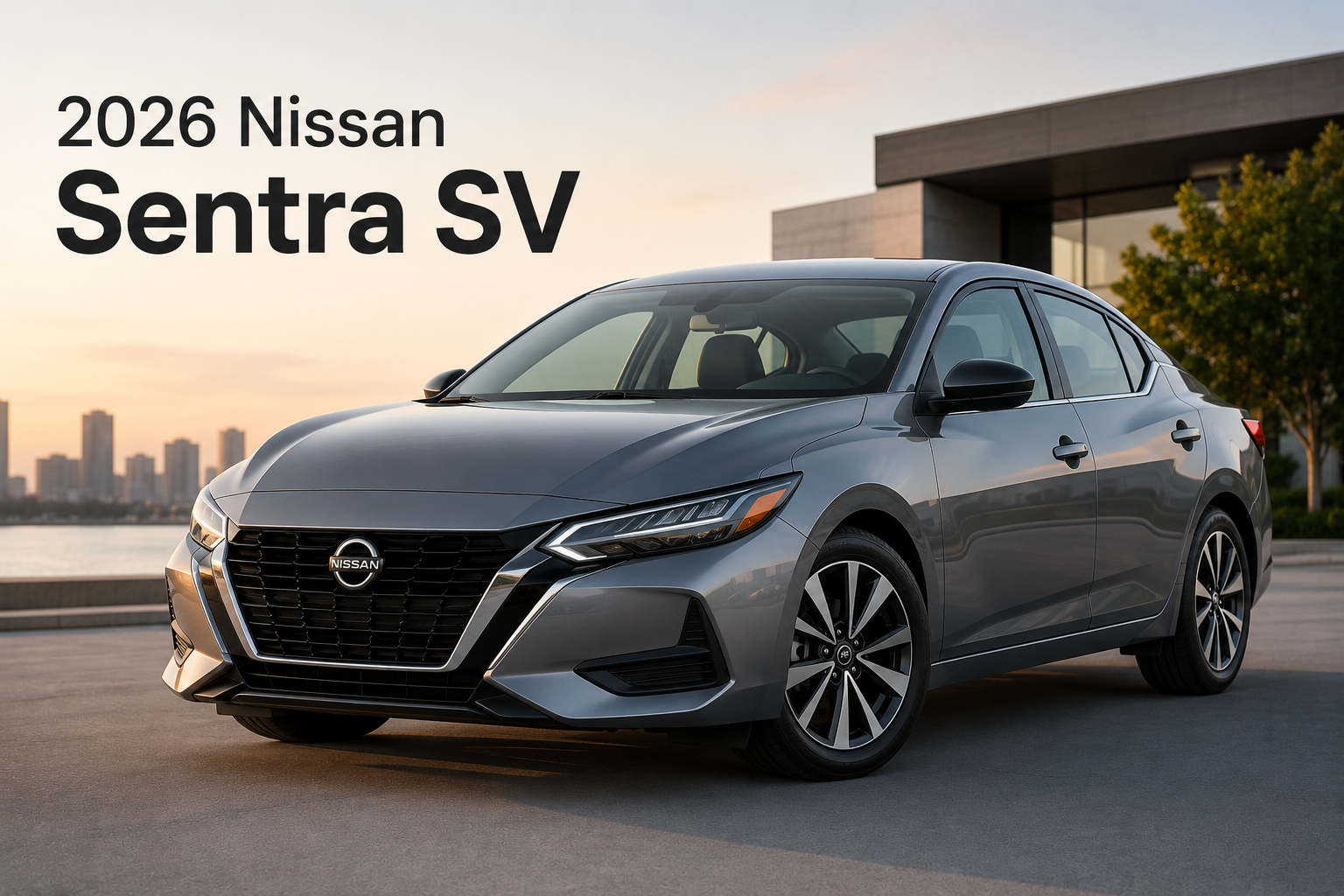
For many shoppers, the 2026 Nissan Sentra SV is the most interesting version because it sits only one step above the base S while adding several features people use every day. This review examines whether the SV really delivers the best balance of price and equipment, or whether buyers should save money with the S or move up to the sportier SR.
| KEY TAKEAWAYS
· The Sentra SV starts at $23,370 before the $1,245 destination charge, making it only $770 more than the base S. · Every 2026 Sentra uses a 149-hp 2.0-liter four-cylinder engine, a CVT, and front-wheel drive. · The SV adds 16-inch alloy wheels, a 12.3-inch digital driver display, remote start, wireless smartphone integration, and access to useful convenience and moonroof packages. · Its strongest qualities are value, ride comfort, cabin technology, fuel economy, and standard driver-assistance features. · Its biggest weakness is modest acceleration, especially when merging, passing, or carrying several passengers. |
2026 Nissan Sentra SV at a Glance
| Category | 2026 Sentra SV Details |
| Starting MSRP | $23,370 before destination |
| Price with destination | $24,615 before options, tax, and dealer charges |
| Engine | 2.0-liter naturally aspirated four-cylinder |
| Output | 149 hp and 146 lb-ft of torque |
| Transmission | Xtronic continuously variable automatic transmission |
| Drivetrain | Front-wheel drive only |
| EPA fuel economy | 30 mpg city, 38 mpg highway, 33 mpg combined |
| Passenger capacity | Five |
| Trunk space | 14.3 cubic feet |
| Warranty | 3 years/36,000 miles basic; 5 years/60,000 miles powertrain |
How Much Does the 2026 Sentra SV Cost?
Nissan prices the SV at $23,370 before destination. Adding the $1,245 destination charge brings the basic delivered price to $24,615 before tax, registration, dealer-installed accessories, and finance costs. The base S begins at $22,600, so the jump to SV is a relatively modest $770 before destination.
The official Nissan trim sheet confirms the SV price and shows that the trim retains the more efficient 30/38/33 mpg city/highway/combined rating. It also lists the SV-specific upgrades and available packages, making the Nissan Sentra specifications page the best place to verify equipment before purchasing because package content and inventory can vary by vehicle.
For buyers comparing several affordable sedans, a broader compact sedan buying guide can help put the Sentra’s price, fuel economy, warranty, and powertrain into context against the Honda Civic, Toyota Corolla, Hyundai Elantra, Kia K4, and Volkswagen Jetta.
Sentra S vs. SV vs. SR vs. SL
| Trim | Starting MSRP | What It Adds | Best For |
| S | $22,600 | Steel wheels, 7-inch driver display, basic keyless entry | Lowest purchase price |
| SV | $23,370 | Alloy wheels, 12.3-inch driver display, remote start, broader package access | Best overall value |
| SR | $25,000 | Sport styling, 18-inch wheels, more aggressive appearance | Buyers who prioritize design |
| SL | $27,990 | Quilted seating, Bose audio, moonroof, ProPILOT Assist, premium comfort features | Near-luxury equipment |
What Does the SV Add Over the Base S?
The SV’s appeal is not based on one dramatic feature. Its value comes from several smaller upgrades that make the car easier and more pleasant to live with. The 16-inch alloy wheels look more finished than the S model’s steel wheels and covers, while the 12.3-inch digital gauge display gives the cockpit a much more modern presentation.
Remote engine start is standard on the SV, and wireless Apple CarPlay and Android Auto reduce cable clutter. The SV also gives buyers access to optional equipment that is unavailable on the S, including wireless phone charging, heated exterior mirrors, mirror-mounted turn signals, upgraded audio, and a power moonroof, depending on the package selected.
These differences make the SV easier to recommend to commuters and first-time new-car buyers. Someone preparing to finance a vehicle may also benefit from a first-time car buyer checklist that covers out-the-door pricing, loan terms, insurance quotes, dealer add-ons, and the importance of comparing total cost rather than monthly payment alone.
Engine and Performance: Adequate, Not Exciting
Every 2026 Sentra uses a 2.0-liter four-cylinder engine producing 149 horsepower and 146 lb-ft of torque. Power goes through a continuously variable automatic transmission to the front wheels. There is no turbocharged engine, hybrid system, manual transmission, or all-wheel-drive option.
Around town, the powertrain is sufficient for ordinary errands and commuting. The revised CVT tuning aims to make acceleration feel smoother and more natural, and the SV includes a Sport drive mode that sharpens response. Even so, drivers should not expect strong passing power. The Sentra needs planning when entering a fast highway or overtaking on a two-lane road.
Car and Driver praised the redesigned model’s composed ride and tighter handling but continued to criticize the weak engine. Its full 2026 Nissan Sentra review also notes that tested Sentra trims remained near the back of the compact-car class for acceleration, even though chassis revisions improved the way the car feels through turns and over uneven pavement.
Ride Quality and Daily Driving
The SV’s 16-inch wheels may be a practical advantage. They provide more tire sidewall than the SR’s 18-inch setup, which can help absorb potholes and sharp road edges. Replacement tires may also be less expensive. For buyers who spend most of their time commuting, carrying family members, or driving on imperfect city streets, the SV’s calmer setup may be preferable to the sportier-looking SR.
Nissan says the body structure is six percent stiffer than before, and the car receives revised dampers and a larger steering damper. These changes do not turn the Sentra into a sports sedan, but they help create a stable, controlled feel. The steering is light enough for parking and urban driving, while the suspension prioritizes predictability over excitement.
Fuel Economy and Expected Driving Range
The SV is rated at 30 mpg in the city, 38 mpg on the highway, and 33 mpg combined. Its 12.41-gallon fuel tank suggests a theoretical combined range of roughly 410 miles, although real-world range will vary with traffic, weather, speed, cargo, tire pressure, and driving habits.
The Sentra cannot match the fuel savings of a hybrid Corolla or Civic Hybrid, but its lower starting price may offset some of that difference for drivers with moderate annual mileage. Buyers should estimate their own fuel use over several years instead of choosing solely by the highest mpg figure.
Interior, Screens, and Everyday Comfort
The 2026 redesign gives the Sentra a cleaner, more upscale dashboard. A 12.3-inch infotainment touchscreen is standard across the range, while the SV adds a matching 12.3-inch digital instrument display. Together, the screens create the visual impression of a continuous dual-display panel, which helps the SV feel more expensive than its price suggests.
Wireless Apple CarPlay and Android Auto are especially valuable in a commuter car because drivers can leave the phone in a pocket or bag. Three USB-C ports are standard, and wireless charging is available through the SV Convenience Package. Nissan retains steering-wheel buttons and direct climate-control access, reducing the need to navigate the screen for basic tasks.
Passenger space remains competitive for a compact sedan. Front occupants get 44 inches of legroom, while rear passengers receive 34.8 inches. Two adults should fit comfortably in the back for normal trips, although the center rear position is better suited to occasional use. Nissan’s Zero Gravity seat design aims to reduce pressure points during longer drives.
Cargo Space and Practicality
The trunk provides 14.3 cubic feet of space, which is useful for groceries, luggage, backpacks, and everyday family needs. A wide opening and folding rear seatbacks improve flexibility. The Sentra is still a sedan, so buyers who frequently carry tall furniture, bicycles, large pets, or bulky outdoor gear may prefer a hatchback or small crossover.
Safety and Driver-Assistance Features
The 2026 Sentra includes a substantial standard driver-assistance package. Features include automatic emergency braking with pedestrian detection, forward collision warning, rear cross-traffic alert, lane-departure warning and prevention, blind-spot intervention, adaptive cruise control, high-beam assist, traffic-sign recognition, and driver-attention monitoring.
The SV uses Intelligent Cruise Control rather than the more advanced ProPILOT Assist system fitted to the SL or offered through certain higher-trim packages. Buyers who spend hours in stop-and-go highway traffic may value ProPILOT’s lane-centering and expanded speed-control functions, but the SV’s standard adaptive cruise control still provides meaningful convenience for its price.
Which SV Packages Are Worth Considering?
| Package or Option | Typical Content | Who May Value It | Watch For |
| Convenience Package | Wireless charging, heated mirrors, turn-signal indicators, upgraded audio and related convenience items | Cold-climate commuters and tech-focused buyers | Confirm the exact window sticker because content may vary |
| Moonroof Package | Power sliding glass moonroof and manual sunshade | Buyers who want more light and an airier cabin | Reduces value advantage if heavily optioned |
| Dealer accessories | Floor mats, protection packages, appearance items | Owners who need specific accessories | Dealer pricing can be higher than aftermarket alternatives |
The SV is most compelling when kept close to its base price. Adding every available package can push it toward the SR or even the better-equipped SL. Before signing, compare the exact out-the-door price of an optioned SV with an in-stock higher trim. A small MSRP difference can disappear after dealer discounts, financing incentives, or installed accessories.
What the Sentra SV Does Well
- Strong feature value for a compact sedan priced below $25,000 before destination and options.
- Modern 12.3-inch infotainment and digital gauge displays.
- Comfortable ride with practical 16-inch wheels and tires.
- Good fuel economy without requiring a hybrid price premium.
- Useful standard safety and adaptive-cruise technology.
- Competitive rear-seat room and a 14.3-cubic-foot trunk.
- Simple trim positioning that makes it easy to understand what the extra money buys.
Where the Sentra SV Falls Short
- The 149-hp engine feels slow compared with stronger compact cars.
- No hybrid, turbocharged, manual-transmission, or all-wheel-drive option.
- Some desirable features remain locked in option packages or higher trims.
- Nissan’s warranty coverage is less generous than Hyundai and Kia coverage.
- No complimentary scheduled maintenance is included.
- Touch-sensitive dashboard controls may be less intuitive than traditional buttons for some drivers.
Should You Buy the 2026 Nissan Sentra SV?
The SV is the strongest choice for buyers who want a new compact sedan with modern screens, good fuel economy, a comfortable ride, and a broad safety package without moving far beyond the base price. The $770 trim upgrade over the S buys features that can improve daily ownership, especially the digital gauge cluster, alloy wheels, remote start, and expanded option availability.
Choose the S if the lowest possible price matters more than appearance and convenience. Choose the SR if sporty styling is a priority, but remember that it does not provide more horsepower. Choose the SL if you want a moonroof, premium seating, Bose audio, ProPILOT Assist, and a more luxurious cabin without assembling packages.
The SV is less suitable for drivers who expect quick acceleration or want a hybrid. A Honda Civic, Volkswagen Jetta, Mazda3, or hybrid Toyota Corolla may better serve those priorities. For shoppers focused on value and comfort, however, the Sentra SV is a sensible middle trim that avoids both the base car’s plainness and the upper trims’ higher cost.
Frequently Asked Questions
How much is the 2026 Nissan Sentra SV?
The starting MSRP is $23,370. Adding Nissan’s $1,245 destination charge brings the base delivered price to $24,615 before tax, registration, options, accessories, and dealer fees.
Does the 2026 Sentra SV have all-wheel drive?
No. Every 2026 Sentra is front-wheel drive.
Does the Sentra SV have a turbo engine?
No. It uses a naturally aspirated 2.0-liter four-cylinder engine with 149 horsepower and 146 lb-ft of torque.
Does the 2026 Sentra SV have wireless Apple CarPlay?
Yes. Nissan lists wireless Apple CarPlay and wireless Android Auto for the SV.
Does the Sentra SV have remote start?
Yes. Keyfob remote start is standard on the SV.
Is the Sentra SV faster than the S?
The trims share the same engine and transmission. Sport mode can change response, but the SV does not receive additional horsepower.
Is the 2026 Sentra SV a good first car?
It can be a strong first new car because of its manageable price, fuel economy, safety technology, warranty, and easy driving manners. Buyers should still compare insurance and financing costs.
Is the SV better than the SR?
The SV is usually the better value. The SR mainly adds sportier styling and larger wheels, while using the same powertrain. The SR may appeal more to buyers who prioritize appearance and available premium options.
Final Verdict
The 2026 Sentra SV succeeds because it concentrates on the features most value-conscious buyers notice every day. It looks and feels substantially more modern than the previous generation, and its small price premium over the S is easy to justify. It is not fast, adventurous, or mechanically innovative, but it is comfortable, efficient, well equipped, and attractively priced.
For US shoppers who want an affordable new sedan and can accept modest performance, the SV is likely the sweet spot of the 2026 Sentra lineup. The smartest purchase is a lightly optioned SV with a competitive out-the-door price, rather than a heavily accessorized example that approaches the cost of stronger or more efficient rivals.