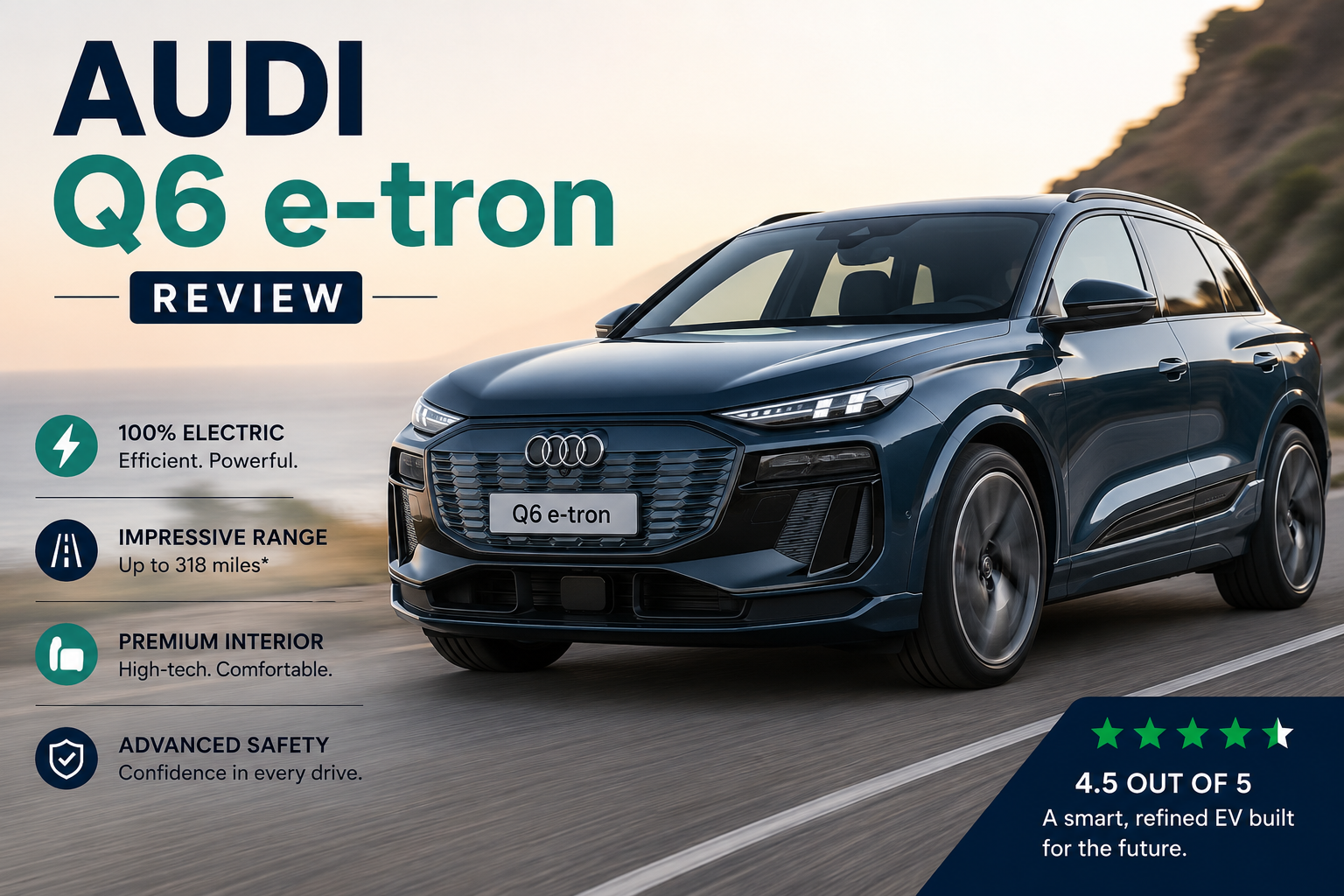

The Audi Q6 e-tron is built around a simple promise: make electric driving feel easy. It is not the loudest-looking luxury EV, and it does not chase sports-car reactions at every corner. Instead, it combines quick acceleration, a quiet cabin, useful passenger space, and one of the most road-trip-friendly charging systems in its class.
This Audi Q6 e-tron review examines the SUV from a real-world ownership perspective. The goal is not only to list horsepower and screen sizes, but to explain how it behaves in traffic, how quickly it recovers range on a road trip, where the interior feels genuinely premium, and where Audi could have done more.
| KEY TAKEAWAYS
· Best traits: rapid DC charging, quiet ride, confident acceleration, well-blended regenerative braking, and adult-friendly rear seating. · The current 2027 Q6 e-tron starts at $64,500 in the United States before destination, taxes, and options. · The quattro model produces 456 horsepower with launch control and uses a 100-kWh gross battery pack. · Audi says a 10 to 80 percent DC fast charge can take about 21 minutes under suitable conditions. · The main compromise is character. The Q6 feels polished and capable, but less distinctive inside and less athletic than some rivals. |
Audi Q6 e-tron Specifications at a Glance
| Item | Current US specification or tested result |
| Current model year referenced | 2027 Audi Q6 e-tron |
| Starting MSRP | $64,500 before destination and options |
| Power | 456 hp with launch control, Q6 e-tron quattro |
| Drive layout | Dual-motor quattro all-wheel drive |
| Battery | 100 kWh gross, approximately 94 kWh usable |
| Peak DC charging | 270 kW |
| Claimed 10 to 80% charge | About 21 minutes |
| Car and Driver 0 to 60 mph | 4.4 seconds for the tested 2025 quattro |
| EPA range cited in the test | 295 miles with 20-inch wheels |
| Observed 75-mph highway range | 250 miles in instrumented testing |
| Cargo space | 30 cu ft behind rear seats, 60 cu ft maximum |
| Front trunk | 2 cu ft |
What the Q6 e-tron Feels Like in Everyday Driving
The first impression is not speed, even though the Q6 is quick. It is composure. The steering is light, the accelerator response is smooth, and the suspension filters out broken pavement without making the body feel uncontrolled. This personality works especially well in American commuting conditions, where drivers often move between stop-and-go traffic, short freeway bursts, and uneven suburban roads in the same trip.
Audi also gives the driver several regenerative-braking choices. Steering-wheel paddles can adjust deceleration, while a stronger B setting supports near one-pedal driving. The most interesting option is the automatic mode, which changes regeneration based on traffic, curves, hills, navigation information, and road signs. It reduces the need to constantly switch settings and makes the SUV feel natural after only a few miles.
In instrumented testing, Car and Driver recorded a 4.4-second run to 60 mph, a 250-mile result in its 75-mph highway range test, and a 35-minute 10 to 90 percent fast-charge session. Those results show why the Q6 is more convincing as a long-distance luxury EV than its conservative styling initially suggests.
Acceleration Is Strong, but This Is Not the Sportiest Choice
The dual-motor quattro version delivers immediate and drama-free acceleration. It merges confidently, passes slower traffic without hesitation, and has enough reserve power to make highway driving effortless. The power delivery is clean rather than theatrical. There is little wheelspin, little noise, and no sense that the SUV is trying to turn every stoplight into a performance event.
That calmness is both a strength and a limitation. Drivers who want an EV that feels playful in corners may prefer the Porsche Macan Electric or Audi SQ6 e-tron. The standard Q6 has a substantial curb weight, soft suspension tuning, and steering that favors ease over feedback. Available adaptive dampers and air suspension improve body control, but they do not transform the vehicle into a sharp-edged performance SUV.
| ROAD-TEST VERDICT
The Q6 e-tron is fast enough to feel premium and relaxed enough to use every day. Buy it for refinement and charging ability, not for maximum steering excitement. |
Range and Charging Are the Main Reasons to Buy It
The Q6 e-tron uses an 800-volt electrical architecture, a major advantage when a compatible high-power charger is available. Audi quotes a peak charging rate of 270 kW and says the battery can move from 10 to 80 percent in about 21 minutes. That is the type of stop that can fit naturally into a coffee, restroom, and snack break instead of turning a road trip into a long waiting exercise.
Real charging speed still depends on battery temperature, starting charge level, charger condition, and weather. A strong peak number is only part of the experience. The more useful question is whether the vehicle can hold a high rate for a meaningful portion of the session. The Q6 performed well in independent testing, which gives its road-trip claims more credibility than a specification-sheet peak alone.
Owners who mainly charge at home should review a practical home EV charging guide before delivery. A properly installed Level 2 setup usually matters more to daily convenience than public fast-charging speed, because most owners begin each morning with the range they need.
How Much Range Can Buyers Expect?
Range varies with trim, wheels, temperature, speed, and climate-control use. Larger wheels generally reduce efficiency, while sustained high-speed driving uses energy faster than lower-speed commuting. In the referenced road test, the quattro model carried a 295-mile EPA rating with its wheel setup and completed 250 miles at a steady 75 mph.
For most households, that is enough to cover several days of normal driving between charges. On long trips, the fast-charging system matters almost as much as the starting range. A vehicle that adds energy quickly can be easier to travel with than one that begins with a slightly higher range number but spends much longer at chargers.
Interior: Quiet, Spacious, and Screen-Heavy
The cabin is tall, airy, and easy to enter. Front-seat support is strong, and rear outboard passengers receive adult-sized seating rather than a sharply compromised bench. The flat floor helps foot space, and the cargo area is large enough for family luggage, groceries, or bulky daily-use items. A small front trunk provides extra storage for charging equipment or items that should remain separated from the main cargo area.
Audi places an 11.9-inch digital instrument display beside a 14.5-inch center touchscreen. An available 10.9-inch passenger display can handle entertainment and selected vehicle functions. The curved digital layout looks modern and provides plenty of information, although some buyers may need time to learn the menus. A useful voice assistant can reduce the need to search through screen layers while driving.
The Q6 succeeds most clearly in noise control and ride comfort. Acoustic glass, available air suspension, and strong body insulation create a calm highway environment. However, some glossy black surfaces and lower-cost-feeling materials do not fully match the expectations created by a heavily optioned luxury-SUV price. The design is polished, but it lacks the visual theater found in some BMW, Cadillac, and Mercedes electric interiors.
Current Price, Equipment, and Trim Strategy
For the current US model, Audi lists the 2027 Q6 e-tron with a starting MSRP of $64,500 before destination, taxes, dealer charges, and optional equipment. Audi also lists 456 horsepower with launch control, 270-kW charging capability, and an approximately 21-minute 10 to 80 percent charging claim.
The base price places the Q6 in the heart of the luxury electric SUV market. Options can move the final figure upward quickly. Features such as adaptive air suspension, upgraded audio, acoustic glass, a panoramic roof, augmented-reality head-up display, ventilated seats, heated rear seats, and the passenger screen can make the SUV feel more complete, but buyers should compare the final build price against larger or more distinctive alternatives.
| Buyer priority | Best Q6 e-tron configuration strategy |
| Lowest purchase price | Choose the standard wheel size and limit appearance packages |
| Longest practical range | Avoid oversized wheels and prioritize efficiency over styling |
| Best ride comfort | Look for adaptive dampers or available air suspension |
| Best cabin experience | Add acoustic glass, upgraded audio, and comfort seating features |
| Most performance | Consider the SQ6 e-tron rather than heavily optioning the standard model |
| Frequent road trips | Prioritize fast-charging access, route planning, and suitable home charging |
Q6 e-tron Versus Key Luxury EV Rivals
| Model | Where it stands out | Main trade-off |
| Audi Q6 e-tron | Fast charging, quiet ride, balanced size, familiar luxury-SUV usability | Cabin design and handling are less distinctive |
| Porsche Macan Electric | Sharper steering, stronger performance character, premium road manners | Higher price and fewer value-focused configurations |
| BMW iX | Bold interior, strong comfort, spacious cabin, long-range options | Larger footprint and polarizing design |
| Cadillac Lyriq | Comfort, design presence, competitive pricing, roomy cabin | Charging is not as quick as the Audi at its best |
| Mercedes-Benz electric SUV alternatives | Technology-rich interiors and strong brand luxury appeal | Can become expensive with options |
| Tesla Model Y | Charging-network convenience, efficiency, cargo versatility | Less traditional luxury feel and a simpler cabin |
Readers comparing several vehicles should also review a broader guide to the best luxury electric SUVs. The Audi is most persuasive for buyers who want a conventional premium-SUV shape, a calm driving experience, and very fast charging without moving into a much larger vehicle.
What Could Be Better?
The first weakness is personality. Audi has created a vehicle that is easy to recommend, but not always easy to remember. The exterior looks familiar, the steering is light, and the cabin relies heavily on gloss-black trim and screens. Buyers expecting the visual confidence of an e-tron GT or the handling precision of a Macan Electric may find the standard Q6 too reserved.
The second issue is option inflation. A well-equipped Q6 can move far above its starting price, which creates tougher comparisons with more powerful, larger, or more emotionally appealing rivals. Shoppers should build the vehicle around needs, not around every available package. Fast charging, good seats, and appropriate wheels are more valuable than cosmetic equipment for most owners.
Finally, public charging remains inconsistent across the United States. The Q6 can accept energy very quickly, but it cannot fix an occupied, broken, or underperforming charging station. Home charging and reliable regional networks remain central to a smooth ownership experience.
Who Should Buy the Audi Q6 e-tron?
The Q6 e-tron is a strong match for drivers moving from a gasoline Audi Q5, BMW X3, Mercedes-Benz GLC, or similar compact luxury SUV. It preserves a familiar seating position and manageable exterior size while adding quiet electric performance and faster road-trip charging.
It also suits buyers who value comfort more than cornering excitement. Commuters will appreciate the smooth regenerative braking and quiet cabin. Families will appreciate the rear-seat space and useful cargo area. Frequent travelers will benefit from the 800-volt charging system, provided their routes include reliable high-power stations.
Performance-focused drivers should test the SQ6 e-tron and Porsche Macan Electric before deciding. Value-focused shoppers should compare the Cadillac Lyriq and well-equipped versions of the Tesla Model Y. Buyers who want dramatic interior design may prefer BMW or Mercedes alternatives.
Final Verdict
The Audi Q6 e-tron is not the most exciting electric SUV in its class, but it may be one of the easiest to live with. It is quick, exceptionally quiet, comfortable on rough roads, spacious enough for family use, and capable of short charging stops when connected to the right equipment.
Its biggest strengths are practical rather than emotional. The vehicle saves time at fast chargers, removes stress from routine driving, and delivers the solid, insulated feel many luxury buyers expect. The restrained design and ordinary steering keep it from being a class-defining enthusiast choice, but they do not prevent it from being a highly competent everyday EV.
| BOTTOM LINE
Choose the Audi Q6 e-tron for comfort, charging speed, range confidence, and familiar luxury-SUV usability. Look elsewhere when dramatic styling or sports-car handling matters more than calm everyday refinement. |
Frequently Asked Questions
Is the Audi Q6 e-tron fully electric?
Yes. The Q6 e-tron is a battery-electric luxury SUV. The quattro version uses front and rear electric motors for all-wheel drive and does not include a gasoline engine.
How fast can the Audi Q6 e-tron charge?
Audi lists a peak DC fast-charging rate of 270 kW and an estimated 10 to 80 percent charging time of about 21 minutes under suitable conditions. Actual charging times vary with charger output, battery temperature, weather, and starting charge level.
What is the Audi Q6 e-tron range?
Range depends on model year, trim, wheels, and testing method. The referenced 2025 quattro test vehicle carried a 295-mile EPA rating and traveled 250 miles in a 75-mph highway test. Buyers should verify the EPA label for the exact current vehicle they are considering.
Is the Q6 e-tron comfortable?
Yes. Ride comfort, cabin quietness, supportive seating, and smooth acceleration are among its strongest qualities. Available adaptive suspension equipment can improve comfort further.
Is it better than the Porsche Macan Electric?
The Q6 is generally the more comfort-focused and practical choice, while the Macan Electric has a sportier personality and sharper driving responses. The better vehicle depends on whether the buyer values calm refinement or athletic handling.