
A reveal-focused guide to design, performance, range, charging, interior technology, pricing, and buyer fit in the United States
Mercedes-Benz is giving its best-known compact luxury sedan an electric counterpart for 2027. Rather than converting the existing gasoline C-Class, the company created a dedicated battery-electric model with its own body, platform, charging system, cabin technology, and performance character. That makes this launch more significant than a routine powertrain update.
For shoppers researching the 2027 c class, the central question is not simply whether it uses electricity. The real issue is whether Mercedes has preserved the comfort and prestige associated with the C-Class while giving the new sedan enough range, charging speed, performance, and practicality to compete with newer electric rivals.
| KEY TAKEAWAYS
· The first confirmed US model is the C400 4Matic, with dual motors, all-wheel drive, 482 horsepower, and a claimed 0-to-60-mph time of 3.9 seconds. · A 94-kWh battery and 800-volt electrical architecture support DC fast charging at up to 330 kW. · Mercedes has not announced an EPA range rating or final US pricing. Early estimates place range in the mid-300-mile area and starting price near $55,000. · The electric model is longer and more practical than the gasoline C-Class, with a larger trunk and slightly improved rear-seat space. · Its biggest strengths appear to be performance, charging speed, cabin technology, and everyday luxury. Final value will depend on pricing, standard equipment, and real-world efficiency. |
| Category | 2027 Mercedes-Benz C-Class EV |
| Launch model | C400 4Matic |
| Powertrain | Dual electric motors with standard all-wheel drive |
| Output | 482 horsepower |
| Claimed 0-60 mph | 3.9 seconds |
| Battery | 94 kWh |
| Electrical system | 800 volts |
| Peak DC charging | Up to 330 kW |
| Estimated US range | Not official; approximately mid-300 miles |
| Estimated starting price | About $55,000 |
| Expected US arrival | Early 2027 |
A New Kind of C-Class, Not an Electric Conversion
The electric sedan shares the C-Class name, but it is not simply the current W206 model with a battery under the floor. Mercedes developed it as a battery-electric vehicle from the beginning. That decision allows the designers to stretch the wheelbase, package the battery more efficiently, improve rear-seat space, and create a more aerodynamic shape without working around an engine, transmission tunnel, exhaust system, or fuel tank.
The result is a car that still reads as a Mercedes compact luxury sedan, yet looks more futuristic than the gasoline model. It also lets the brand keep selling conventional and electric C-Class variants at the same time, giving buyers a choice without forcing both powertrains into one compromised platform.
Exterior Design: Familiar Proportions With a More Dramatic Face
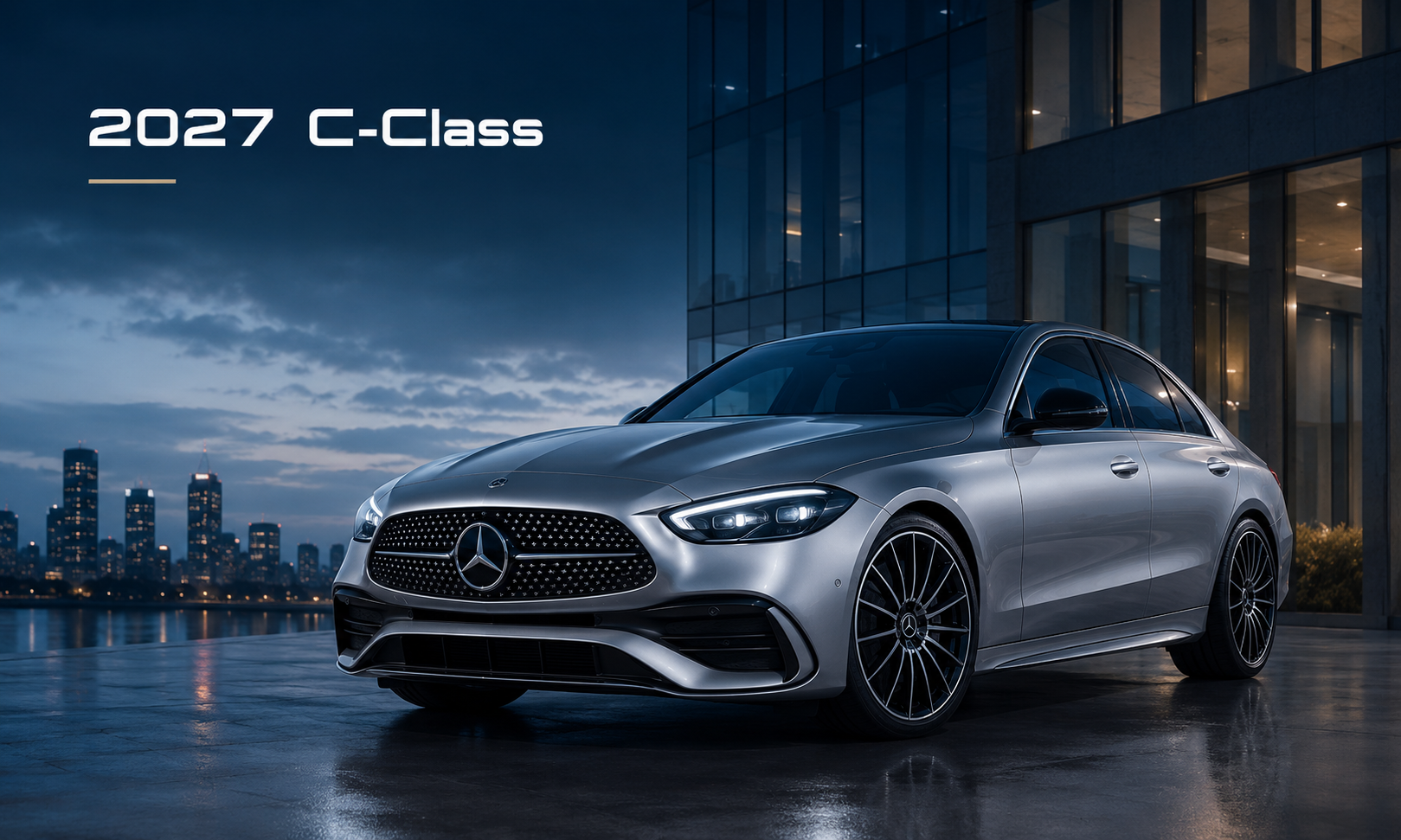
The front end is the most controversial part of the design. A large closed grille dominates the nose and carries an oversized three-pointed star. Depending on specification, lighting elements can make the grille appear even more prominent at night. Slim headlights, star-shaped daytime-running-light graphics, flush door handles, and a clean lower body help reduce visual clutter.
The Car and Driver exterior gallery shows the sedan from multiple angles and highlights its fastback-like roofline, star-themed taillights, wide rear light bar, and short rear deck. The styling is less traditional than the gasoline car, but it gives the EV a clear identity rather than making it look like a trim package.
Aerodynamics appear to play a major role in the shape. The roof flows smoothly toward the rear, the underbody is carefully managed, and the body sides avoid unnecessary openings. Buyers who prefer the restrained look of the regular C-Class may find the illuminated details excessive, while drivers who want their EV to look different will likely appreciate the stronger visual statement.
Performance: Quick Enough to Challenge Sport Sedans
The first announced version is the C400 4Matic. Its two electric motors produce a combined 482 horsepower and send power to all four wheels. Mercedes claims a 3.9-second sprint from 0 to 60 mph, which places the car well beyond the normal gasoline C300 and close to serious performance-sedan territory.
The rear motor operates most of the time, while the front motor can disconnect when additional traction or acceleration is not needed. This strategy reduces drag and energy consumption during steady cruising. A two-speed transmission on the rear axle is designed to improve both low-speed acceleration and high-speed efficiency, an approach that remains unusual among electric sedans.
Available air suspension and rear-wheel steering should broaden the car’s abilities. The air springs are intended to deliver the smooth, controlled ride expected from Mercedes, while rear-wheel steering can make the sedan feel more agile in tight spaces and more stable at highway speed. Real road tests will determine whether it truly deserves Mercedes’ claim of being the sportiest C-Class yet.
Range and Charging: The Numbers That Matter Most
Mercedes has confirmed a 94-kWh battery and an 800-volt electrical architecture. At a compatible high-power charger, the sedan can accept up to 330 kW. The company says a short fast-charging stop can add a substantial amount of driving range, making the car more suitable for interstate travel than earlier luxury EVs with slower charging curves.
An official EPA range rating is not yet available. Early US estimates place the C400 4Matic in the mid-300-mile range, although final results will depend on wheel size, tire choice, climate control use, speed, and testing certification. Buyers should treat any pre-launch estimate as provisional until the EPA label and independent highway tests are published.
Home charging will still be the most convenient option for most owners. A detailed home EV charging guide can help shoppers compare Level 2 charger output, installation costs, electrical-panel requirements, and overnight charging times before the car arrives.
Interior: A Digital Cabin With More Useful Space
The cabin is built around a dashboard-wide display arrangement. A 12.3-inch digital instrument cluster, a 17.7-inch center touchscreen, and a 12.3-inch passenger display sit beneath a continuous glass surface. The visual impact is dramatic, and the system supports voice commands, wireless smartphone integration, entertainment apps when parked, and advanced navigation functions.
Luxury materials remain central to the experience. Nappa leather, open-pore wood, natural-fiber-style trim, metal accents, and customizable ambient lighting help prevent the interior from feeling like a technology showroom with seats. An available panoramic glass roof incorporates small illuminated stars, extending the brand’s lighting theme into the cabin.
The longer wheelbase is expected to provide slightly more rear headroom than the gasoline car. Cargo volume is listed at 16.6 cubic feet, about five cubic feet more than the conventional C-Class sedan. That improvement matters because electric sedans are often judged not only on range, but also on whether their battery placement reduces everyday usefulness.
Electric C-Class Versus Gasoline C-Class
| Area | Electric Model | Gasoline Model |
| Platform | Dedicated battery-electric architecture | Combustion-based sedan platform |
| Power | 482 hp in the announced C400 4Matic | 255 hp in the current C300; more in AMG versions |
| Acceleration | Claimed 3.9 seconds to 60 mph | Slower in C300 form |
| Energy source | Battery charging | Premium gasoline |
| Cabin technology | Three-screen panoramic layout | Large central screen with separate instrument display |
| Cargo room | 16.6 cu ft listed | About 11.6 cu ft |
| Best fit | Drivers with reliable charging who want quiet performance | Drivers who prefer fast refueling or lack charging access |
Sustainability Is Part of the Engineering Story
The new platform is not only about acceleration and screens. Mercedes says it increased the use of recycled and lower-carbon materials in the body, battery housing, plastics, interior textiles, and structural components. The company also designed the vehicle with material recovery and lifecycle impact in mind.
Mercedes’ official 360-degree environmental assessment states that the battery-electric sedan can reduce lifecycle carbon emissions by roughly two-thirds compared with the current combustion-powered version, based on the company’s audited methodology and assumed energy mix. Actual owner impact will vary according to electricity generation, mileage, climate, and vehicle life.
Pricing and Release Date
Mercedes has not announced final US pricing. Current estimates suggest a starting price near $55,000 for the first C400 4Matic, but options such as air suspension, rear-wheel steering, premium audio, upgraded displays, large wheels, driver-assistance packages, and luxury trim could push transaction prices much higher.
The car is expected to reach US dealers in early 2027. A less powerful rear-wheel-drive version may follow and could deliver a lower price and better range, while an AMG model would likely focus on maximum acceleration and chassis performance. Those additional versions have not been fully detailed for the US market.
How It May Compare With Key Rivals
| Model | Likely Advantage | Potential Concern |
| Mercedes-Benz C400 4Matic EV | Fast charging, luxury cabin, strong performance | Final price and EPA range are unknown |
| BMW i4 | Proven driving dynamics and established market history | Older platform and less dramatic charging specifications |
| Audi A6 e-tron | Aerodynamic efficiency, spacious cabin, modern EV platform | Larger footprint may not suit compact-sedan buyers |
| Tesla Model 3 Performance | Acceleration, charging access, price efficiency | Less traditional luxury atmosphere and dealer experience |
| Lucid Air Pure | Long range and generous cabin space | Higher market-positioning uncertainty and fewer service locations |
Who Should Wait for It?
The car makes the most sense for a buyer who wants a compact luxury sedan, can charge at home or work, values quick acceleration, and prefers Mercedes design and technology. It may also appeal to drivers who find the CLA EV too small but do not want the size or price of a larger executive electric sedan.
Waiting is less compelling for shoppers who need a vehicle immediately, regularly travel through areas with limited charging, prefer physical controls, or want firm pricing before placing a deposit. The highly digital cabin may also feel distracting to buyers who favor simpler interiors.
Before deciding, shoppers can use an electric luxury sedan comparison to evaluate charging speed, rear-seat space, warranty coverage, insurance costs, and local service access across competing models.
Final Verdict
Mercedes has treated its electric compact sedan as a chance to rethink the C-Class rather than merely electrify it. The combination of 482 horsepower, an 800-volt charging system, a larger and more practical cabin, and ambitious display technology gives the car a strong technical foundation.
Its success in the United States will depend on three unanswered questions: final EPA range, standard equipment at the estimated price, and how the car drives on imperfect roads. If Mercedes delivers competitive real-world range and avoids excessive option costs, the new EV could become one of the most complete luxury electric sedans in its class.
Frequently Asked Questions
Is the 2027 Mercedes C-Class fully electric?
The newly revealed model is a dedicated battery-electric sedan. Mercedes is expected to continue offering gasoline-powered C-Class models separately, so the electric version does not automatically replace every conventional C-Class.
How much horsepower does the C400 4Matic EV have?
The announced dual-motor C400 4Matic produces 482 horsepower and includes standard all-wheel drive.
What is its estimated driving range?
Mercedes has not published an official EPA figure. Early US estimates place the range roughly in the mid-300-mile area, but the certified number may differ.
How quickly can it charge?
The 800-volt system supports DC fast charging at up to 330 kW when connected to a compatible charger and when battery conditions allow the peak rate.
When will it go on sale in the United States?
The first version is expected to arrive at US dealerships in early 2027, with pricing announced closer to launch.
What will it cost?
Car and Driver estimates a starting price of about $55,000. Mercedes has not confirmed the final MSRP, destination charge, or standard equipment list.
Does it have more cargo space than the gasoline sedan?
Yes. Mercedes lists 16.6 cubic feet of trunk space, which is about five cubic feet more than the current gasoline C-Class.