
Tag: Future Vehicles

  • Hyundai Boulder Concept Explained: What Is Real, What Is Speculation, and Why It Matters

    Hyundai Boulder Concept Explained: What Is Real, What Is Speculation, and Why It Matters

    STATUS
    Pure design study
    CONFIRMED PRODUCTION
    Midsize pickup by 2030
    SUV PRICE / DATE
    Not announced

    Hyundai Boulder at a Glance

    Quick fact Current information
    Vehicle status SUV-shaped concept and body-on-frame platform preview
    Global debut April 1, 2026, New York International Auto Show
    Production vehicle confirmed A Hyundai midsize pickup targeted for delivery by 2030
    Production SUV confirmed No
    Design team Hyundai Design North America in Southern California
    Architecture Fully boxed body-on-frame concept platform
    Tire specification 37×12.50R18 LT mud-terrain tires
    Key utility features Coach-style doors, dual-hinged tailgate, power rear window, accessory-ready body
    Powertrain Not announced
    Official price Not announced
    Primary market focus United States and North America
    Information status Updated July 20, 2026
    THE 30-SECOND ANSWER: The dramatic SUV is real as a concept, but Hyundai has not approved it for production. The company has confirmed that its new body-on-frame architecture will support a U.S.-focused midsize pickup by 2030.

    The Hyundai Boulder Concept is one of the clearest signs yet that Hyundai wants to move beyond crossover-based adventure trims and enter America’s serious off-road market. Revealed in New York with huge tires, an upright body, and trail-focused utility, it looks ready to challenge the Ford Bronco, Jeep Wrangler, and Toyota 4Runner. Its real significance, however, is more strategic than its show-car appearance suggests.

    This guide uses a reality-check approach. It separates confirmed engineering and design details from media estimates, then considers which ideas are most likely to survive if Hyundai develops a showroom SUV from the concept. That distinction matters because the related pickup has a public deadline, while the SUV does not.

    Market estimate: Car and Driver currently presents the vehicle as a possible 2028 model with an estimated $40,000 starting price. Both figures are projections rather than manufacturer announcements. See the publication’s early Boulder overview for its current interpretation of the project.

    What Hyundai Has Actually Confirmed

    Official record: Hyundai confirms an April 2026 debut, a fully boxed body-on-frame architecture, 37-inch mud-terrain tires, U.S.-centered development, and a production midsize pickup due by 2030. The complete details appear in Hyundai Motor Group’s launch announcement.

    The crucial wording is ‘design study.’ Hyundai says the SUV previews the company’s first fully boxed body-on-frame architecture. The manufacturer directly commits that platform to a midsize pickup, but it stops short of promising that the SUV body shown at the auto show will reach dealerships.

    Topic Status What that means
    Concept debut and design Confirmed Shown publicly in April 2026
    Fully boxed body-on-frame platform Confirmed Production pickup will use the new architecture
    Midsize pickup by 2030 Confirmed The clearest production commitment
    Production Boulder SUV Unconfirmed Hyundai calls the SUV a pure design study
    2028 model-year arrival Media estimate Possible, but not announced by Hyundai
    $40,000 starting price Media estimate Useful positioning guess, not official pricing
    Engine, hybrid system, or EV setup Unknown No powertrain details released
    Towing, payload, dimensions, MPG Unknown No production specifications released

    Why This Concept Is Bigger Than a Styling Exercise

    Hyundai already sells SUVs with XRT branding, but those vehicles begin with unibody crossover platforms. The Boulder points toward a different class of product. In a body-on-frame vehicle, the cabin and body sit on a separate structural frame. That arrangement is commonly chosen when durability, towing, payload, modification potential, and rough-terrain use take priority over minimum weight and carlike road behavior.

    For Hyundai, the platform is the headline. It gives the brand a route into U.S. segments where authenticity matters and where appearance packages alone are not enough. A credible midsize pickup needs more than rugged trim. It needs a structure, cooling strategy, suspension, four-wheel-drive hardware, and accessory ecosystem designed around work and trail use from the start.

    The concept also gives Hyundai a low-risk way to test public reaction to a fixed-roof SUV before it commits billions of dollars to a second body style. Strong demand for the pickup platform could make an SUV easier to justify later, especially if major components can be shared.

    Exterior Design Decoded

    An upright shape built around visibility

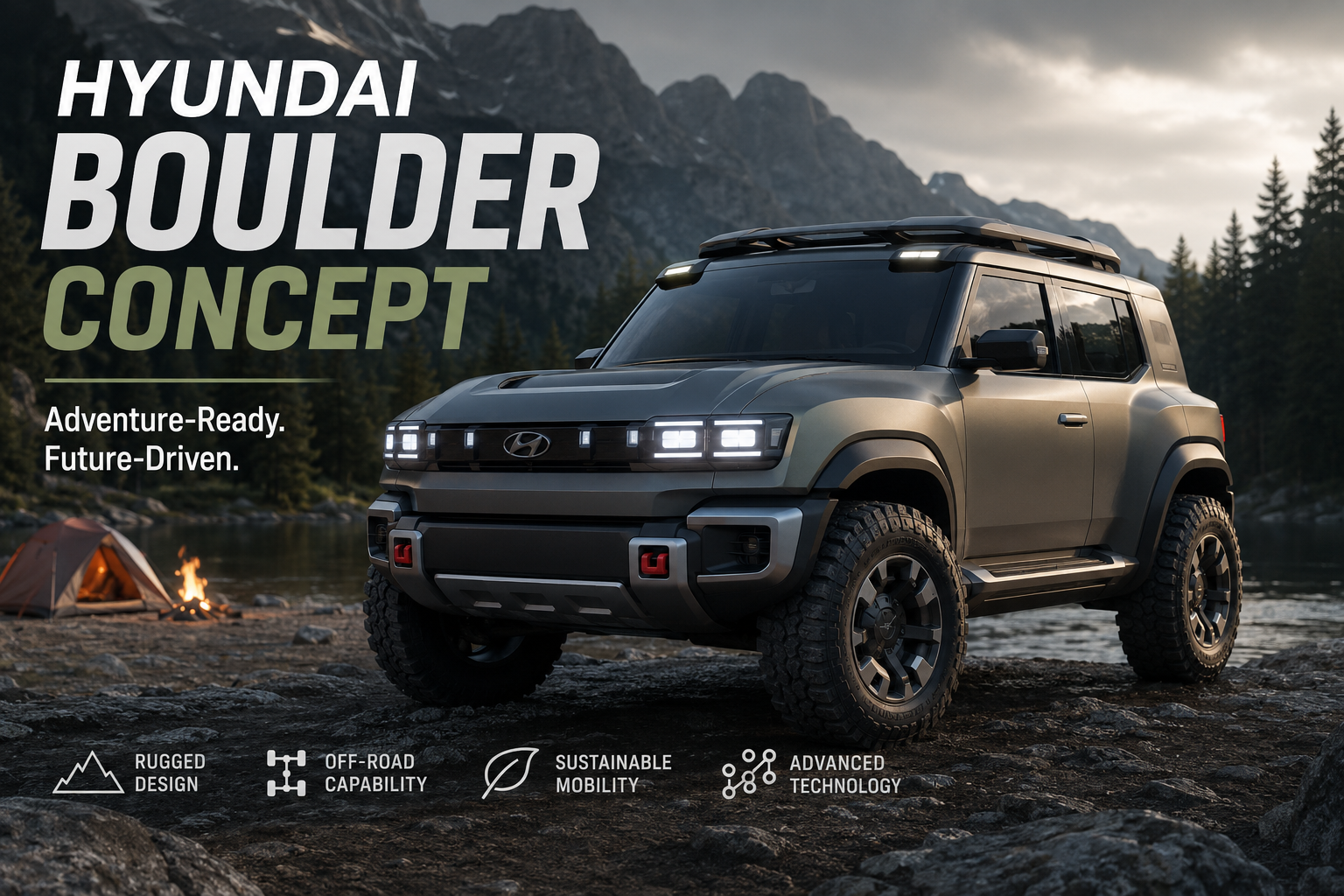
    The Boulder uses a traditional two-box silhouette, with a long, level roof and a nearly vertical rear. This shape is not simply retro styling. It can improve outward visibility, create a more usable cargo area, and leave room for roof-mounted equipment. The tall greenhouse and square corners also help a driver judge the vehicle’s position on narrow trails.

    Art of Steel gives the body visual weight

    Hyundai describes the design language as Art of Steel. Broad surfaces transition into crisp edges, giving the body a forged and machined appearance instead of the soft surfacing found on many crossovers. The Liquid Titanium finish reinforces that theme. A production model would probably simplify some forms for stamping, repairability, and cost, but the upright stance and strong shoulder line could translate well.

    Thirty-seven-inch tires create the show-car drama

    The concept rides on 37×12.50R18 LT mud-terrain tires and carries a matching full-size spare on the tailgate. Tires this large improve obstacle clearance and visual presence, but they also add rotating mass, road noise, aerodynamic drag, cost, and stress on steering and driveline parts. A showroom version would be more likely to use smaller standard tires, with the most aggressive size reserved for a halo trim or dealer accessory package.

    The doors and tailgate focus on access

    Coach-style rear doors create a wide side opening for people and equipment. At the back, a double-hinged cargo door can open from either side, while a power drop-down rear window can accommodate long items and increase ventilation. These ideas are more than visual theater, but each would require careful engineering for sealing, crash performance, hinges, wiring, and long-term durability.

    Safari windows and an accessory-ready roof

    Fixed upper windows add daylight and improve the view of steep terrain. A low-profile rack with steel webbing provides another mounting surface for cargo and adventure equipment. Hyundai also describes the exterior as a blank canvas for accessories. That matters because buyers in the off-road market often personalize vehicles with racks, recovery gear, lighting, protection, storage, and camping equipment.

    The Cabin Makes a Case for Physical Controls

    The interior does not chase the biggest possible central touchscreen. Hyundai emphasizes durable materials at grab handles and other high-wear points, plus physical knobs and buttons that can be operated while the vehicle is moving over rough ground. That is a practical choice. A driver wearing gloves or bracing against motion can use a distinct control more reliably than a flat touch target.

    Fold-out tray tables make the cabin useful during trail stops, remote work, or camping. The broader design suggests a modular space rather than a luxury lounge. Any production version would still need airbags, storage, cupholders, climate controls, charging ports, and family-friendly comfort, but the concept establishes a clear priority: function should remain visible.

    The Digital Spotter Could Matter More Than the Giant Tires

    Hyundai says an available software-driven, real-time off-road guidance system can act like a digital spotter. The company has not explained the full sensor package, but the basic idea is compelling. Cameras, wheel-angle data, inclinometer readings, and terrain views could help a driver place tires, avoid rocks, monitor clearance, and choose a safer line.

    This is one concept feature with a strong chance of reaching production in some form. Camera-based trail views already exist in the market, and software can give Hyundai a point of difference without relying only on mechanical hardware. The system’s value would depend on clear graphics, low latency, durable cameras, and controls that remain simple under pressure.

    What Is Most Likely to Survive Production?

    Concept cars exaggerate proportions and features to communicate an idea quickly. The table below is an editorial assessment, not a Hyundai product plan. It ranks how easily each element could transfer to a production SUV or pickup.

    Concept element Transfer likelihood Reasoning
    Body-on-frame architecture Very high Already confirmed for the future pickup
    Upright, boxy proportions High Supports visibility, cargo use, and market identity
    Physical off-road controls High Practical and consistent with the concept mission
    Accessory mounting strategy High Important for work, overlanding, and personalization
    Digital trail guidance Medium to high Software feature is realistic, details may change
    Safari-style upper windows Medium Distinctive, but adds cost and sealing complexity
    Dual-hinged rear cargo door Medium Useful, yet mechanically more complex
    Coach-style rear doors Low to medium Crash, cost, and daily-use requirements may alter them
    37-inch standard tires Low Likely too extreme for mainstream trims

    Powertrain: The Biggest Missing Piece

    Hyundai has not announced an engine, transmission, battery, electric range, horsepower figure, or four-wheel-drive system. It has not confirmed locking differentials, a low-range transfer case, axle types, or suspension travel either. Those omissions prevent meaningful performance comparisons with established off-roaders.

    A production pickup or SUV could take several paths. A turbocharged gasoline engine would support familiar refueling and towing use. A hybrid could add low-speed torque and improve efficiency. A battery-electric version could deliver precise motor control, but large tires, towing, cold weather, and remote charging would create range challenges. A mixed powertrain family may ultimately be the most flexible strategy, but that remains analysis rather than confirmed information.

    The drivetrain hardware will matter more than the headline horsepower. Off-road buyers will look for low-speed control, cooling capacity, underbody protection, axle articulation, recovery points, water management, and dependable operation far from pavement.

    Release Date and Price: How to Read the Estimates

    The 2028 date circulating online should be treated as an early forecast for a possible SUV, not a launch schedule. Hyundai’s official timetable applies to the midsize pickup, which is planned for delivery by 2030. An SUV could arrive before the truck, alongside it, after it, or not at all. Platform testing, factory planning, supplier contracts, and market research will determine the order.

    A $40,000 entry estimate would place a hypothetical production model near the lower portion of the serious midsize off-road SUV market. That number is plausible as a target, but the concept’s specialized doors, large tires, trail technology, and body-on-frame structure could push well-equipped versions much higher. Until Hyundai names a production vehicle, even a broad price range is speculative.

    Timing or price item Current answer
    Official SUV release date Not announced
    Media forecast Possible 2028 model year
    Confirmed related product Midsize pickup targeted by 2030
    Official SUV price Not announced
    Media starting-price estimate About $40,000
    Best interpretation Use the estimates for market context, not purchase planning

    Where a Production Boulder Would Fit in the U.S. Market

    A showroom version would enter a crowded but clearly defined field. The Wrangler owns the open-air trail identity, the Bronco combines retro design with a broad off-road trim ladder, the 4Runner emphasizes fixed-roof utility, and the Defender adds a premium technology angle. Hyundai would need a distinct reason for buyers to switch.

    The concept suggests that reason could be a combination of approachable pricing, unusual cargo access, strong warranty coverage, digital trail assistance, and a factory-backed accessory strategy. Hyundai would also need to prove durability and off-road credibility over time. In this category, brand trust is built through real-world use, not only specifications.

    Reference point Established appeal Possible Hyundai angle
    Ford Bronco Open-air adventure and broad trim range Modern utility features and potentially lower entry pricing
    Jeep Wrangler Deep trail heritage and removable body panels More enclosed daily usability with tech-forward assistance
    Toyota 4Runner Fixed-roof utility and established reputation Fresh cabin design and unusual cargo-access ideas
    Land Rover Defender Premium image and advanced terrain technology A more accessible, American-built interpretation
    Hyundai pickup sibling Work, towing, and bed utility Shared platform could create an SUV family with lower development cost

    Who Should Pay Attention Now?

    The concept is most relevant to shoppers who like the idea of a Bronco or 4Runner but are open to a new brand, especially buyers interested in camping, overlanding, outdoor equipment, towing, and vehicle customization. It is also important for current Hyundai owners who want more capability than a crossover can provide.

    It is not yet a vehicle to wait for in a practical purchase timeline. There are no order books, trims, dealer allocations, production specifications, or official reservation program. A buyer who needs an off-road SUV soon should compare vehicles that are already on sale rather than delay a purchase around an unconfirmed concept.

    What to Watch Next

    • Hyundai naming the U.S. factory that will build the body-on-frame family.
    • Prototype sightings that reveal wheelbase, suspension, cab size, and powertrain packaging.
    • Trademark activity or official language that separates the pickup name from a possible SUV name.
    • Announcements about engines, hybrid systems, four-wheel drive, towing, and payload.
    • Whether Hyundai expands XRT into a genuine hardware-led off-road sub-brand.
    • A production-intent concept with conventional doors, road-legal lighting, and realistic tire sizes.

    Frequently Asked Questions

    Is the Hyundai Boulder a real vehicle?

    It is a real, publicly displayed concept vehicle. It is not a production model and cannot currently be ordered.

    Has Hyundai confirmed a Boulder SUV for production?

    No. Hyundai describes the SUV as a pure design study. The company has confirmed a midsize pickup using the new body-on-frame architecture by 2030.

    Why do some websites call it a 2028 model?

    That date is an editorial forecast based on the concept and Hyundai’s future product plans. Hyundai has not announced a 2028 SUV launch.

    How much could a production version cost?

    Car and Driver estimates a starting price near $40,000. Hyundai has not released official pricing, so the final amount could differ substantially.

    What engine does it use?

    Hyundai has not disclosed a powertrain. Gasoline, hybrid, and electric possibilities remain open until the company provides production details.

    Does the concept have 37-inch tires?

    Yes. Hyundai specifies 37×12.50R18 LT mud-terrain tires, including a tailgate-mounted full-size spare. A production vehicle may use smaller sizes.

    What is a digital off-road spotter?

    Hyundai describes a software-driven real-time guidance system that can assist the driver on trails. Exact cameras, sensors, displays, and functions have not been detailed.

    Will the related pickup replace the Santa Cruz?

    Hyundai has not said that it will. The future midsize body-on-frame truck would serve a more capability-focused role than the unibody Santa Cruz.

    Final Verdict

    The Hyundai Boulder Concept matters because it reveals a business plan, not merely an eye-catching show vehicle. Hyundai is developing an American-centered body-on-frame family, and the concept establishes the design, utility, and technology themes that could define it. The confirmed pickup is the near-term commitment. A production SUV remains a credible possibility, but it should not be treated as a guaranteed 2028 model until Hyundai says so.

    For now, the most useful way to view the Boulder is as a promise of direction. Expect the production vehicles to retain the tough architecture, upright character, practical controls, and accessory focus. Expect the extreme tires, dramatic door solutions, and show-car details to be evaluated against cost, safety, efficiency, and everyday usability.