
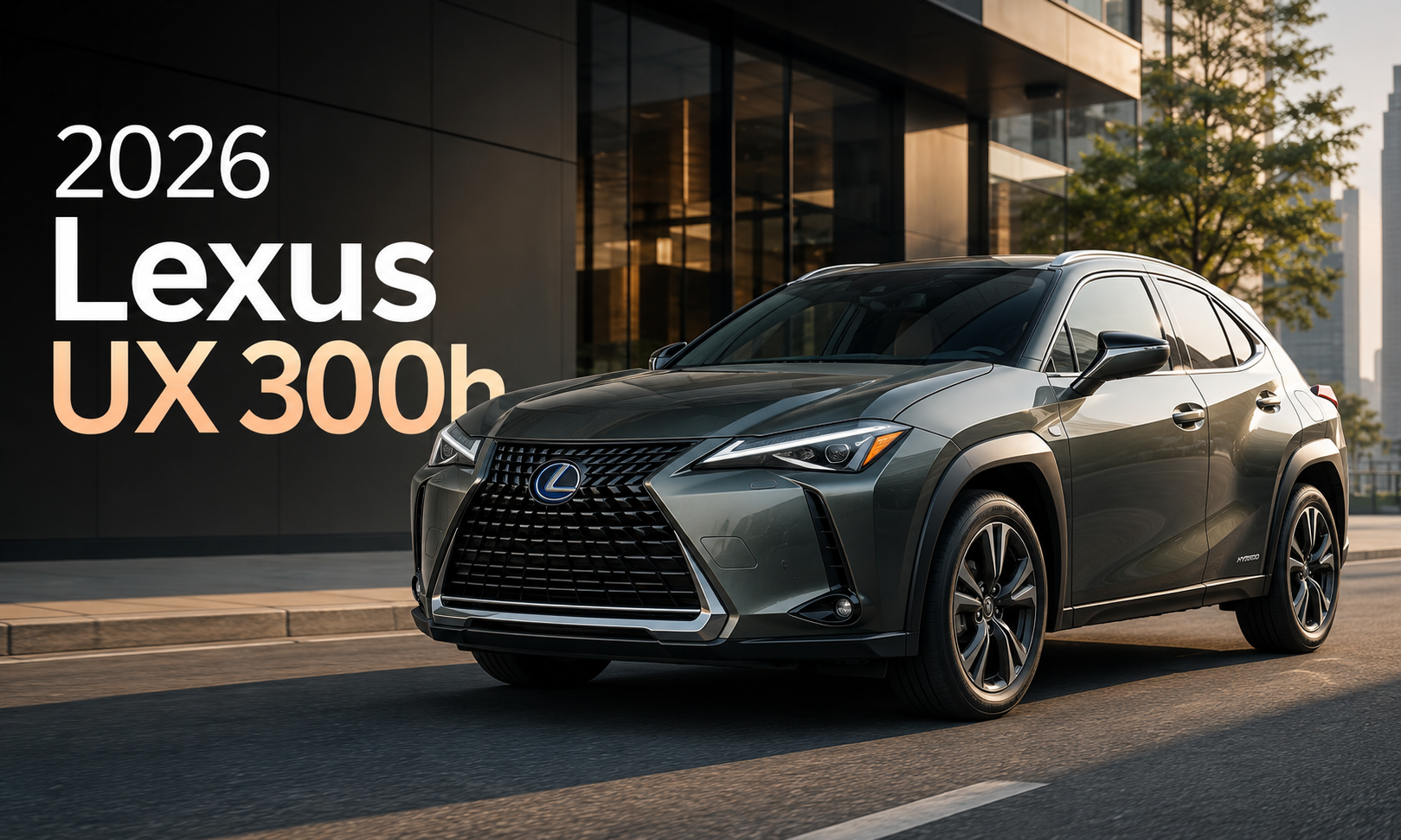

A practical look at the smallest Lexus for commuters, couples, city drivers, and buyers who value hybrid efficiency more than rear-seat or cargo space
| 2026 UX 300h fact | Details |
| Vehicle type | Subcompact luxury hybrid crossover |
| Powertrain | 2.0-liter four-cylinder with electric motors and an electronic CVT |
| Combined output | 196 horsepower |
| Drivetrains | Front-wheel drive or electronic all-wheel drive |
| Price range | $38,850 to $48,850, including $1,395 delivery, processing, and handling |
| EPA fuel economy | Up to 46 mpg city, 42 mpg highway, and 44 mpg combined |
| Tested acceleration | 0 to 60 mph in 7.7 seconds for a front-wheel-drive test vehicle |
| Cargo space | 17 cubic feet behind the rear seat |
| Best value trim | UX 300h Premium FWD |
| Main advantage | Outstanding city fuel economy in an easy-to-park luxury crossover |
| Main compromise | Tight rear seating and limited cargo capacity |
| Verdict in 30 seconds
The UX 300h is best viewed as a premium hybrid hatchback with a slightly raised seating position, not a small family SUV. It is quiet, maneuverable, richly equipped, and exceptionally efficient in city driving. The Premium FWD is the strongest value. Choose AWD only when slippery-weather traction matters, and test the rear seat and cargo area before committing. |
The 2026 Lexus UX 300h is aimed at buyers who want Lexus comfort, hybrid fuel economy, and compact dimensions in one vehicle. It works especially well for urban commuting, two-person road trips, and drivers moving up from a mainstream hatchback or sedan. Its limits become clear when tall adults regularly use the rear seat or bulky cargo is part of everyday life.
For 2026, Lexus makes only modest changes because the hybrid powertrain, technology, and safety equipment received larger updates for 2025. The result is a mature, easy-to-understand crossover whose value depends more on choosing the right trim than on finding the strongest engine or newest redesign.
Key Takeaways
- Every US model is a hybrid with 196 total system horsepower.
- Front-wheel drive delivers the best fuel economy and lowest price.
- The Premium trim adds the comfort equipment most luxury buyers will notice daily.
- F Sport Design is mostly a styling choice, while F Sport Handling adds adaptive suspension hardware.
- Rear-seat and cargo space are the main reasons to choose a larger competitor instead.
What Is New for 2026?
The 2026 UX carries over the fifth-generation hybrid system introduced for 2025. New details include Ultra White paint availability on Base and Premium grades, revised door-panel switch layouts with chrome accents, and a 12.3-inch digital instrument cluster that is now standard on Premium and F Sport versions. Base models retain a 7.0-inch driver display.
F Sport Handling now includes a power rear door with a kick sensor as standard equipment. Lexus also offers new appearance choices, including black exterior accents and wheel treatments, but there is no major mechanical redesign.
The official Lexus 2026 UX 300h announcement confirms the 196-hp fifth-generation hybrid system, eight front- and all-wheel-drive configurations, the updated display equipment, and current pricing that already includes the $1,395 delivery, processing, and handling fee.
2026 Lexus UX 300h Prices and Trims
| Trim | FWD price | AWD price | Best for |
| UX 300h | $38,850 | $40,420 | Lowest price and maximum efficiency |
| Premium | $42,120 | $43,690 | Best overall balance |
| F Sport Design | $42,685 | $44,255 | Sportier appearance |
| F Sport Handling | $47,270 | $48,850 | Adaptive suspension and maximum equipment |
The base UX is already well equipped, but the Premium trim is easier to recommend because it adds heated and ventilated front seats, a moonroof, rain-sensing wipers, an auto-dimming mirror, and a power liftgate with kick sensor. These are features owners will use more often than the cosmetic changes on F Sport Design.
F Sport Handling adds the 12.3-inch center touchscreen, sport seats, a heated steering wheel, adaptive dampers, additional drive-mode tuning, and model-specific trim. It looks and feels more special, but its near-$50,000 AWD price moves the UX into territory occupied by roomier and faster luxury SUVs.
Hybrid Performance and Driving Experience
The hybrid system pairs a 2.0-liter gasoline engine with electric motor-generators and a lithium-ion battery. Front-wheel-drive models use the front hybrid system, while AWD versions add a rear electric motor for traction. Total system output remains 196 horsepower in both layouts.
Acceleration is adequate rather than exciting. A front-drive test vehicle reached 60 mph in 7.7 seconds, which is quick enough for merging and daily traffic but slower than turbocharged rivals such as the BMW X1. The payoff is smooth low-speed response and fewer abrupt gear changes because the electronic CVT blends gasoline and electric power continuously.
The supplied Car and Driver 2026 Lexus UX review rates the model 8 out of 10, praising its exceptional efficiency, available AWD, quiet ride, and standard safety technology while identifying acceleration, rear-seat room, and cargo capacity as the principal weaknesses.
The UX feels most convincing in the city. Its compact footprint makes parking simple, steering is light and accurate, and the suspension isolates broken pavement better than its size suggests. F Sport Handling can firm or soften the adaptive dampers, but it does not turn the UX into a true performance crossover.
Fuel Economy and Ownership Costs
EPA ratings cited for the front-wheel-drive model are 46 mpg city, 42 mpg highway, and 44 mpg combined. AWD lowers each figure by about 1 mpg. Car and Driver averaged 40 mpg during a two-week evaluation, which remains excellent for a luxury crossover.
At 12,000 miles per year, a vehicle averaging 43 mpg uses about 279 gallons. A 28-mpg rival would use about 429 gallons over the same distance. That difference of roughly 150 gallons per year can partially offset the UX premium, especially for drivers who spend most of their time in stop-and-go traffic where hybrids are most efficient.
| FWD or AWD?
Choose FWD for the lowest price, best mileage, and mild-climate commuting. Choose AWD for added traction during snowy starts, wet hills, or loose surfaces. The rear motor helps traction, but it does not turn the UX into an off-road vehicle. |
Interior Comfort, Cargo, and Everyday Use
Front-seat comfort is a strength. The driving position is easy to adjust, the seats are supportive, and materials such as soft-touch trim, detailed stitching, and washi-inspired dashboard surfaces create a more premium atmosphere than most mainstream hybrids. Road and powertrain noise are also well controlled during normal driving.
The rear seat is the reality check. Children and smaller adults fit reasonably well, but tall passengers will notice limited knee and foot room. Families using rear-facing child seats should test installation behind the normal driving position before buying.
Cargo capacity is 17 cubic feet behind the second row. That is enough for groceries, a few carry-on bags, or everyday commuter gear, but it is small for the class. Buyers carrying strollers, large pet crates, golf bags, or multiple suitcases should bring those items to the dealership.
Technology, Safety, and Warranty
Base, Premium, and F Sport Design trims use an 8.0-inch center touchscreen, while F Sport Handling receives a 12.3-inch display. Wireless Apple CarPlay and Android Auto are standard, along with five USB ports. Available upgrades include cloud navigation, wireless charging, a head-up display, digital key capability, and a 10-speaker audio system.
Lexus Safety System+ 3.0 is standard. It includes automatic emergency braking with pedestrian, cyclist, and motorcyclist detection, full-speed adaptive cruise control, lane-centering assistance, lane-departure warning with steering support, road-sign recognition, and proactive driving assistance. Blind-spot monitoring and rear cross-traffic alert are also important features to confirm on the window sticker.
| Coverage | Term |
| Basic limited warranty | 4 years or 50,000 miles |
| Powertrain warranty | 6 years or 70,000 miles |
| Hybrid component warranty | 8 years or 100,000 miles |
| Complimentary maintenance | 1 year or 10,000 miles |
Who Should Buy the UX 300h?
| Buyer type | Recommendation | Reason |
| Urban commuter | Strong buy | Excellent mileage, easy parking, quiet ride |
| Couple or solo driver | Strong buy | Front-seat comfort matters more than rear space |
| Snow-belt commuter | Choose AWD | Extra traction with only a small mileage penalty |
| Family with tall teenagers | Test carefully | Rear-seat room is limited |
| Frequent cargo hauler | Consider a larger SUV | 17-cu-ft cargo area is restrictive |
| Performance-focused buyer | Shop elsewhere | 196 hp and 7.7-second acceleration are modest |
Frequently Asked Questions
How much is the 2026 Lexus UX 300h?
Prices start at $38,850 for the front-wheel-drive base model and reach $48,850 for F Sport Handling AWD. These figures include the $1,395 delivery, processing, and handling charge.
Is the Lexus UX 300h a plug-in hybrid?
No. It is a conventional self-charging hybrid. The battery is charged through the gasoline engine and regenerative braking, so there is no charging port.
How fast is the UX 300h?
A tested front-wheel-drive model reached 60 mph in 7.7 seconds. The vehicle is tuned for smoothness and efficiency rather than rapid acceleration.
Is AWD worth it?
AWD is worthwhile for drivers who regularly face snow, steep wet roads, or loose surfaces. FWD is the better value for mild climates and delivers slightly higher fuel economy.
Which trim is the best value?
The Premium FWD is the sweet spot because it adds heated and ventilated seats, a moonroof, rain-sensing wipers, and a power liftgate without the high price of F Sport Handling.
Is the UX large enough for a family?
It can work for a small family, but rear-seat and cargo space are limited. Buyers should test child seats, passenger legroom, and regular cargo before purchasing.
Final Verdict
The 2026 Lexus UX 300h is a smart luxury hybrid for the right lifestyle. It delivers impressive fuel economy, a calm ride, strong standard safety technology, and a cabin that feels genuinely upscale from the front seats. Its small size is an advantage in crowded cities but a compromise for passengers and luggage.
The Premium FWD is the most sensible configuration for most buyers. Add AWD when weather requires it, and move to a larger model when rear-seat comfort or cargo capacity matters more than efficiency and maneuverability.