
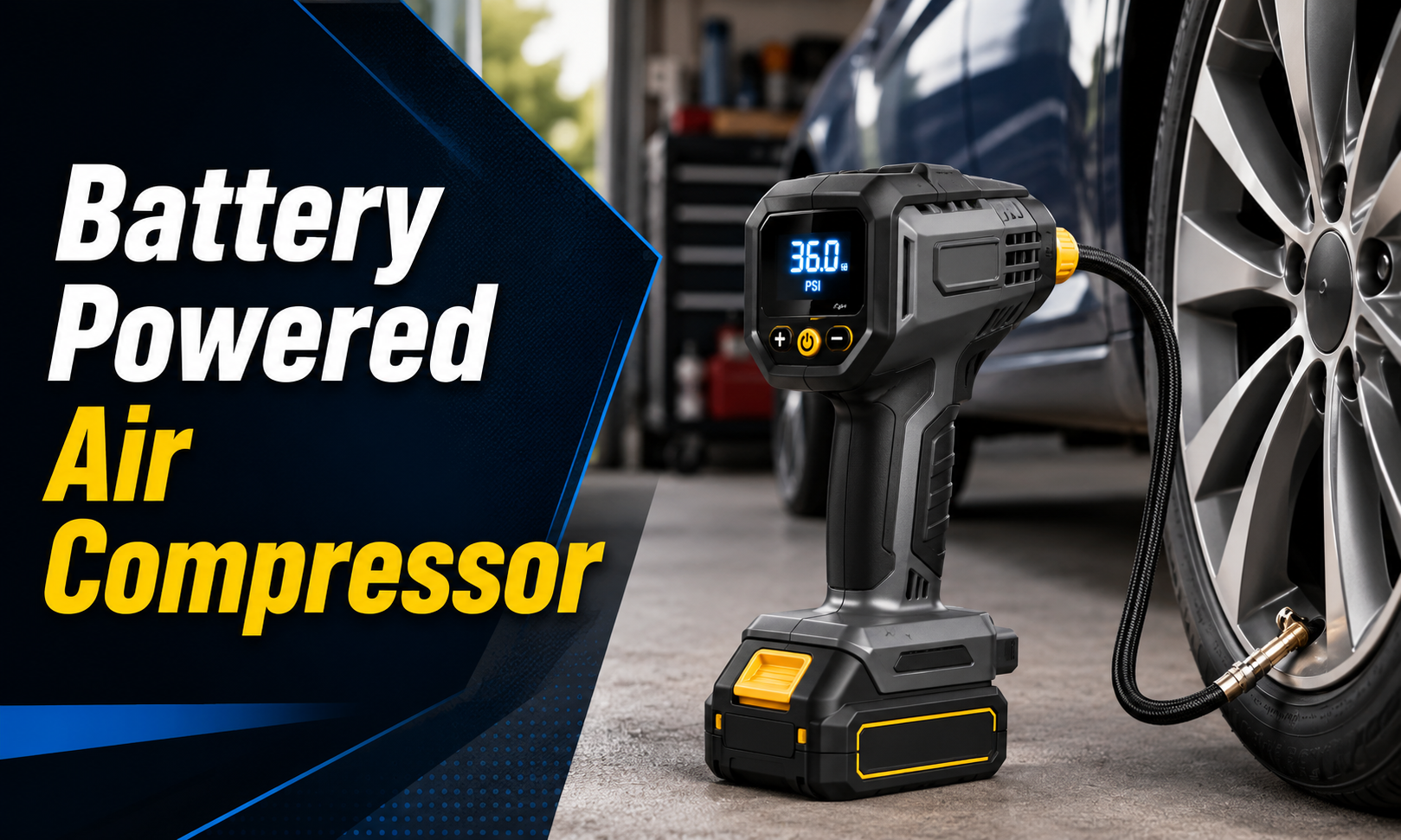

Five cordless picks for emergency tire top-offs, fast inflation, compact storage, and all-in-one roadside use
| Model | Best for | Power | 30 psi time | 45 psi time | Weight |
| Slime Cordless Pro Power | Best overall | Internal battery plus 12V | 2:18 | 5:09 | 4.4 lb |
| Avid Power Cordless | Best budget | 20V battery plus 12V | 4:14 | 8:44 | 2.6 lb |
| Milwaukee M18 | Fastest | M18 battery | 1:34 | 2:47 | 8.7 lb |
| AstroAI L4 | Most portable | 6600 mAh battery | 6:40 | 13:15 | 1.1 lb |
| Wolfbox Megavolt 24 Air | Best emergency combo | Internal lithium battery | 3:12 | 6:10 | 5.0 lb |
Inflation times shown above were recorded during the supplied hands-on test using a passenger-vehicle tire that began at 10 psi. Results will vary by tire size, starting pressure, temperature, battery charge, and compressor duty cycle.
| Best overall choice
The Slime Cordless Pro Power is the strongest all-around option because it combines quick inflation, a compact body, an unusually long flexible hose, an easy clamp connector, and a 12-volt backup cord. The Milwaukee M18 is much faster, but it is heavier and makes the most sense for buyers already using Milwaukee batteries. |
A battery powered air compressor is one of the most useful items to keep in a car because it can correct a low tire before the vehicle becomes difficult or unsafe to drive. The best models are small enough for regular storage, fast enough to handle a meaningful pressure loss, and simple enough to use on a dark roadside without searching for a gas-station air pump.
The right choice depends on more than maximum pressure. Inflation speed, battery capacity, backup power, hose length, valve connector, gauge accuracy, weight, and heat management all affect real-world usefulness. A tiny inflator is convenient, but it may take more than 10 minutes to fill a large tire. A workshop-style unit may be quick, but too bulky for a glovebox or trunk organizer.
Best Battery-Powered Air Compressors for Car Tires
- Slime Cordless Pro Power: Best Overall
The Slime Cordless Pro Power offers the best balance of speed, reach, portability, and backup power. It reached 30 psi in 2 minutes 18 seconds and 45 psi in 5 minutes 9 seconds, which is impressive for a 4.4-pound cordless unit. Its standout feature is the included 15-foot flexible hose, making it easier to reach every valve stem without moving the compressor around the vehicle.
The clamp-style connector is quick to attach, the digital controls are straightforward, and the internal battery eliminates the need to leave the engine running during a routine top-off. Battery endurance is the main weakness. The charge indicator fell substantially during a demanding test, but the included 12-volt cable provides a useful fallback when the internal pack is low.
- Avid Power Cordless: Best Budget Choice
The Avid Power Cordless is a practical choice for buyers who want a removable 20-volt battery without paying power-tool-brand prices. It uses a pistol-grip shape with a trigger-style control, includes a 12-volt vehicle adapter, and comes with adapters for sports equipment, inflatables, and Presta bicycle valves.
Its 4-minute 14-second time to 30 psi is slower than the leading models but still acceptable for emergency use and seasonal top-offs. The 2.6-pound weight is manageable, and the battery includes a USB port that can provide limited phone charging. Noise and the short 19.6-inch hose are the primary compromises.
- Milwaukee M18: Fastest Cordless Inflator
The Milwaukee M18 is the performance pick. It took only 1 minute 34 seconds to reach 30 psi and 2 minutes 47 seconds to reach 45 psi, making it the fastest model in the reference test. That speed is valuable for truck tires, off-road air-down and air-up routines, multiple vehicles, and owners who frequently adjust pressure.
The tradeoff is size and cost. At 8.7 pounds, it is closer to a compact workshop tool than a glovebox inflator. The required M18 battery and charger may be sold separately, so it is most economical for someone already invested in Milwaukee tools. Its screw-on connector provides a secure seal, although it can be less convenient with cold fingers.
- AstroAI L4: Best for Small Storage Spaces
The AstroAI L4 is the easiest model to store. It weighs only 1.1 pounds and can fit in a glove compartment, seat pocket, or compact emergency kit. The bright display, intuitive controls, and clamp connector make it friendly for occasional users who prioritize convenience over maximum speed.
Its limitation is clear: it required 6 minutes 40 seconds to reach 30 psi and 13 minutes 15 seconds to reach 45 psi. The 12-inch hose may also force the user to hold the unit when the valve stem is high on the wheel. It is suitable for topping up a passenger-car tire, but not ideal for repeated use on large SUV or truck tires.
- Wolfbox Megavolt 24 Air: Best Emergency-Kit Combination
The Wolfbox Megavolt 24 Air combines a tire inflator, jump starter, and USB power bank in one case. It reached 30 psi in 3 minutes 12 seconds and 45 psi in 6 minutes 10 seconds, so the compressor function is more than an afterthought. The 24,000 mAh battery gives the unit enough reserve to support multiple roadside functions.
This is the best choice for drivers who want to reduce the number of separate tools in the trunk. It is heavier than a handheld inflator, and the 20-inch hose is short for large wheels, but the all-in-one design is valuable for road trips, older vehicles, and drivers who do not already carry a dedicated jump pack.
The rankings and measured inflation results in this guide follow the current Car and Driver portable tire inflator test, which evaluated inflation speed, noise, gauge accuracy, hose length, connector type, attachments, weight, and power source. The test used the same tire and starting pressure for each unit, making the performance differences more meaningful than manufacturer claims alone.
How to Choose the Right Cordless Inflator
| Feature | Why it matters | Best choice for most drivers |
| Power source | An internal battery is convenient, while 12-volt backup prevents a dead battery from making the tool useless. | Dual-power model |
| Inflation speed | Faster units reduce roadside exposure and handle larger tires with less heat buildup. | Under 5 minutes from 10 to 30 psi |
| Hose length | A longer hose reaches high valve stems and large wheels without holding the compressor. | At least 20 inches, preferably longer |
| Connector | Clamp fittings are faster; screw-on fittings seal securely but take longer. | Clamp for emergency use |
| Auto shutoff | Stops at the selected pressure and reduces overinflation risk. | Digital preset with shutoff |
| Battery ecosystem | Tool-brand batteries can save money when the charger and packs are already owned. | Match an existing system |
Also check the duty cycle. Small compressors generate heat and may require a cooling period after several minutes of continuous use. A compact inflator intended for occasional passenger-car top-offs should not be expected to reseat a tire bead, operate pneumatic tools, or repeatedly inflate oversized off-road tires from very low pressure.
Battery Power Versus 12-Volt Power
Cordless operation is faster to set up and allows the compressor to be used away from the vehicle, but rechargeable batteries can be forgotten in storage. A unit that has sat through months of heat, cold, and inactivity may not have enough charge during an emergency. Recharge it every few months and before long trips.
A 12-volt inflator is usually cheaper and can run as long as the vehicle can supply power, but its cord may be difficult to route around a large SUV or pickup. Dual-power models provide the best emergency protection because they work cordless for convenience and can switch to the vehicle outlet when the battery is depleted.
Use the Correct Tire Pressure
An inflator is only useful when the target pressure is correct. NHTSA TireWise guidance advises checking all tires at least monthly when they are cold, meaning the vehicle has not been driven for at least three hours. Use the pressure on the driver-side doorjamb label or in the owner manual, not the maximum number molded into the tire sidewall.
- Park on a safe, level surface and turn on hazard lights when working roadside.
- Inspect the tire for cuts, bulges, exposed cords, or objects before adding air.
- Set the recommended cold pressure and confirm it with a separate quality gauge when possible.
- Stop if the compressor, hose, battery, or connector becomes unusually hot.
- Treat repeated pressure loss as a tire problem that needs professional repair, not a reason for constant refilling.
| A portable inflator does not repair a damaged tire
If a tire loses pressure rapidly, has a sidewall bulge, makes the vehicle pull, or cannot hold the recommended pressure, stop driving and arrange professional help. Adding air can provide temporary mobility in some situations, but it cannot make a punctured or structurally damaged tire safe. |
Frequently Asked Questions
Can a battery-powered compressor inflate a completely flat tire?
Many can, provided the tire is still seated on the wheel and the compressor has enough battery capacity. Inflation will take longer and generate more heat than a normal top-off.
How often should the battery be charged?
Check and recharge it every few months, after each demanding use, and before long trips. Follow the manufacturer instructions for storage temperature and charging.
Is a handheld inflator strong enough for truck tires?
It may handle a moderate top-off, but a fast power-tool inflator or direct-to-battery compressor is better for large light-truck and off-road tires.
Should the vehicle be running when using the 12-volt cord?
Many manufacturers recommend it to maintain voltage, but follow the product instructions and never run a vehicle in an enclosed space.
Why does the pressure rise after driving?
Tires heat during use, which increases pressure. Set and compare pressure when the tires are cold for the most accurate result.
Final Verdict
The best battery powered air compressor for most drivers is the Slime Cordless Pro Power because it combines fast inflation, compact storage, a long hose, and 12-volt backup. The Avid Power is the better budget purchase, while the Milwaukee M18 is the clear performance choice for truck owners and existing Milwaukee users.
Choose the AstroAI L4 when storage space matters most and the Wolfbox when an inflator, jump starter, and power bank in one case is more useful than minimum weight. Whichever model you buy, keep it charged, test it before an emergency, and use the vehicle manufacturer’s cold-pressure specification.