| 419,035
SUVs potentially involved |
$0
Dealer software remedy |
NO
Do Not Drive advisory |
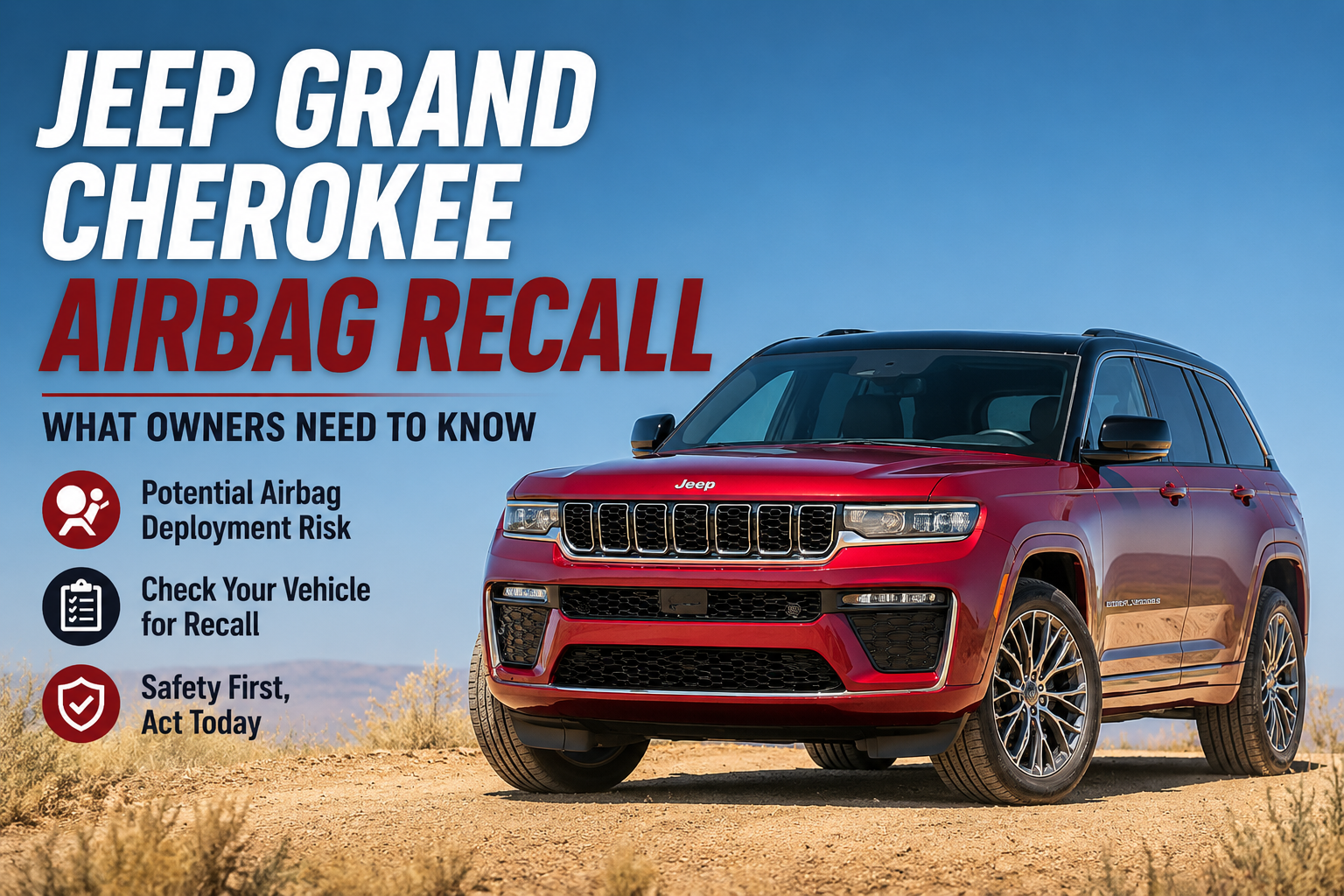
The Jeep Grand Cherokee airbag recall covers 419,035 SUVs in the United States because software in the Occupant Restraint Controller may delay side-airbag deployment in certain crashes. The campaign includes specific 2022-2026 Grand Cherokee vehicles and 2023-2025 Grand Cherokee L vehicles, but model year alone cannot confirm eligibility. Owners need to check the 17-character VIN.
FCA US says dealers will reprogram the controller with updated software at no charge. NHTSA’s filing does not carry a Do Not Drive or Park Outside instruction, but the defect affects occupant protection, so an open recall should be scheduled promptly rather than postponed.
| USA RECALL SNAPSHOT | |
| Recall status | Active U.S. safety recall with a dealer software remedy |
| NHTSA campaign | 26V328, also displayed as 26V328000 in some databases |
| Manufacturer campaign | 01D |
| Potential population | 419,035 vehicles |
| Affected models | Certain 2022-2026 Jeep Grand Cherokee and 2023-2025 Jeep Grand Cherokee L SUVs |
| Affected component | Occupant Restraint Controller (ORC) software |
| Safety concern | Side airbags may deploy late in certain crashes, reducing occupant protection |
| Warning after fault sets | Airbag light remains illuminated and a chime sounds at each ignition cycle |
| Dealer remedy | Reprogram the ORC with updated software |
| Owner cost | No charge for the recall repair |
| Driving advisory | No formal Do Not Drive or Park Outside notice for campaign 26V328 |
| Key contacts | FCA US: 800-853-1403 | NHTSA Vehicle Safety Hotline: 888-327-4236 |
What Owners Should Do Today
| YOUR SITUATION | WHAT TO DO NEXT |
| Your model year appears in the recall range | Do not rely on model year alone. Check the VIN for NHTSA campaign 26V328 or FCA campaign 01D. |
| Your VIN shows an open recall | Call an authorized Jeep dealer, quote campaign 01D, and schedule the free ORC software reprogramming. |
| The airbag light stays on or a chime sounds at every start | Contact a dealer promptly and describe the warning. Other restraint-system faults can cause similar symptoms, so a diagnosis still matters. |
| Your VIN shows no unrepaired recall | Save the result. If you recently bought the SUV or received a letter that conflicts with the result, ask Jeep or NHTSA to verify the VIN. |
Which Vehicles Are Included?
The Jeep Grand Cherokee airbag recall is not a blanket recall of every SUV in the listed model years. FCA used vehicle production and supplier records to identify the suspect population, and similar vehicles built after the suspect periods or with door impact pressure sensors from a different supplier were excluded. A VIN result is the final practical test for an individual vehicle.
| MODEL | MODEL YEARS | SUSPECT PRODUCTION DATES | VEHICLES | SHARE |
| Jeep Grand Cherokee (non-L) | 2022-2026 | May 16, 2022 to Aug. 19, 2025 | 140,130 | 33.4% |
| Jeep Grand Cherokee L | 2023-2025 | May 16, 2022 to Oct. 9, 2025 | 278,905 | 66.6% |
| Total | VIN-specific | Combined suspect population | 419,035 | 100% |
| Why the dates can look confusing: A model year does not have to match the calendar year in which a vehicle was assembled. For example, the affected Grand Cherokee L range begins with 2023 model-year vehicles even though the suspect production period began in May 2022. |
A 2026 Grand Cherokee L is not named in this campaign’s model-year range, while a 2026 non-L Grand Cherokee may be included. A 2021 vehicle is not part of campaign 26V328. None of those statements replaces a VIN check, because the same vehicle may have other open recalls or service campaigns.
What Went Wrong Inside the Airbag System?
The Occupant Restraint Controller is the electronic decision unit that monitors parts of the supplemental restraint system. Door pressure sensors help the vehicle identify a side-impact event. According to FCA’s filing, the suspect ORC software can cause a temporary door airbag pressure-sensor fault to stay active for the remaining life of the sensor.
| STAGE | NORMAL ROLE | RECALL CONDITION |
| Door pressure sensor | Provides information used to recognize certain side impacts | A transient sensor fault can occur |
| ORC software | Evaluates restraint-system information and controls deployment decisions | Software may keep the transient fault active |
| Side airbag response | Deploys at the timing needed for occupant protection | Deployment may be delayed in certain crash types |
This is not an airbag-inflator rupture recall, and the filing does not describe an airbag deploying without a crash. It is a software and sensor-fault handling problem that can affect how quickly the side airbags respond. It is also separate from the older Takata inflator campaigns.
How Serious Is the Safety Risk?
NHTSA’s report says delayed side-airbag deployment may reduce protection in certain crashes and increase the risk of injury. FCA also identified a possible failure to comply with Federal Motor Vehicle Safety Standard 214, which covers side-impact protection.
| QUESTION | OFFICIAL STATUS | PRACTICAL OWNER TAKEAWAY |
| Can the side airbags deploy late? | Yes, in certain crash types if the fault condition is present | Complete an open recall promptly |
| Is there an injury concern? | Yes, reduced protection can increase injury risk | Do not treat the update as optional maintenance |
| Is this a Do Not Drive recall? | No formal Do Not Drive advisory is listed | Driving is not prohibited by the filing, but repair should not be delayed |
| Must the SUV be parked outside? | No Park Outside advisory is listed | This is not a fire-risk parking instruction |
| Does FCA estimate every recalled SUV has the defect? | No, the filing estimates 1% of the population may have the defect | Every VIN with an open campaign is still eligible for the remedy |
| The 1% estimate is not an owner-level diagnosis. Drivers cannot tell from appearance, mileage, trim, engine, or normal operation whether the software condition will occur. If the VIN shows an open recall, the correct response is to complete the free update. |
Warning Signs to Watch For
The recall documentation says there is no warning before the fault sets. Once it sets, the airbag warning light will remain continuously illuminated in the instrument cluster, and a chime will sound at each ignition cycle.
| WHAT YOU SEE OR HEAR | WHAT IT MAY MEAN | RECOMMENDED RESPONSE |
| Airbag light appears briefly at startup, then turns off | Normal system self-check in many vehicles | Still check the VIN because the absence of a warning does not rule out the recall |
| Airbag light stays on continuously | A restraint-system fault has been detected | Contact an authorized Jeep dealer promptly |
| Airbag light plus chime at every ignition cycle | Consistent with the warning described after this recall fault sets | Mention campaign 01D when booking service |
| Warning remains after recall service | The update may not have been recorded, or another restraint-system issue may exist | Return to the dealer and keep the repair paperwork |
| Important: Do not wait for the dashboard light before checking eligibility. The official filing specifically says there is no warning before failure. |
How to Check Your VIN in Three Minutes
- Find the 17-character VIN. Look through the lower driver-side corner of the windshield, or check the registration card, title, insurance card, or driver-door label.
- Search the complete VIN, not only the year, make, and model. A VIN search identifies whether that exact SUV has an unrepaired recall.
- Look for NHTSA campaign 26V328 or manufacturer campaign 01D. Save a screenshot or printout for your records.
Use NHTSA’s official recall lookup to enter the VIN or license plate. NHTSA explains that a VIN result shows unrepaired recalls, while a recall that has already been completed may no longer appear as open.
If the result says “0 unrepaired recalls,” it means the database does not show a currently open recall for that VIN at the time of the search. It does not prove the vehicle was never included, and it does not replace repair documentation. If a mailed notice or dealer record conflicts with the online result, ask FCA US or NHTSA to verify the VIN.
What the Jeep Dealer Will Do
The official remedy is to reprogram the Occupant Restraint Controller with updated software. The filing describes a software repair rather than replacement of the side airbags, pressure sensors, or controller hardware as the standard campaign remedy.
| STEP | WHAT TO EXPECT |
| Before the visit | Provide the VIN, quote recall 01D, confirm that the dealer can perform the update, and ask for an estimated appointment time. |
| At the dealership | A technician reprograms the ORC using the approved recall procedure. The recall repair is provided at no charge. |
| Before leaving | Request a repair order showing the VIN, mileage, campaign number, completion date, and work performed. |
| After the visit | Confirm that the airbag warning light completes its normal startup check and does not remain on. Keep the paperwork with the vehicle records. |
Do not assume that a routine Uconnect or infotainment update completed the recall. The campaign documentation calls for dealer reprogramming of the ORC. Appointment length can vary with dealer workload, equipment availability, and any unrelated diagnostic work.
Can You Keep Driving Before the Repair?
NHTSA’s Part 573 report leaves the Do Not Drive and Park Outside advisory boxes unchecked. That means campaign 26V328 does not carry either formal instruction. It does not mean the defect is harmless or that an owner should ignore an open recall.
| SITUATION | SENSIBLE NEXT STEP |
| VIN is open, but no airbag warning is present | Arrange the free update at the earliest practical appointment. |
| Airbag light remains on or chime repeats at startup | Call the dealer promptly, describe the warning, and ask for vehicle-specific guidance. |
| Vehicle has recent collision or restraint-system repair history | Tell the dealer before the recall visit because additional diagnosis may be appropriate. |
| Dealer cannot schedule immediately | Ask for the earliest opening, call another authorized Jeep dealer, and document your attempts. |
An authorized dealer can give advice based on the warning lights, stored fault codes, and condition of the specific vehicle. Owners should follow any newer instruction from FCA US or NHTSA if the campaign guidance changes after this article is published.
Recall Timeline
| DATE | DEVELOPMENT |
| February 2023 | FCA engineering and supplier quality became aware of a small number of warranty incidents involving door airbag pressure sensors. |
| June 6, 2024 | FCA’s safety and regulatory organization opened an investigation into possible delayed side-airbag deployment. |
| April 22, 2026 | FCA recognized a vehicle-build issue that could create noncompliance with the side-impact standard. |
| May 14, 2026 | FCA decided that a federal safety-standard noncompliance existed in certain vehicles. |
| May 21, 2026 | FCA submitted Part 573 recall report 26V328 to NHTSA. |
| May 28, 2026 | Dealers were scheduled to be notified, and affected VINs were scheduled to become searchable. |
| June 11-19, 2026 | Owner remedy letters were scheduled to be mailed in phases. |
| July 20, 2026 | This guide was checked against the available recall filing and owner-action information. |
The supplied Car and Driver report provides the original news overview of the 419,035-vehicle campaign and the affected Grand Cherokee versus Grand Cherokee L split.
What If You Already Paid for Related Work?
FCA’s NHTSA filing states that the manufacturer has a general reimbursement plan on file. That does not guarantee that every prior airbag-light diagnosis, sensor replacement, software update, towing charge, or rental expense will qualify. Eligibility depends on the work performed, the dates, the recall condition, and FCA’s reimbursement rules.
- Keep the original repair invoice and proof of payment.
- Record the VIN, mileage, repair date, dealer or shop name, diagnostic codes, and parts or software listed.
- Contact FCA US or an authorized Jeep dealer and ask specifically about reimbursement under campaign 01D.
- Do not surrender original documents unless you retain clear copies.
Advice for Used-Grand-Cherokee Shoppers
A used SUV may fall within the model-year range but already have the recall completed, or it may still have an open campaign. Check the VIN yourself rather than relying only on a listing, history report, window sticker, or verbal statement from the seller.
- Run the VIN before placing a deposit or taking delivery.
- Ask for the dealer repair order if the seller says campaign 01D was completed.
- Confirm that the airbag warning light comes on for its normal startup check and then turns off.
- Recheck the VIN after purchase and register the vehicle with current contact information so future recall letters reach you.
Frequently Asked Questions
Is every 2022-2026 Grand Cherokee recalled?
No. The listed model years describe the potential population, but the recall is VIN-specific. Similar vehicles built outside the suspect period or using a different sensor supplier were excluded.
Does the recall include the Grand Cherokee L?
Yes. It includes certain 2023-2025 Grand Cherokee L vehicles. The L accounts for 278,905 of the 419,035 potentially involved SUVs.
Is a 2026 Grand Cherokee L included?
The NHTSA filing lists 2023-2025 for the Grand Cherokee L. Owners of any model year should still run the VIN because other recalls may apply.
Does the airbag light need to be on for the VIN to qualify?
No. The filing says there may be no warning before the fault sets. Recall eligibility comes from the VIN, not the presence of a dashboard light.
What exactly is delayed?
The concern is delayed deployment of the side airbags in certain crash types when the relevant sensor fault is active.
Is this the same as a Takata airbag recall?
No. Campaign 26V328 concerns ORC software and the handling of a door pressure-sensor fault, not a Takata inflator.
Is the repair free if the SUV is out of warranty?
The campaign remedy is a safety-recall repair and is listed as free of charge. Confirm the open VIN and appointment details with an authorized Jeep dealer.
Can an independent repair shop perform the official recall?
The no-charge campaign remedy is administered through authorized Jeep dealers. An independent shop may diagnose other issues, but owners should use a Jeep dealer to record completion of campaign 01D.
Will a software update replace any airbag parts?
The standard remedy described by FCA is ORC reprogramming. A dealer may recommend separate work only if it finds an unrelated or additional fault.
What should I do if the warning remains after the update?
Return to the dealer, describe when the light or chime appears, and ask for written documentation of the diagnosis. Keep both the recall repair order and any follow-up records.
Final Owner Checklist
| Priority: Check the VIN now, schedule an open recall promptly, and keep proof that campaign 01D was completed. |
- Locate the full 17-character VIN.
- Search for NHTSA 26V328 or FCA 01D.
- Book an authorized Jeep dealer if the campaign is open.
- Mention any continuously illuminated airbag light or repeated ignition chime.
- Get a dated repair order showing the recall was completed at no charge.
- Return for diagnosis if the warning remains after service.
The most important distinction is simple: matching a model-year range means the SUV may be involved, while the VIN confirms whether the individual vehicle has an open recall. Owners do not need to diagnose the software themselves. They need to verify the VIN, arrange the free dealer reprogramming, and preserve the completion record.
Leave a Reply