
A detailed look at the five-seat layout, physical controls, OLED displays, materials, passenger space, and everyday usability of Ferrari’s first EV
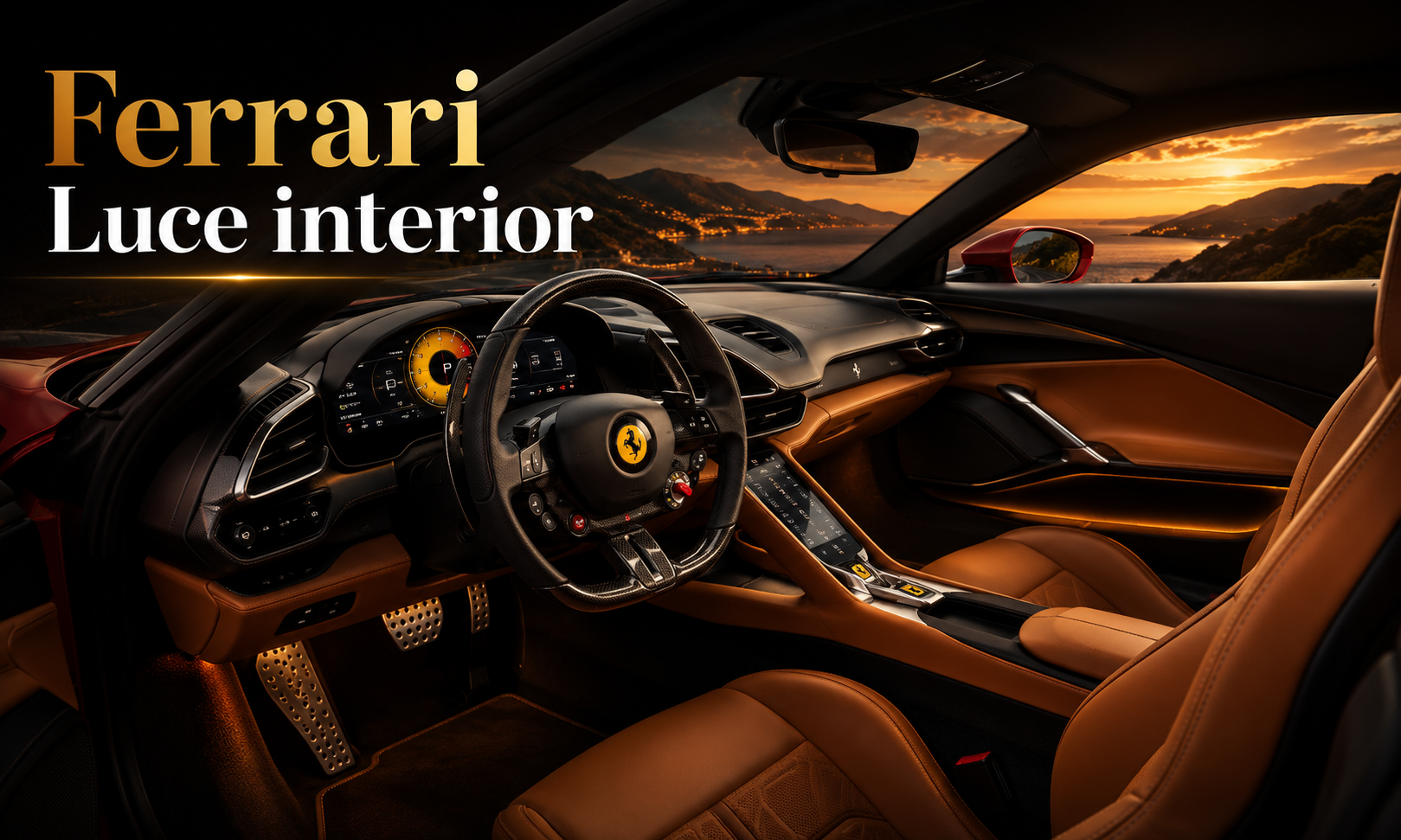
Ferrari could have filled its first electric vehicle with oversized touchscreens and software-driven controls. Instead, the Luce cabin takes a more deliberate route. It combines modest digital displays with machined switches, rotary controls, glass surfaces, and driver-focused hardware that is intended to feel special before the car even moves.
The Ferrari Luce interior is important because it is not merely a new dashboard inside an electric Ferrari. It introduces the brand’s first five-seat cabin, a more open floor plan, a rear passenger interface, center-opening doors, and a control philosophy that favors tactile interaction over touchscreen dependence. For buyers, the real question is whether this unconventional layout still feels like a Ferrari while becoming significantly more practical.
| KEY TAKEAWAYS
· The Luce is Ferrari’s first production model with seating for five. · Its cabin blends OLED displays with physical switches, dials, paddles, and toggles. · The center touchscreen can pivot toward the driver or front passenger. · Rear passengers receive their own screen and physical controls at the back of the center console. · The steering wheel replaces frustrating touchpads with real switchgear and dedicated driving controls. · The interior is more spacious and usable than a traditional Ferrari, but its unusual design will not appeal to every buyer. |
Ferrari Luce Interior at a Glance
| Interior feature | What Ferrari has shown | Why it matters |
| Seating | Five-seat layout with a three-person rear bench | Makes the Luce Ferrari’s most family-oriented cabin |
| Displays | OLED driver display, pivoting center screen, rear passenger screen | Keeps digital functions visible without covering the dashboard in glass |
| Controls | Physical buttons, toggles, rotary dials, and steering-wheel paddles | Improves tactile feedback and reduces menu dependence |
| Steering wheel | Manettino, e-Manettino, real switches, regen and torque paddles | Keeps performance controls close to the driver |
| Access | Four doors with rear-hinged rear doors | Creates a wide opening for rear passengers |
| Cargo | Ferrari’s largest rear trunk to date | Adds real grand-touring and family usefulness |
| Design influence | Ferrari Styling Centre with LoveFrom | Blends Italian performance cues with product-design minimalism |
A Ferrari Cabin That Rejects Screen Overload
The most surprising part of the cabin is restraint. Ferrari’s official Luce presentation frames the car as a completely new electric architecture, yet the interior does not imitate the wide-screen dashboards used by many premium EVs. Instead, the displays are integrated into individual objects and surrounded by physical controls.
This approach gives the dashboard a product-like character. Each switch, dial, vent, and screen appears designed as a separate tactile object, but the overall cabin remains visually clean. It feels closer to a collection of high-end instruments than a single digital panel stretched from door to door.
That restraint should also help with usability. Common actions can be performed through hardware rather than hidden software menus. Drivers who dislike touching a screen to change basic settings may find the Luce more intuitive than many modern luxury EVs.
The OLED Instrument Cluster Mixes Digital Data With Analog Form
The driver display uses OLED technology, but Ferrari presents the information through three metal-ringed circular forms. The center dial shows speed and battery charge. The left dial communicates available power and regenerative braking, replacing the traditional tachometer. The right dial can be configured for other vehicle information.
This is a smart visual bridge between combustion-era Ferrari instrumentation and an electric powertrain. The graphics can change, but the driver still sees familiar circular references instead of an anonymous rectangular screen. The display also moves with the steering column, helping preserve the viewing angle when the wheel is adjusted.
A Pivoting Center Screen Shares Control With the Passenger
The central touchscreen is intentionally smaller than the tablet-style displays found in many EVs. It combines digital functions with physical switches and can rotate toward either front occupant. This creates a more cooperative cabin because the passenger can handle navigation, media, or comfort settings without reaching awkwardly across the console.
The pivoting design also lets the driver angle the screen for better visibility when traveling alone. Unlike a fixed passenger display, the same hardware serves two roles. That reduces visual clutter while adding flexibility.
Physical Controls Restore a Sense of Occasion
Ferrari has moved away from the touch-sensitive steering-wheel pads criticized in some recent models. The Luce uses real switches that can be located by feel. The steering wheel includes the traditional Manettino for chassis and driving settings, plus an e-Manettino dedicated to the electric powertrain.
Two large paddles sit behind the steering wheel, but they do not shift gears because the Luce has no conventional transmission. The left paddle adjusts regenerative braking through five levels. The right paddle changes available torque in five stages. Ferrari designed this system to give the driver something active to do when approaching, entering, and leaving a corner.
The cabin also includes a ceiling-mounted handle for launch control. Pulling an overhead control is less convenient than pressing a console button, but convenience is not the point. The theatrical motion turns a performance setting into an event, much like opening a guarded switch in an aircraft cockpit.
| Control | Function | User-experience benefit |
| Manettino dial | Selects driving and chassis modes | Familiar Ferrari control that can be used by feel |
| e-Manettino dial | Changes electric powertrain behavior | Separates EV settings from chassis modes |
| Left paddle | Adjusts regenerative braking in five steps | Lets the driver increase deceleration before a corner |
| Right paddle | Adjusts available torque in five steps | Adds driver involvement during acceleration |
| Overhead handle | Activates launch control | Creates a memorable sense of occasion |
| Physical switches | Operate frequently used functions | Reduces dependence on touchscreen menus |
Five Seats Change What a Ferrari Interior Can Do
The Luce is Ferrari’s first five-seater. Previous four-door Ferraris, such as the Purosangue, have used four individual seats. The Luce adds a three-person rear bench, which makes the car more flexible for families, airport transfers, and short trips with an extra passenger.
An electric platform helps make this possible. Without a central transmission tunnel and rear transaxle intruding into the passenger compartment, Ferrari can create a flatter floor and use the cabin width more effectively. The result is a roomier environment than the exterior proportions might suggest.
Rear-Hinged Doors Improve Access
The rear doors are hinged at the back, creating center-opening access when the front and rear doors are open together. This layout provides a broad opening and makes the rear seat easier to reach. It may be particularly useful when helping a child into the cabin or loading bulky items onto the rear bench.
The design does raise practical questions that road tests will need to answer. Center-opening doors can be convenient in open spaces but less helpful in tight parking areas if front and rear occupants must coordinate their movements. Final impressions will depend on door opening angles, pillar placement, and whether either door can be operated independently in every situation.
Rear Passengers Get Their Own Interface
A second screen is mounted at the back of the center console for rear passengers. It mirrors the front unit’s combination of a digital display and physical toggle switches. This gives rear occupants control without forcing them to rely entirely on a phone or ask the driver to change settings.
The feature supports the Luce’s grand-touring mission. Ferrari is not treating the rear bench as an emergency space. It is giving the second row its own dedicated interaction point, suggesting that the car is intended to carry adults regularly rather than occasionally.
Materials: Glass, Aluminum, Leather, and Deliberate Contrast
The Luce cabin combines polished and matte metal, strengthened glass, leather, and precisely machined components. The materials are presented honestly rather than disguised. Glass looks like glass, metal feels like metal, and switches are designed to create distinct movements and sounds.
This matters in a vehicle expected to cost well above conventional luxury EVs. Expensive materials alone do not create luxury. The way a control moves, the resistance of a dial, the sound of a toggle, and the temperature of a metal surface all contribute to perceived quality. The Luce appears designed around those small interactions.
The front seats use slim structures that help preserve rear legroom while maintaining a sculptural appearance. Final comfort will depend on cushioning, driving position, seat adjustment range, and support during long trips. Those factors cannot be judged fully from photographs.
The Key Fob Becomes Part of the Start-Up Ritual
Ferrari places a docking point for the key in the center console. Inserting the Ferrari-badged key activates the vehicle, turning a normally invisible electronic process into a physical ritual. The idea fits the broader interior philosophy: electric technology is present, but the driver still interacts with objects that have weight, movement, and purpose.
Interior Practicality: More Than a Styling Exercise
The Luce is designed to be the most usable Ferrari cabin yet. It has four doors, five seats, a large rear opening, and what Ferrari describes as the biggest trunk in its road-car history. Those features move it beyond the narrow definition of a weekend supercar.
The Car and Driver interior photo gallery shows the three-person rear seat, the pivoting front display, the rear control screen, the overhead launch handle, and the unusually large cargo area. The photos support the idea that Ferrari has prioritized real passenger and luggage space, not only dramatic design.
| Practicality area | Luce approach | What still needs real-world testing |
| Rear seating | Three-person bench with dedicated controls | Adult comfort in the center position and long-trip support |
| Door access | Rear-hinged doors and wide center opening | Ease of use in narrow parking spaces |
| Cargo space | Largest trunk yet offered by Ferrari | Exact US volume and shape with luggage |
| Driver ergonomics | Physical controls and adjustable screens | Learning curve and reach while driving |
| Visibility | Forward cabin position and expansive glass | Rear visibility and blind-spot performance |
| Seat comfort | Slim sculptural seats | Cushioning and support over several hours |
How the Luce Cabin Differs From Other Ferrari Interiors
Recent Ferrari interiors have increasingly relied on digital surfaces, steering-wheel touch controls, and separated cockpit zones. The Luce moves in another direction. It is visually simpler, more open, and more interested in physical feedback. It also reduces the sense that the passenger is isolated from the driver.
Compared with the Purosangue, the Luce adds a fifth seat and a flatter floor. Compared with two-seat and 2+2 Ferrari models, it offers far easier rear access and much greater cargo utility. The tradeoff is that the cabin may feel less traditionally sporty to buyers who expect a tightly wrapped cockpit and a prominent center spine.
| Interior priority | Ferrari Luce | Traditional Ferrari approach |
| Passenger capacity | Five seats | Usually two, 2+2, or four individual seats |
| Cabin division | Open layout with no large center tunnel | More separated driver and passenger zones |
| Digital strategy | Small integrated OLED displays | Larger or more dominant digital surfaces in recent models |
| Control strategy | Physical switches, toggles, and dials | Greater use of touch-sensitive controls in some models |
| Rear access | Four doors with rear-hinged rear doors | Two doors or conventional rear doors |
| Cargo mission | Grand-touring and family flexibility | Performance first, limited luggage space on many models |
What Works Best About the Ferrari Luce Interior
- Physical controls should be easier to operate without looking away from the road.
- The three-dial digital cluster preserves a recognizable Ferrari-style focal point.
- The pivoting screen gives the driver and passenger equal access without adding another display.
- Five seats and a large trunk make the cabin genuinely useful for longer trips.
- Rear passengers receive dedicated controls rather than being treated as occasional occupants.
- The material palette and start-up ritual create a sense of occasion that many minimalist EVs lack.
Potential Drawbacks and Open Questions
- The retro-futuristic design may feel unusual to buyers who prefer traditional Ferrari cabins.
- Slim seats can look elegant but may not provide the best long-distance comfort for every body type.
- Center-opening doors may require more coordination in tight parking spaces.
- The five-seat claim does not guarantee that three adults will be comfortable across the rear bench.
- Unique glass and metal interior components could be expensive to repair or replace.
- Final software responsiveness, glare control, storage usability, and climate-control ergonomics need road testing.
Who Is the Ferrari Luce Interior Designed For?
The Luce is aimed at buyers who want Ferrari performance but need more everyday flexibility than a conventional supercar provides. Its cabin suits an owner who values design objects, tactile controls, passenger space, and quiet long-distance travel as much as lap-time credibility.
It may also appeal to technology and design collectors who see the collaboration with LoveFrom as part of the vehicle’s identity. Buyers who want a traditional V-12 soundtrack, a low two-seat cockpit, or an interior dominated by classic Ferrari cues may find the Luce less emotionally familiar.
Frequently Asked Questions
How many seats does the Ferrari Luce have?
The production Luce has five seats, including a three-person rear bench. It is the first five-seat production Ferrari.
Does the Ferrari Luce interior have a large touchscreen?
No. The central display is relatively modest and can pivot toward the driver or passenger. Ferrari combines it with physical switches rather than relying only on touch controls.
What do the steering-wheel paddles do?
The left paddle changes regenerative braking through five levels. The right paddle changes available torque through five levels, adding driver interaction to the electric powertrain.
Does the rear seat have its own controls?
Yes. Rear occupants receive a screen and physical toggle controls mounted at the back of the center console.
Is the Ferrari Luce practical for families?
It is more family-friendly than any previous Ferrari because it has four doors, five seats, a flatter cabin floor, and a large trunk. Real-world child-seat access and center-seat comfort still need testing.
When will the Ferrari Luce reach the United States?
Ferrari plans a US arrival in 2027. Exact dealer timing and final US specifications may vary.
How much will the Ferrari Luce cost?
US pricing has not been formally announced. Current industry estimates place it around the mid-$600,000 range before options, taxes, and fees.
Final Verdict
The Ferrari Luce cabin is one of the most significant interiors the company has created because it redefines both the electric-car interface and Ferrari practicality. It avoids the common EV formula of replacing nearly every control with a screen. Instead, it uses physical interaction, carefully shaped materials, compact displays, and performance-specific hardware to keep the driver involved.
Its success will depend on execution. Photographs show a distinctive, intelligent, and surprisingly useful interior, but seat comfort, software quality, door operation, visibility, and everyday ergonomics will determine whether the design remains impressive after the novelty fades. On first inspection, the Luce offers a convincing answer to a difficult question: how can an electric five-seat Ferrari feel futuristic without losing the theater that makes the brand special?
Related Reading
For a broader look at the model’s powertrain, performance, battery, and US arrival, read our Ferrari Luce EV overview.
For projected MSRP, options, and ownership-cost context, see our Ferrari Luce price and release guide.