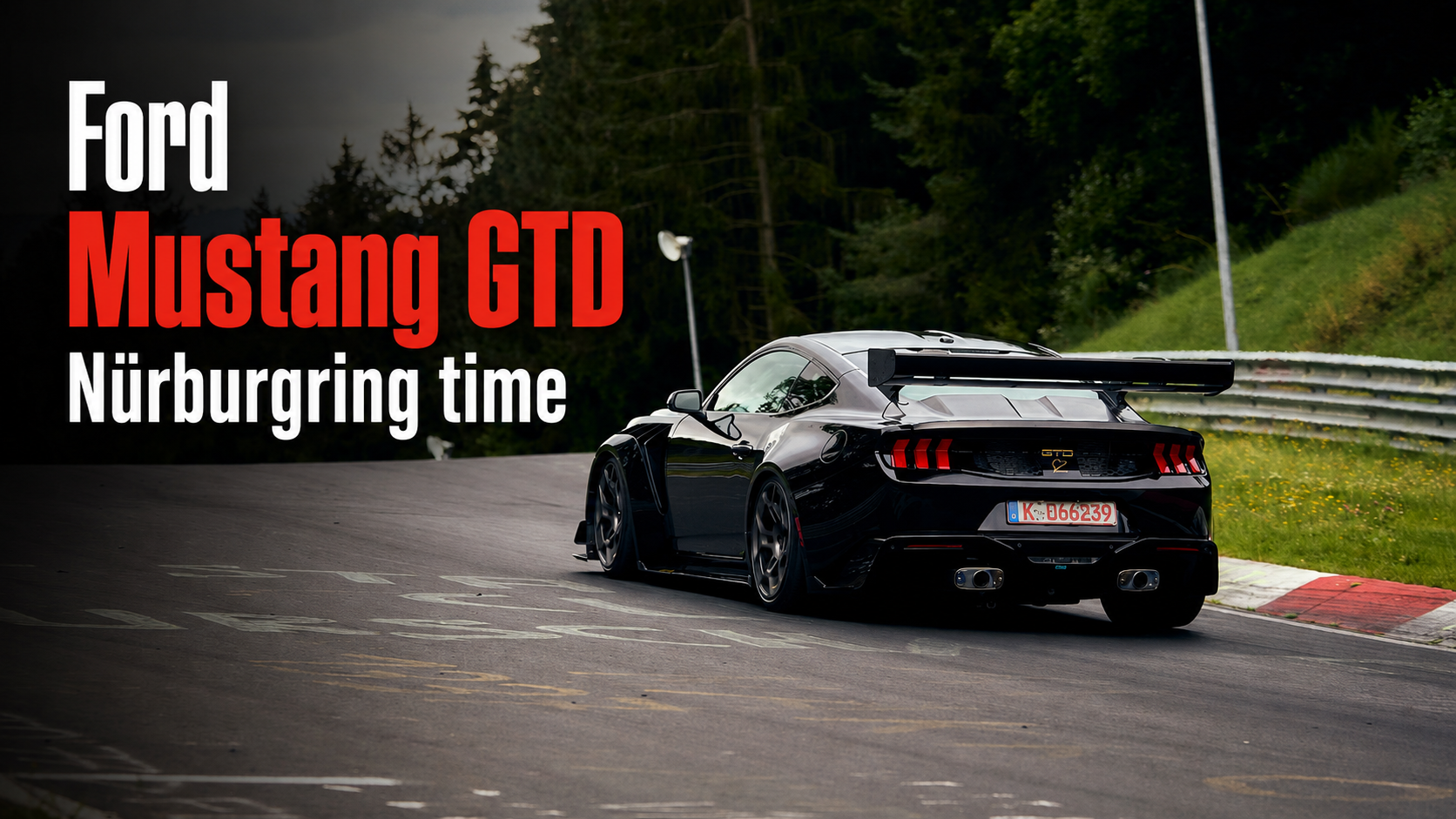
| FASTEST GTD LAP 6:40.835 |
VERSION GTD Competition |
OFFICIAL CATEGORY Pre-Production / Prototype |
Mustang GTD Lap Time at a Glance
| Fastest published GTD lap | 6:40.835 | |
| Vehicle | Ford Mustang GTD Competition | |
| Driver | Dirk Müller | |
| Course | Nürburgring Nordschleife, 20.832 km / 12.94 miles | |
| Timing format | Full lap with a flying start | |
| Public announcement | April 17, 2026 | |
| Official category | Pre-Production / Prototype | |
| Position at announcement | Sixth-fastest time in that category | |
| Standard GTD production benchmark | 6:52.072 | |
| Original sub-seven-minute GTD lap | 6:57.685 | |
| Original GTD output | 815 hp and 664 lb-ft | |
| Competition output | Targeted beyond 815 hp; final rating not announced | |
| U.S. availability | Future limited, serialized, street-legal special edition | |
| Overall Nürburgring record | No | |
| THE 30-SECOND ANSWER: The headline number is 6:40.835, but that result belongs to the GTD Competition and sits in the Nürburgring pre-production/prototype class. The regular GTD production sports-car benchmark is 6:52.072. A precise article should state both numbers and identify the category attached to each. | ||
The current Ford Mustang GTD Nürburgring time is 6 minutes 40.835 seconds, set by the GTD Competition with Ford Racing and Multimatic factory driver Dirk Müller. That is the fastest GTD lap published so far, and it cut more than 11 seconds from the regular car’s 2025 production-class benchmark.
That simple answer needs context. Ford has now publicized three major GTD laps, and the newest car was not classified in the same category as the earlier customer-specification machine. Treating all three numbers as interchangeable can make a technically correct headline misleading.
Why Three Mustang GTD Times Are Circulating
The GTD program did not stop after its first sub-seven-minute result. Ford returned with a refined production car, then developed a more extreme Competition version. Each step produced a faster lap, but the official category changed for the newest attempt.
| GTD run | Lap time | Official category | Driver | Gain vs. prior | Why it matters |
| 2024 GTD milestone | 6:57.685 | Production sports car | Dirk Müller | Baseline | First car from an American brand below seven minutes |
| 2025 updated GTD | 6:52.072 | Production sports car | Dirk Müller | 5.613 sec faster | Regular GTD production benchmark |
| 2026 GTD Competition | 6:40.835 | Pre-Production / Prototype | Dirk Müller | 11.237 sec faster | Current fastest GTD lap |
The 6:57.685 lap was the breakthrough. It put a Mustang below seven minutes and established a production sports-car baseline for an American brand. Ford immediately made clear that it intended to return rather than treat the first result as the end of the project.
The 6:52.072 lap came from the updated road-going GTD that entered production. Ford described the gain as the result of customer-focused improvements and track-proven refinements. At the time of the announcement, the car ranked fourth in the production sports-car class.
The 6:40.835 lap is a separate level of achievement. It belongs to the GTD Competition, a future limited special edition with more power, additional aerodynamic work, new tires, and reduced weight. The Nürburgring lists that attempt in its pre-production/prototype category, not the same production class used for the 6:52.072 run.
Which Number Should You Quote?
For a current news article or general search answer, the Ford Mustang GTD Nürburgring time should be written as 6:40.835 for the GTD Competition, followed immediately by the 6:52.072 production-class figure for the standard GTD. This wording gives readers the latest number without hiding the classification difference.
| Reader intent | Correct number | Best editorial wording |
| Latest and fastest GTD result | 6:40.835 | State that it was the GTD Competition in the pre-production/prototype class. |
| Regular production-class GTD result | 6:52.072 | Use this when discussing the customer-specification GTD or same-class production comparisons. |
| Original American-brand milestone | 6:57.685 | Use this for the first sub-seven-minute achievement in 2024. |
| Direct GT3 RS production comparison | 6:52.072 vs. 6:49.328 | The Porsche was 2.744 seconds quicker in the comparable production-car context. |
How an Official Nordschleife Lap Is Measured
Official record attempts use the complete 20.832-kilometer Nordschleife, which is approximately 12.94 miles. The start and finish point is defined at the T13 section, and the car completes a full lap with a flying start rather than beginning from rest.
The Nürburgring’s official record-drive rules explain the full 20.832-kilometer layout, the flying-start procedure, independent supervision, vehicle inspection, and category system used for published attempts.
Calibrated timing equipment and notarial supervision help make the result verifiable. A neutral testing organization also documents the vehicle condition when production conformity is relevant. Cars are then listed in categories defined by German vehicle classifications or in special groups for prototypes and other unusual machines.
This is why the word official does not automatically mean overall record. It means the attempt followed the track’s measurement and supervision process. The GTD Competition was sixth-fastest in the pre-production/prototype class when Ford announced the result. The standard GTD remained a production sports-car entry.
What Changed for the GTD Competition
Ford identified four development areas behind the 11.237-second jump from the 2025 production benchmark. The changes were not a single software adjustment. They touched the engine, aerodynamic balance, mechanical grip, and mass.
| Development area | Competition change | Likely lap-time benefit |
| Power | Hardware updates and more aggressive tuning target output beyond 815 hp. | Stronger acceleration and higher speed between braking zones |
| Aerodynamics | Revised rear wing, secondary front dive planes, rear carbon-fiber aero discs, and the existing drag-reduction system | More downforce without abandoning straight-line efficiency |
| Tires | New high-performance tires | More grip under braking, cornering, and acceleration |
| Weight | Magnesium wheels, carbon bucket seats, a lighter damper system, and additional reductions | Lower inertia and less work for the tires and brakes |
Ford has not published a final horsepower rating, certified curb weight, tire specification, price, or complete production count for the Competition model. Any article that assigns exact figures to those items is moving beyond the confirmed information.
The project also produced a useful second data point. Ford Racing engineer Steve Thompson recorded a 6:49.337 lap in the GTD Competition, faster than the regular GTD benchmark. Ford said Thompson had accumulated fewer than 40 laps at the circuit, which suggests the car’s performance was not limited to a single perfect run by one professional driver.
The Lap-Time Math
The clock shows how aggressively the program progressed. Ford removed 5.613 seconds between the first and second production-class runs, then removed another 11.237 seconds with the Competition version. The total improvement from the original result is 16.850 seconds.
| Version | Lap time | Total seconds | Approx. lap average | Change |
| 2024 GTD | 6:57.685 | 417.685 sec | 111.6 mph | Baseline |
| 2025 GTD | 6:52.072 | 412.072 sec | 113.1 mph | 5.613 sec faster |
| 2026 GTD Competition | 6:40.835 | 400.835 sec | 116.3 mph | 11.237 sec faster than 2025 |
Average speeds are calculated from the official 20.832-kilometer lap length and rounded to one decimal place. They are useful for scale, but they are not official telemetry and do not show the large speed changes between the Nordschleife’s fast sections, compressions, crests, and low-speed corners.
An 11-second gain on a track this long is not a minor weather fluctuation in ordinary editorial terms. It points to a materially different performance package. At the same time, conditions, driver confidence, tire preparation, and traffic-free access can still affect the final stopwatch result, so the hardware alone cannot be assigned every fraction of the improvement.
Did It Beat the Porsche 911 GT3 RS?
The answer depends on which GTD is being discussed. Porsche recorded 6:49.328 with the 992-generation 911 GT3 RS on the 20.8-kilometer Nordschleife. The regular GTD’s 6:52.072 production-class lap is 2.744 seconds slower. The GTD Competition’s 6:40.835 lap is 8.493 seconds faster by the stopwatch, but it was placed in a different official category.
| Measure | Standard Mustang GTD | Porsche 911 GT3 RS | Reading |
| Official Nordschleife time | 6:52.072, production class | 6:49.328, production car | Porsche faster by 2.744 sec |
| Competition-version time | 6:40.835, prototype class | Not applicable | Ford faster on time, but not same category |
| Power | 815 hp | 518 hp | Ford adds 297 hp |
| Curb weight in road test | 4,404 lb | 3,216 lb | Porsche is 1,188 lb lighter |
| 0 to 60 mph | 2.8 sec | 2.7 sec | Porsche quicker by 0.1 sec |
| Quarter-mile | 10.6 sec at 133 mph | 10.9 sec at 127 mph | Ford pulls ahead at higher speed |
| 300-ft skidpad | 1.17 g | 1.16 g | Near tie |
| 70 to 0 mph braking | 132 ft | 133 ft | Near tie |
For road behavior beyond the stopwatch, Car and Driver’s GTD versus 911 GT3 RS comparison found the Ford devastatingly quick and unusually comfortable for its capability, while the Porsche delivered clearer steering and a more intense driver connection.
The numbers explain the contrasting methods. The Mustang uses almost 300 more horsepower and enormous tire width to overcome a substantial weight disadvantage. The Porsche relies on far less mass, a high-revving naturally aspirated engine, and years of development around the rear-engine 911 layout. Both can reach similar braking and lateral-grip figures through very different engineering routes.
For comparison articles, the fairest conclusion is not that one model has permanently defeated the other. The standard production figures favor the GT3 RS by a small margin at the Nordschleife, while the newer GTD Competition is quicker but belongs to another class and contains hardware beyond the original 815-hp car.
How a 4,400-Pound Mustang Can Run This Fast
Weight is the GTD’s most obvious disadvantage, yet Ford reorganized the car around track performance rather than simply adding power to a normal Mustang. The eight-speed dual-clutch transmission sits at the rear as a transaxle, helping the car approach a 50/50 weight balance instead of carrying most of its mass over the front axle.
The 5.2-liter supercharged V8 produces 815 hp and 664 lb-ft in the regular GTD. A carbon-fiber driveshaft sends that output to the rear transaxle, and a dry-sump oil system protects lubrication under sustained cornering loads. Ford lists a 202-mph top speed for the standard car.
The chassis uses a specialized front suspension and a pushrod-actuated rear layout with adaptive spool-valve dampers. Track mode lowers the car by about 40 mm, reducing ride height and changing the suspension’s operating range. Carbon-ceramic brakes and Michelin Pilot Sport Cup 2 R tires measuring 325 mm at the front and 345 mm at the rear create the contact and stopping capacity needed to manage the mass.
Aerodynamics complete the package. Carbon-fiber body panels reduce weight where possible, while the available active rear wing and front aero devices alter the balance between downforce and drag. The Competition model intensifies that strategy instead of attempting to solve every problem with engine output alone.
What the 6:40.835 Time Does and Does Not Prove
| Claim | Verdict | Reason |
| It is the fastest published Mustang GTD lap | Supported | The Competition model recorded 6:40.835. |
| A regular GTD customer car will run 6:40.835 | Not supported | The standard production-class benchmark is 6:52.072. |
| It is the overall Nürburgring record | False | Faster cars exist in other categories. |
| It beat the GT3 RS in an identical official class | Not established | The GTD Competition and standard GT3 RS results use different classifications. |
| The Competition model is intended to be street legal | Supported | Ford describes it as a future street-legal special edition. |
| The final horsepower and price are known | False | Ford has not released either final figure. |
Lap times are valuable because they compress acceleration, braking, grip, aerodynamic stability, cooling, and driver confidence into one demanding result. They are also easy to misuse. A responsible comparison keeps the course length, vehicle specification, tire, category, date, and driver attached to the number.
U.S. Price and Availability Context
The regular GTD already occupies supercar territory. The supplied road test listed a base price of $327,960 and an as-tested price of $367,960 for a car equipped with the $40,000 Performance package. That package included the active rear wing, front aerodynamic hardware, dive planes, reduced sound insulation, and magnesium wheels, although the test car did not have the magnesium wheels because of supply issues.
Ford says the GTD Competition will be offered in the future as a street-legal special edition in strictly limited, serialized quantities. The company has not announced a final MSRP, exact production total, completed power rating, or delivery schedule. Because of that, a price estimate should be labeled clearly as speculation or omitted.
For U.S. readers, the practical distinction is simple. The standard GTD is the known road car with published specifications and a production-class lap. The Competition version is the future halo model responsible for the 6:40.835 figure, and its final customer configuration still requires additional confirmation.
Why the Lap Matters
The achievement matters beyond a single leaderboard position. The first GTD run broke a psychological barrier for an American brand. The second showed that Ford could improve the customer car rather than rely on an early development prototype. The third demonstrated how much performance remained when Ford removed more compromises.
It also changes the identity of the Mustang name. The GTD shares little more than its basic visual theme with an ordinary Mustang. Its carbon bodywork, rear transaxle, competition-derived suspension, active aerodynamics, and supercar price place it in a global engineering contest that includes Porsche, Mercedes-AMG, and other specialist performance programs.
The result does not make every Mustang a supercar, and it does not settle every comparison. It does prove that Ford created a front-engine, rear-drive machine capable of running among some of the quickest road-related vehicles ever officially timed on the Nordschleife.
Frequently Asked Questions
What is the fastest Mustang GTD Nürburgring lap?
The fastest published lap is 6:40.835, recorded by the Mustang GTD Competition with Dirk Müller driving. It is listed in the pre-production/prototype category.
What is the regular Mustang GTD production-car time?
The standard GTD recorded 6:52.072 in the production sports-car class. That is the most relevant figure for same-class discussion of the regular customer car.
What was the first sub-seven-minute GTD lap?
The first official GTD result was 6:57.685 in 2024. It made the Mustang the first car from an American brand to complete an officially certified Nordschleife lap in less than seven minutes.
Who drove the Mustang GTD at the Nürburgring?
Ford Racing and Multimatic factory driver Dirk Müller set all three headline GTD times. Ford Racing engineer Steve Thompson also recorded a 6:49.337 lap in the GTD Competition.
Is the 6:40.835 car a production model?
The Nürburgring classifies that attempt as pre-production/prototype. Ford says the GTD Competition is intended to become a limited, serialized, street-legal special edition, but final customer specifications have not been released.
Is the Mustang GTD faster than the Porsche 911 GT3 RS?
The standard GTD is 2.744 seconds slower than the 911 GT3 RS based on their official 6:52.072 and 6:49.328 laps. The GTD Competition is 8.493 seconds quicker on time, but the two results are not in the same official category.
How long is the timed Nürburgring lap?
Official record drives use the full 20.832-kilometer Nordschleife, equal to approximately 12.94 miles, with a flying start and finish at the defined T13 timing line.
How much horsepower does the GTD Competition make?
Ford says the supercharged 5.2-liter V8 is targeted to produce more than the standard GTD’s 815 hp. A final certified output has not been announced.
What is the Mustang GTD top speed?
Ford lists a 202-mph top speed for the standard 815-hp GTD. The final top speed of the GTD Competition has not been confirmed.
How much will the GTD Competition cost?
Ford has not announced pricing. The regular GTD in the supplied comparison started at $327,960, while the tested car totaled $367,960 with its Performance package.
Final Verdict
The most current headline is 6:40.835, achieved by the Ford Mustang GTD Competition. The most comparable production-class result for the regular GTD is 6:52.072. Both numbers are legitimate, but they answer different questions.
The best reporting identifies the model, driver, course length, and official class before drawing conclusions. With that context in place, the story is even more impressive: Ford improved the GTD program by 16.850 seconds from its first landmark lap and created a limited special edition capable of running deep into modern hypercar territory.